
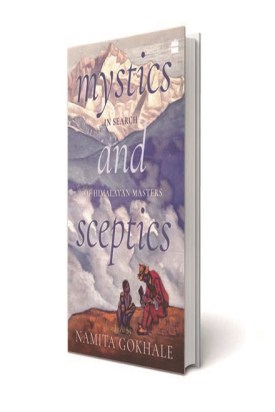
Before you even open Mystics and Sceptics: In Search of Himalayan Masters, edited by Namita Gokhale, you are bound to be struck by the book’s cover. Russian painter Nicholas Roerich, who spent two decades in Kullu, left an enriching body of work with the Himalayas as his muse. His painting Pearl of Searching adorns the book as its cover, setting the tone for what is inside.
And what is inside the book does justice to the cover. Traversing the highs of the mighty Himalayas, the book, an anthology of 25 essays, traverses religions, sects, mysticism and geographies, taking readers through the Shaivite tradition of Kashmir and Sufis and pirs of Pir Panjal to the several babas and sadhus of Uttarakhand and from the tantric Buddhism of Tibet to the Khasi tradition of Meghalaya. The geography is expansive, and so are the themes and scope, done justice to by the group of writers, consisting of acclaimed writers, scholars, journalists, diplomats, and those seeking spirituality.
Each essay penned by a different writer renders a personal touch to each account. Take the case of former diplomat-writer Navtej Sarna’s The Mountain Sojourns of Guru Nanak and Gobind Singh, which exudes reverence towards the founder of the Sikh religion. Similarly, Gokhale’s essay on Neem Karoli Baba, “one of the greatest Himalayan masters”, is an extremely personal one. On the other hand, Makarand Paranjape’s Moving Mountains is a more academic and detailed insight into Swami Vivekananda’s Himalaya sojourns. The interview of the 14th Dalai Lama by writer and his personal student Rajiv Mehrotra is a deep dive into the concept of reincarnation, and in Magic and Mystery, Belgian-French Buddhist-explorer-writer Alexandra David-Néel writes about her travel to Tibet in the early 1900s and her meeting with the 13th Dalai Lama.
There is something about the Himalayas that it has nurtured a vibrant civilisation, its several religions and sects, while blurring the line between worldly and the other-worldly. Swami Vivekananda puts it beautifully: “If these Himalayas are taken away from the history of religious India, there will be very little left behind.”
Like most other spaces, those of religion, spirituality and mysticism are also dominated by men, as evident in the book. “Women who tread the mystic path tend to become invisible, even more so in the high reaches of the Himalaya,” writes Gokhale.
However, the opening essay is on Yeshe Tsogyal, “the Vajra master from India who went to Tibet in the eighth century and built the first Buddhist monastery there,” writes Holly Gayley, professor of Buddhist studies. Tsogyal is “credited with a seminal role in establishing Buddhism in Tibet” and is “pre-eminent among Tibetan women practitioners”.
Another essay, by Ranjit Hoskote, gives an account of Lal Ded, one of Kashmir’s best-known literary and spiritual figures who is equally revered by both Hindus and Muslims. However, the clash of religious identities does not even spare historical figures as Hoskote writes, “It is true that Lal Ded was constructed differently by each community, but she was simultaneously Lallesvari or Lalla Yogini to the Hindus and Lal’arifa to the Muslims; today, unfortunately, these descriptions are increasingly being promoted at the expense of one another”.
Also read: Book review: Nation vs religion
The anthology, although expansive and inclusive, puts a profound focus on Tibet, Buddhism, and Hinduism. “This collection of essays are the joint strands of Indian and Tibetan tantric understanding,” writes Gokhale. However, this deep focus ends up neglecting other religions, sects and geographies to some degree. For example, the pirs and sufis of Pir Panjal find a brief mention only in the last chapter.
Similarly, Tibet and surrounding regions, along with Uttarakhand remain the focus, while places like Bhutan, Nepal, and northeastern states find little mention despite these being intrinsic parts of the Himalayan ecosystem.
Also, not all essays might appeal to one reader and might depend on her interests and religious and spiritual inclination.
However, Mystics and Sceptics: In Search of Himalayan Masters is an important piece of work written by those who have known these mountains personally, and things are not seen from the western lens.
Mystics and Sceptics: In Search of Himalayan Masters
Edited by Namita Gokhale
HarperCollins
Pp 326, Rs 699