



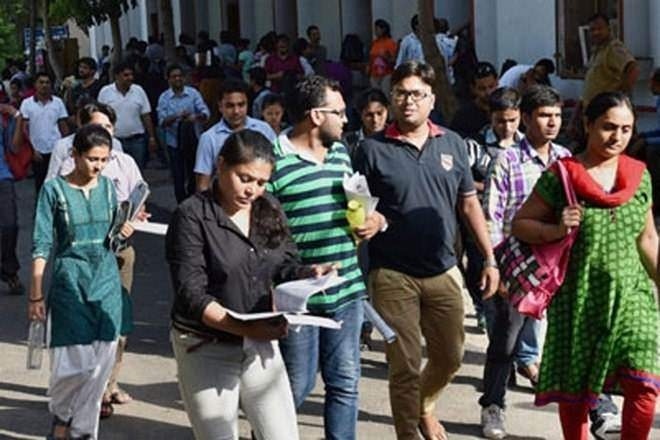
Over 50 per cent of BE/BTech seats are going vacant amid abandoned lecture halls and ghost campuses. According to a 2011 survey by Nasscom, only 17.5 per cent engineering graduates were deemed employable. Former IIT Kanpur director Sanjay Dhande says engineering as a profession has been “devalued”. While other experts say the problem of empty engineering seats comes with larger consequences for the economy, reported the Indian Express. According to IIT-Kanpur chairman and chief of Maruti Suzuki, R C Bhargava, one of the major requirements for Make in India to succeed is that India needs to improve the quality of education basic. The problem – first, the outdated syllabus that is not in sync with the industry, second, undergraduates training on obsolete equipment, reported the Indian Express.
Is it the poor quality of colleges? Or is it graduates with poor skill and employability? Or is this a symptom of the market? Here is what experts have to say:
IIT Kanpur director Sanjay Dhande: “It happened in the case of lawyers, Bachelor’s of Arts and, now, nobody gives an engineering graduate a second look. That’s because there are a lot of jobless engineers ready to do any job even if it is something remotely linked to their education.”
Nuclear scientist and former chairman of IIT Bombay Anil Kakodkar: “Our demographic dividend can be realised only if there is adequate capacity building of people. If that’s not happening, the same dividend can turn into a nightmare.” “If not fixed on time, the engineering crisis will not spare projects such as Make in India, which depend on home-grown talent,” he added.
Former IIM-Bangalore director and currently vice-chancellor of Ahmedabad University, Pankaj Chandra: “Although this crisis may appear to affect only a section of the society, everyone should be worried by it. We are living in a world which is driven by engineering science — from mobile phones to cars. If we don’t have strong engineering programmes in the country, we will lose our competitiveness.”
Director of the Center for the Advanced Study of India and professor of political science at the University of Pennsylvania, Devesh Kapur: “Higher education expands either through high-entry barriers (strict ex-ante regulation at entry), which would result in very gradual expansion but presumably of higher quality; or, alternatively, low-entry barriers, which would result in rapid expansion, but of lower quality. We have chosen the latter option, where… over time, weaker quality institutions fail to meet the market test and demand falls and they close down.”
Former Infosys director T V Mohandas Pai, who is currently Chairman of the Manipal Global Education: “The demand for engineers in the IT sector in India is about 2 to 2.5 lakh, which is the largest in the world. Please remember that this demand cannot be infinite. With automation taking place, the demand for IT engineers will remain stagnant or even come down.”