




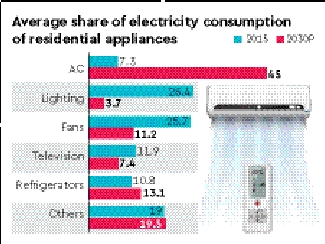
Blame it on rising temperatures, blame it on rising industrialisation, or blame it on both, but air conditioning is going to be the biggest power consumer in the coming years. As per a report by Brookings India, the share of heating, ventilation and air-conditioning, which is currently over 50% of the total commercial demand, would rise to 75% in the segment by 2030. Air conditioners’ share of power usage would grow in residential segments as well. From the contemporary level of 7%, it will comprise 45% of household power demand by 2030.
Electricity consumption by the commercial segment is seen to be growing at the highest speed till 2030, mainly on increasing air conditioning requirements. While industrial consumers would retain the largest chunk for power consumption, the report forecasts a fall in the share of irrigation in overall power usage. ‘New loads’, such as electric cooking and electric vehicles, are seen to be the new avenues of electricity demand.
Aggregate electricity demand could grow from 949 billion units (BU) in 2015 to 2,074-2,785 BU by 2030. The estimates in the study, ‘The future of Indian electricity demand’, have been made considering a range of GDP growth levels between 6.5% and 7.5% and different energy efficiency mechanisms taken up by 2030. The Central Electricity Authority (CEA) estimates electricity demand to grow at 6.6% compound annual growth rate (CAGR) to 1,743 BU by 2027.
With the rising use of electric appliances to cook, it is estimated that kitchen power demand might add 48 to 72 BU of consumption by 2030.
The estimate was arrived at by computing an annual household LPG consumption of 10 cylinders of 15 kg each.
And while much fuss is being made of electric vehicles (EVs), the potential electricity demand from transition to electric vehicles, even with 100% EV sales by 2030, is seen to be less than 100 BU. On the other hand, the government’s plans to increase electrification of rail routes is seen to necessitate requirement of 35-43 BU by 2030. Currently railways consume less than 18 BU annually.
Agricultural power demand is seen to rise at 3.2-4.9% CAGR to 251-358 BU in 2030, comprising 12%-13% of total demand, down from the present share of 21%. This is likely to happen notwithstanding cropping intensity rising by nearly 150% by 2030 and pumpsets getting more powerful, discharging around 700-100 litres per minute (lpm) from the current rate of 300-600 lpm to compensate for depleting water tables.
Demand from the industrial sector, which currently consumes as much as 31% of total electricity, is seen to be in the range of 881- 1,098 BU by 2030 (about 40% of overall demand). Commercial demand is seen to be growing to 247-348 BU (7.6-10.1% CAGR) in the same period, reflecting 28-31% of total power requirement and significantly rising from the current share of 10%.
Per-capita electricity consumption is likely to double or more, but still remain much lower compared to current global average.