



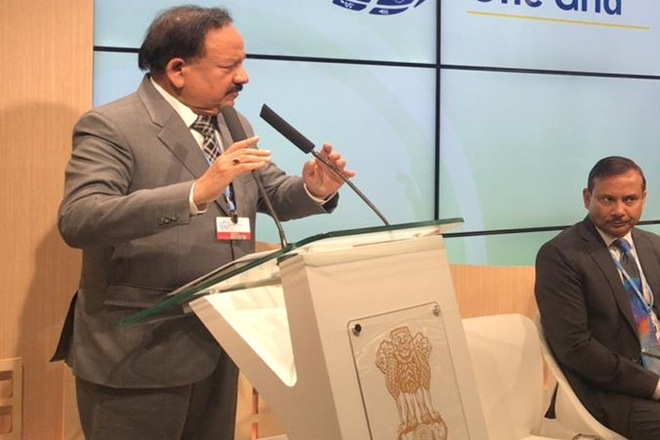
On the first day of United Nations Climate Change Conference in Poland, India told the world that it was well on course to meet its climate targets well ahead of the set deadline and asked the developed countries to fulfil their obligations as well to meet the overall target.
Environment Minister Harsh Vardhan said that New Delhi is doing much more than it was expected to do to fight the climate change menace. “We will achieve all our targets ahead of our schedule. There is no question about that,” he said.
He told the gathering that the Indian government is monitoring the progress at the highest level because climate it is not just a matter of technicalities but a moral issue as well.
India is a signatory to the Paris accord in 2015 where countries agree to limit the global temperature rise under 2 degrees Celsius. As a part of the agreement, India had listed a series of actions it will take to fight climate change.
Reducing emission of intensity by 33 to 35% by 2030 compared to 2005 baseline was among the important ones that New Delhi has promised. India had also said that it will take measures to make sure that 40% of total power generation is the country is done through renewable sources of energy by 2030.
#COP24: “Prime Minister Shri @narendramodi Ji has set an ambitious target that 40 per cent of its installed power capacity will be from non-fossil fuels by 2030.” #ClimateChange @UNEnvironment @PMOIndia pic.twitter.com/CAqbBG4MIU
— Dr. Harsh Vardhan (@drharshvardhan) December 3, 2018
On carbon sink, India had promised to create addition 2.5 to 3 billion tonnes carbon sinks through afforestation. Environment Secretary CK Mishra said that the current progress of carbon sink would suggest that India was lagging behind but several effective initiatives have been taken on the afforestation sector and currently being unveiled.
“So that the pace of progress would almost be doubled in the next few years. On our other two targets, we will obviously reach there quite soon,” Mishra said. “We are quite conscious of our targets. We are doubly conscious that we are in a position to over-achieve them,” he added.
The first day of the conference coincides with a release of a report by US-based Institute of Energy Economic and Financial Analysis (IEEFA) that India was likely to attain the goal to generate 40% of its total electricity through renewable sources by 2020 instead of 2030.
“IEEFA estimates India’s thermal power capacity will be 226GW, or 63 per cent of India’s total of 360GW, by March 2019. By the close of calendar 2019, India’s non-fossil fuel capacity is set to exceed a 40 per cent share for the first time,” IEEFA said in a statement.