



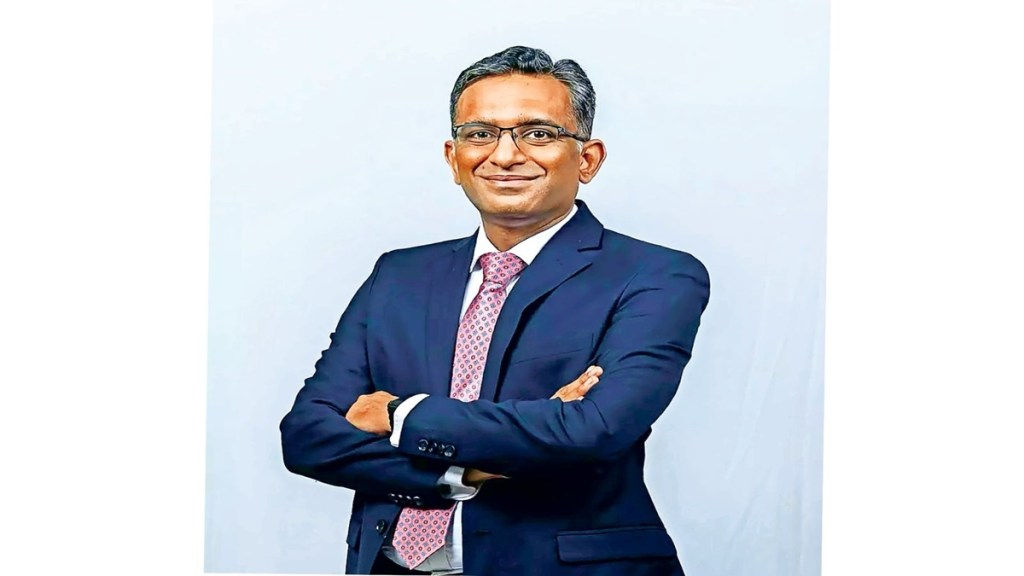
As the domestic IT services firms contend with global uncertainty, TCS remains focused on realigning costs and embracing AI-led transformations. Samir Seksaria, CFO, in an interview with Urvi Malvania & Padmini Dhruvaraj, discusses margin strategies, investment outlook, and how GenAI is reshaping business models. Excerpts:
Q. Do you continue to hold on to your long-term margin aspirations of 26-28%, especially in this macroeconomic climate?
A. Yes, we continue to hold that as a long-term aspiration. The 26-28% range is a goal that takes into account a high single-digit revenue trajectory and the various cost levers we have built over time. That said, we do acknowledge that near-term disruptions can cause temporary dislocations. We are seeing some of that now, but our approach is to continuously realign our cost structure in response. For instance, over the last few years, we have significantly reduced our business analyst (BA) cost, from over 9% of revenues to about 4.5%. That’s a meaningful drop and it has helped us absorb some of the pressure. Similarly, we’ve been optimising our offshore leverage, utilisation, and realisation over the past six quarters. These are still areas with room for further improvement. We are also looking at realisation through a combination of productivity gains, a better product mix, and pricing strategies. While pricing levers are somewhat constrained in the current environment, the other two continue to offer us opportunities.
Q. On the BSNL project, how is TCS approaching the rollout, especially with BSNL looking at 5G services?
A. The BSNL engagement is not one that we view purely from a revenue standpoint. It is more about showcasing our capabilities and contributing to a strategic national objective. We had mentioned in the second quarter of FY25 that the project would be wrapped up between first and second quarter of FY26, and we are on track for that. If the government decides to float tenders for 5G deployment, we would certainly be participating. But again, our focus here is more about building credibility and expertise. Once we have demonstrated what we can do, it opens up potential opportunities not just within BSNL, but also in other parts of the country and even globally. There’s a broader trend where countries are looking to build indigenous networks, partly to reduce dependence on Chinese infrastructure, and that could work in our favour.
Q. What were the major drivers of capital expenditure in FY25, and what should we expect in FY26?
A. Our typical annual capex is about Rs 3,000 crore. In FY25, with land acquisition factored in, the total has gone up to around Rs 5,000 crore. This investment has been spread across physical and technology infrastructure. A significant portion has gone towards expanding delivery capacity. We have added around 40,000 seats across locations such as Bhubaneswar and Indore, as well as in larger metros like Pune and Delhi. Going forward, we expect capex to remain at similar levels and continue to focus on both Tier 2 and major city infrastructure.
Q. Several of your peers are emphasising revenue per employee as a key productivity metric. How does TCS view this?
A. Revenue per FTE (full-time employee) is definitely a metric we track, and in its purest form, it has been trending upward for us both quarter on quarter and year on year. It’s a useful metric but must be read with context. There are variables that can distort the picture. For instance, projects involving third-party costs or those that are less resource-intensive can skew revenue per FTE upwards. Additionally, companies with a strong presence in higher-revenue geographies like the US naturally see a higher revenue per FTE. That doesn’t automatically translate to better margins. From our perspective, while revenue per FTE is useful, profit per FTE might actually be a more insightful and balanced measure of productivity.
Q. You had earlier mentioned delays in client decision-making. Are deal durations also getting impacted?
A. So far, we haven’t seen a meaningful shift in the duration of deals once they are signed. Deal structures and compositions remain largely unchanged. What we did observe, and we highlighted this during our second quarter results, is that decision-making was getting slower. By third quarter, we saw some improvement. In the current climate, it’s natural for clients to take longer due to heightened scrutiny and caution around discretionary spends. But once decisions are made, the execution timeline remains largely consistent.
Q. How do you see Generative AI transforming the traditional IT services model?
A. GenAI is already making a significant impact by boosting productivity. The benefits are being realised and, importantly, they are being shared with clients depending on the engagement model. In an effort-based model, the gains are passed on more directly. If a task can be completed with fewer resources due to GenAI, that’s reflected in what we charge the client. In output- or outcome-based models, the value delivered is shared through the results achieved.