



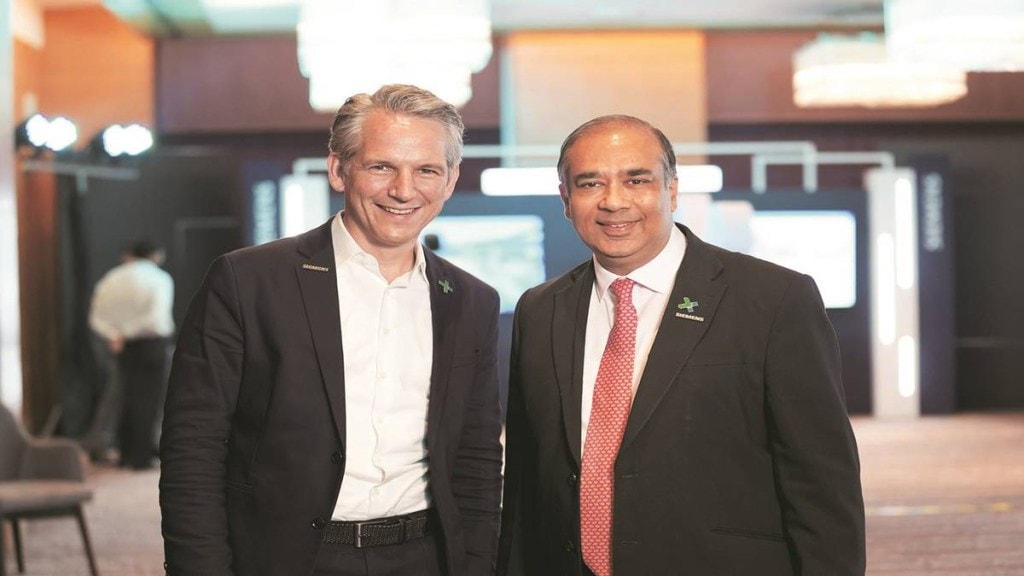
The idea of an industrial metaverse has attracted much interest in recent months. It describes a highly immersive and connected virtual and physical reality enabling never-before-seen levels of connectivity and data analytics. “Indian companies have a unique opportunity to accelerate their digital transformation with Siemens Xcelerator portfolio which includes latest technologies such as industrial AI, industrial edge, digital twin and 5G,” says Peter Koerte, chief technology officer & strategy officer, Siemens AG. On a recent visit, Koerte and Sunil Mathur, MD & CEO, Siemens India, spoke to Sudhir Chowdhary on some of the megatrends and digital use cases on Siemens Xcelerator. Excerpts:
How do you envision the integration of the industrial metaverse with traditional manufacturing processes?
Peter Koerte: The industrial metaverse helps industry become much faster, more flexible, and also more sustainable. We recently built a brand-new factory, but that new factory was first built as a digital twin where we had optimised every machine, every workflow, and every material flow. As a result, our workers already knew how to operate the machines. By the time we started this new factory, it was already 20% more productive. Since we have the digital layout and we can seamlessly combine the real and the digital world, this synergy allows us to achieve 40% increase in flexibility.
How can companies in India gain a competitive advantage by embracing the industrial metaverse?
Sunil Mathur: This is where Siemens Xcelerator, the open, digital business platform, comes into play. You have access to a robust platform featuring an array of products and tailored use cases, designed to address solutions within your respective industry, both globally and in India. It offers an ecosystem of partners to collaborate directly or work alongside Siemens.
There’s a compelling business case for its adoption, especially for SMEs that may not have extensive capital readily available. In most scenarios, there’s a strong business case for taking these steps.
Koerte: Within the Siemens Xcelerator framework, we emphasise the development and delivery of these solutions as a service, specifically, software as a service (SaaS). These services are cloud-based, accessible through subscription models, and often offer free trial periods for testing.
Siemens Xcelerator was launched last year. What is the feedback from customers?
Mathur: The customer response has been very positive, primarily because at the end they want to see the business case. Take, for instance, our involvement with hotels, where they witnessed a return on investment (RoI) within 18 months. Similarly, in the case of cement plants, RoI is realised in just two years. Companies in the pharmaceutical and food and beverage sectors have also begun to experience the tangible benefits of our solutions.
How is AI being applied to optimise industrial processes? What role do you see it playing in manufacturing?
Koerte: The applications of industrial AI are diverse. For example, it plays a crucial role in the operation of gas turbines, where monitoring NOx emissions, CO2 levels, fuel consumption, and temperature is essential. On the shopfloor, one of our recent use cases is bin picking, where AI automatically detects objects and places them from one bin to another or onto the shelf.
Will investments in sustainability and digitalisation work, given that companies also seek RoI and profitability?
Koerte: Indeed, decarbonisation is intrinsically linked to digitalisation. The crucial point is that without prior digitalisation, meaningful decarbonisation cannot be achieved. This stems from the need to establish a baseline for under-standing the amount of CO2 emissions generated throughout the entire value chain. The only reliable method to measure and exchange this information across participants in the supply chain is via digital means, often facilitated by Blockchain.