



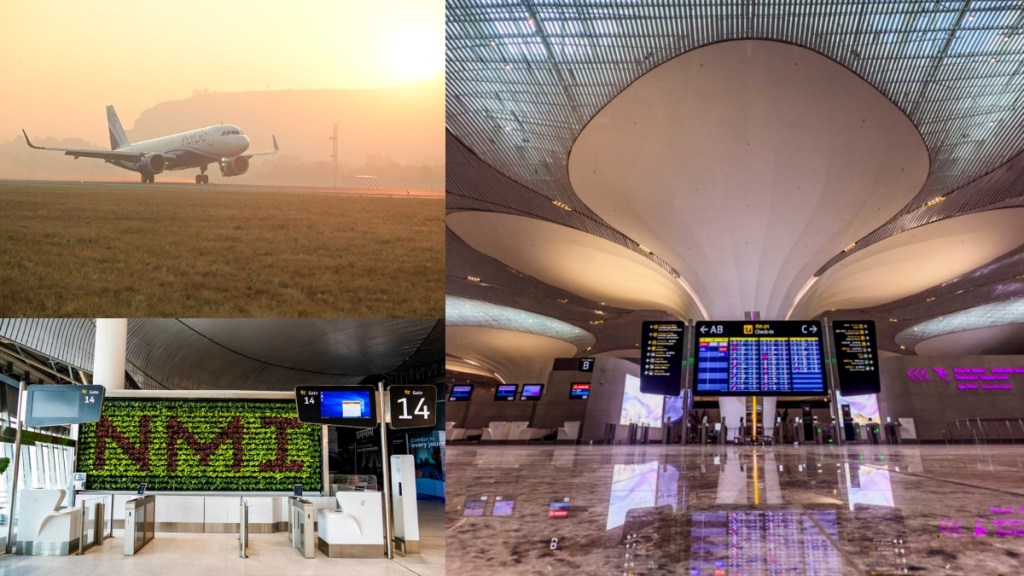
Commercial flight operations commenced on Thursday at the Navi Mumbai International Airport, adding fresh capacity to the Mumbai Metropolitan Region’s constrained aviation network. The first arrival was an early-morning flight from Bengaluru operated by IndiGo, which landed at around 8 am, followed shortly by the airport’s first departure to Hyderabad.
On the opening day, domestic services were operated by IndiGo, Air India Express, Akasa Air and Star Air, linking the new airport to nine cities across the country. The operator said 15 scheduled departures were planned on day one.
Operational Scale-Up
During the initial phase, the airport will function for 12 hours between 8 am and 8 pm. At this stage, it is equipped to handle up to 24 scheduled daily departures to 13 destinations, with the capacity to manage up to 10 aircraft movements an hour, including arrivals and departures. Operations are expected to be scaled up progressively, with plans to move to round-the-clock services from February next year.
Infrastructure and Ownership
The airport was formally inaugurated in October by Prime Minister Narendra Modi. Built at a cost of Rs 19,650 crore, the first phase is part of a larger, five-phase development plan. Once all phases are completed, the airport is designed to handle up to 90 million passengers annually, alongside dedicated cargo facilities and multimodal connectivity.
The project is being developed through a special purpose vehicle, Navi Mumbai International Airport. The SPV is majority-owned by the Adani Group with a 74%, while the remaining 26% is held by City and Industrial Development Corporation.
The start of commercial operations is expected to ease congestion at Mumbai’s existing airport over time, particularly as airlines gradually add capacity and destinations from Navi Mumbai alongside further operational ramp-up in the coming months.