



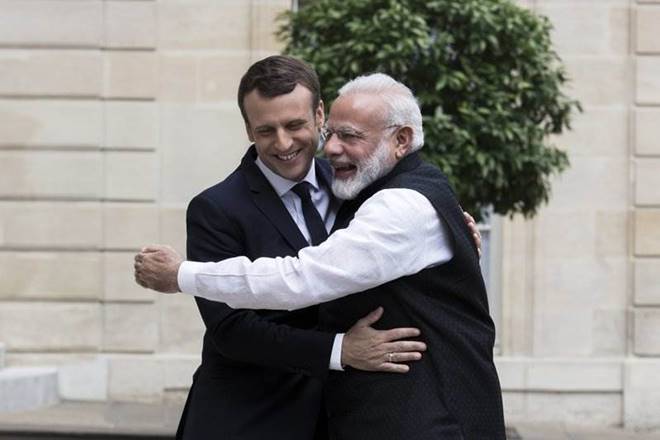
In a major expansion of strategic ties, India and France on Saturday inked 14 pacts in key areas of defence, security, nuclear energy and protection of classified information, besides resolving to deepen cooperation in the Indo-Pacific region and step up joint efforts to contain terrorism. Both countries committed to increase bilateral trade to 15 billion euro by 2022 and “timely relaunching” of negotiations on the India-EU free trade agreement. The agreements were signed after extensive talks between Prime Minister Narendra Modi and French President Emmanuel Macron, including on the changing security dynamics in the Indian Ocean and the Pacific. The visiting leader asserted that the sea lanes cannot be places for hegemonic power play, in a clear reference to China. The pacts included reciprocal logistic support between the armed forces of the two countries and another on protection of classified or protected information, an agreement that comes in the backdrop of the Indian government refusing to divulge details of the multi-billion dollar Indo-French Rafale fighter jet deal. “Our defence cooperation is very strong and we consider France among the most trusted defence partners,” Modi said at a joint media event with Macron. He said the pact on reciprocal logistic support between the armed forces was a “golden step” in defence relations. Modi said both sides have agreed to strengthen cooperation in ensuring freedom of navigation and overflight, as the Indian Ocean will play a key role in ensuring regional peace and stability.
Noting that defence cooperation now has a “new significance”, Macron talked about the Scorpene submarine project for the Indian Navy and the fighter jet deal for the Air Force. Noting that defence cooperation now has a “new significance”, Macron talked about the Scorpene submarine project for the Indian Navy and the fighter jet deal for the Air Force. The deals signed by companies from the two countries include a contract for France’s Safran to supply airline SpiceJet with engines, water system modernisation by Suez in the southern city of Davangere and a contract between industrial gas company Air Liquide and Sterlite. Some €200 million of investments will be made in India, Macron’s office said. “India had made a sovereign decision in this respect (Rafale fighter jet) and we are monitoring the progress in the field. We very much want to continue the programme. It is a long-term contract that is mutually beneficial. I personally consider it as the heart of the strategic partnership,” Macron said. On maritime security, the French President said both the countries will have “unprecedented” level of cooperation to ensure peace and stability in the Indian Ocean and Pacific. He said space agencies of both countries will have joint monitoring mechanism for developments in the maritime sphere, while navies of the two nations will share intelligence and call their respective military bases for any requirement.
In his statement, Modi said the strategic partnership between the two countries may be just 20 years old, but the cultural and spiritual partnership was even older. “The values of liberty, equality and fraternity echo not just in France, but are deeply enshrined in India’s Constitution as well,” the Prime Minister said. Macron also said effectively containing threats of terrorism and radicalisation are going to be key elements in the strategic cooperation between the two countries. He particularly also talked about the threat of Islamist terrorism. “The trust that we share is protecting us as our interests are aligned,” he said, adding, “We want India as our first strategic partner here, and we want to be India’s first strategic partner in Europe, and even in the western world.” The agreement on protection of classified information defines the common security regulations applicable to any exchange of classified and protected information. Another pact provides for a way forward for the implementation of the Jaitapur nuclear power project. The two countries also inked pacts for cooperation in other areas, including railways, environment, solar energy, maritime awareness and checking trafficking of narcotic drugs and psychotropic substances.