



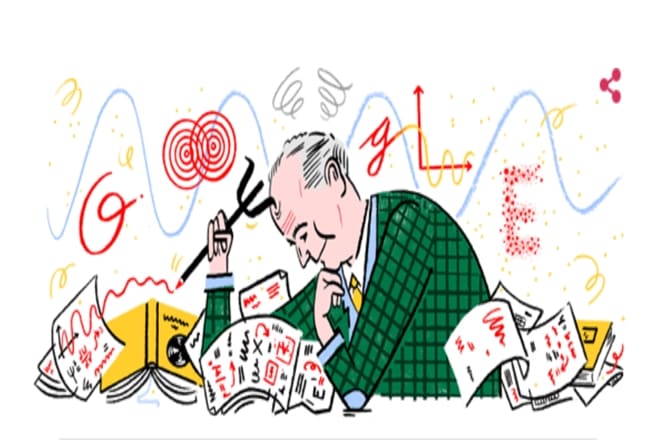
Max Born born on December 11 in 1882 in Breslau then a part of German Empire, now a part of Poland was a German physicist and mathematician. Max who was initially thought to be too frail to be attending school in his early childhood was home tutored and excelled in his studies. Later on, he continued his studies in physics and mathematics in University of Breslau, Heidelberg and went on to earn his PhD from University of Gottingen. Born, after a brief stint at the University of Berlin and the University of Frankfurt returned to University of Gottingen where he accepted the position of professor of theoretical physics turning the institute into one of the most important centres for the study of the atomic and molecular phenomena.
Born worked towards the development of the field of Quantum mechanics, that involves the study of matter at the most granular level. His contribution in the field of quantum physics helped in advancements in the field of medicine, in the invention of personal computers, lasers and medical imaging devices (MRIs). His immense contributions in the field of quantum mechanics were recognised by awarding him the Nobel Prize for Physics in 1954.
Born, however, could not continue his research at Gottingen and had to leave in April 1933 following the rise of Nazism in Germany whereby all the Jews were dismissed from the post of academia and he had to flee to Britain. After accepting a position of lecturer at the University of Cambridge, he was appointed as the Tait Professor of Natural Philosophy at the University of Edinburgh. Born eventually became a British citizen and held the position until his retirement in 1954, same time when he was awarded the Nobel Prize.
Max Born throughout his life worked with eminent scientists and academicians such as Werner Heisenberg, J. Robert Oppenheimer, Max Planck and others. World War I played a crucial role in his academic life as during this time he was drafted into the German Army where he researched on sound ranging and theory of crystals. He also published a book named Dynamics of Crystal Lattices in 1915.
Born received the coveted Nobel Prize for his invention, Born Rule – a quantum theory that helps to determine location of wave particles in a quantum system using mathematical probability.