



Modern wars are no longer fought only with firepower. Control of the electromagnetic spectrum often decides the outcome. The United States carried out a military operation in Venezuela over the weekend, capturing President Nicolás Maduro and his wife and bringing them to the US. The operation was completed within hours and, according to a Wall Street Journal report, involved around 150 US aircraft entering Venezuelan airspace.
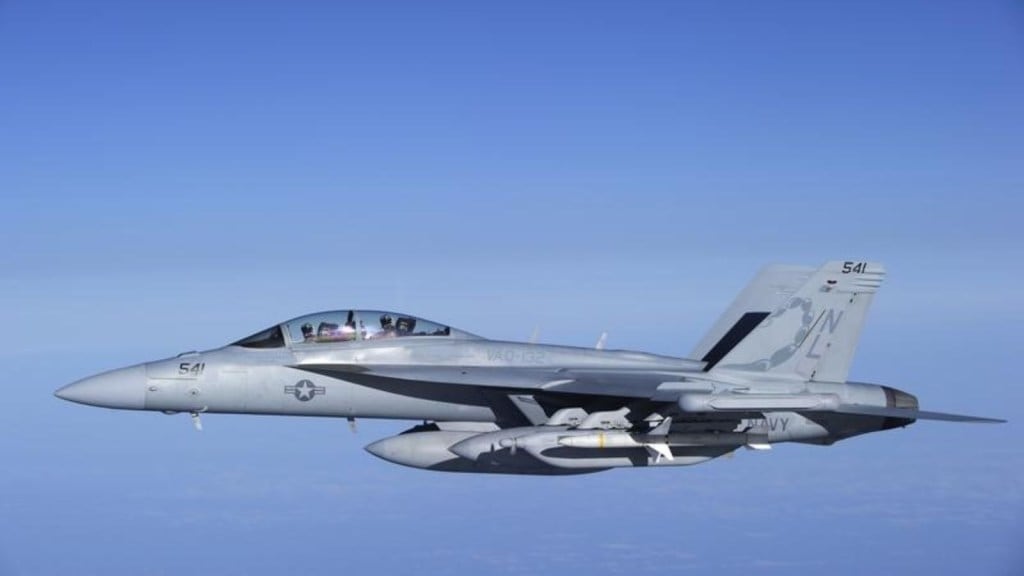
Among those aircraft, one stood out. Its primary role was not to drop bombs or engage in direct combat, but to target something invisible — the electromagnetic spectrum. That aircraft was the EA-18G Growler. Instead of striking people or buildings, the Growler goes after signals, including radar, radio links, and military communications. Its purpose is to blind enemy’s air defences during military operations.
The Growler is built by Boeing and is flown by a US Navy squadron known as the “Zappers.” During the Venezuela operation, it likely played a major role in overwhelming the country’s air defences within hours, according to WSJ’s internal report.
What electronic warfare really means
Electronic warfare is about controlling the airwaves. It involves blocking enemy radar, jamming communications, and protecting your own systems at the same time. The Growler is one of the US military’s most important tools in this area.
It is based on the F/A-18F Super Hornet but modified to carry powerful electronic equipment. “The Growler forms the mainstay of U.S. air power’s EW component,” said Thomas Withington, an expert at the Royal United Services Institute, to the WSJ. He explained that the Growler would have found Venezuelan radar systems, jammed them, and disrupted military communications across the country.
What is the EA-18G Growler?
According to the official US defence website, the EA-18G Growler has been in service since 2009. It replaced the older EA-6B Prowler and is designed to operate from aircraft carriers. It has a wingspan of nearly 45 feet and can fly at speeds of over 1,300 miles per hour. According to Navair, it can climb higher than 50,000 feet and carries a crew of two, one pilot and one specialist. The aircraft weighs more than 16 tons and costs roughly $67 million per unit. Most EA-18G Growler squadrons are stationed at Naval Air Station Whidbey Island in Washington state. Its armament includes AIM-120 air-to-air missiles, AGM-88 HARM missiles designed to destroy enemy radar, and ALQ-99 tactical jamming pods.
According to WSJ, alongside the Growler, the US deployed several other aircraft during the Venezuela mission. These included F-22 and F-35 stealth fighters, F-18 jets, B-1 bombers, and drones. On the other hand, Venezuela relies mostly on older Soviet- and Russian-made air defence systems. The country had around 12 S-300 missile systems, according to WSJ.
The next evolution of the aircraft, known as Growler Block II, is currently under development. This upgrade will introduce the Advanced Cockpit System, along with internal improvements shared with the F/A-18E/F Block III.
Electronic warfare is not new. The British Navy was already jamming and intercepting radio signals more than a century ago. But after the Cold War, and during conflicts in Afghanistan and the Middle East, the US didn’t rely much on these tactics. That changed with the Ukraine war, now seen as the largest electronic warfare conflict in history.