



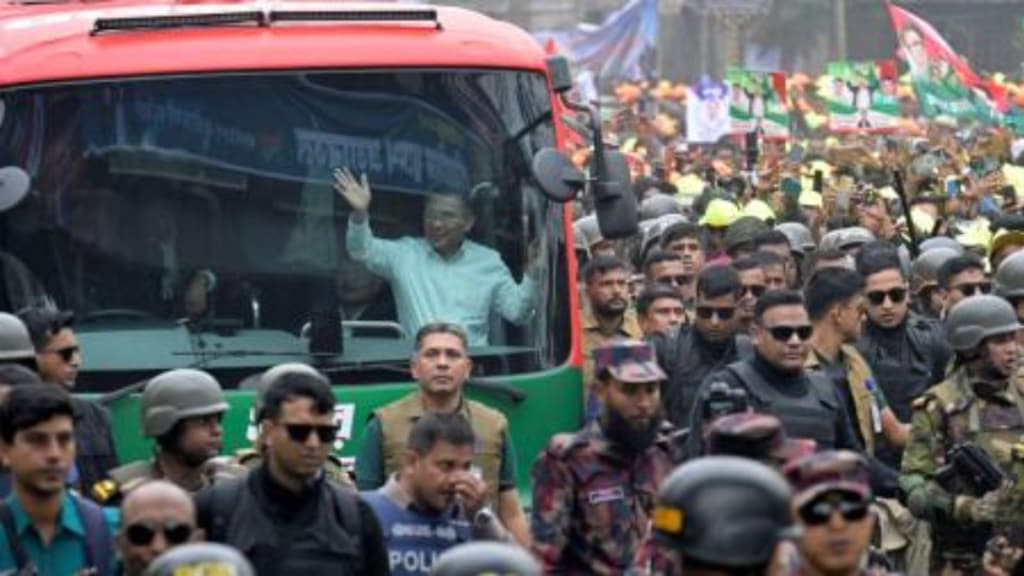
Tarique Rahman, Bangladesh Nationalist Party (BNP) acting chairman, returned to the country after nearly 17 years of self imposed exile. “I have a plan,” the son of former prime minister Khaleda Zia in his first speech on Bangladeshi soil, invoking Martin Luther King Jr’s historic refrain “I have a dream” with his own version.
His homecoming comes just weeks ahead of the February general elections, at a time when Bangladesh is grappling with political instability, violence and shifting regional alignments.
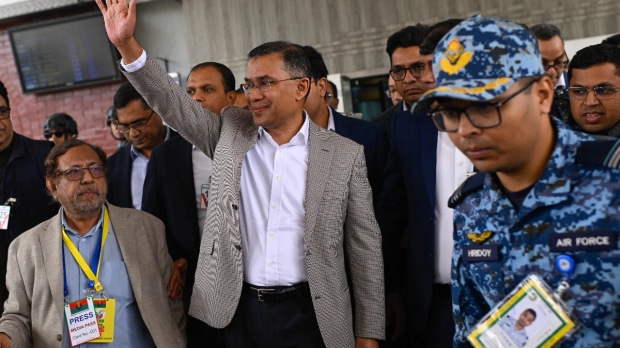
Rahman arrived in the capital accompanied by his wife, Dr Zubaida Rahman, and daughter, barrister Zaima. “In Bangladesh after a long 6,314 days!” Rahman posted upon arrival. His return marks a significant moment for the BNP, which has remained out of power for years, and for a country navigating uncertainty following the fall of the Sheikh Hasina-led government.
“Whatever political party we belong to, whatever religion we believe in, whether we are non-partisan individuals — all must join hands to maintain law and order,” Rahman said in Dhaka, appealing to the people of his troubled nation to work together for bringing peace and stability.
Political stakes rise ahead of February polls
Rahman’s return has injected fresh momentum into the opposition camp and is being closely watched in New Delhi, particularly at a time when pro-India Awami League barred from contesting the upcoming elections and Khaleda Zia remains hospitalised. BNP sees Rahman’s presence as critical to mobilising party workers and consolidating support ahead of a high-stakes vote.
Bangladesh’s political environment has also shifted sharply under interim chief Muhammad Yunus. Radical Islamist groups have gained visibility, raising concerns in New Delhi, particularly over the resurgence of Jamaat-e-Islami, which was banned during the Hasina regime. The party, long accused of maintaining close links with Pakistan’s ISI, has re-entered mainstream politics following Hasina’s ouster.
Recent opinion polls indicate that while the BNP is expected to emerge as the single largest party, Jamaat-e-Islami, once its ally, is making aggressive gains. India’s concerns deepened after the Jamaat’s student wing secured a surprise victory in Dhaka University elections, highlighting its growing influence among youth voters.
India watches closely as foreign policy signals shift
Despite historically strained ties between India and the BNP, New Delhi is increasingly viewing the party as a comparatively liberal alternative amid rising Islamist rhetoric in Bangladesh. Under Hasina, Dhaka maintained strong ties with India, kept Pakistan at arm’s length, and balanced relations with China. That policy shift changed swiftly under Yunus, who has openly pursued closer engagement with Islamabad.
India will hope that the BNP-led government could recalibrate Bangladesh’s foreign policy. There have been recent signs of cautious outreach. On December 1, Prime Minister Narendra Modi publicly expressed concern over Khaleda Zia’s health and offered India’s support. The BNP responded with rare warmth, signalling a possible reset in relations.
Rahman himself has publicly questioned the Yunus administration’s authority to take long-term foreign policy decisions and has distanced the BNP from Jamaat-e-Islami, ruling out an electoral alliance. Earlier this year, he outlined a ‘Bangladesh First’ approach to foreign relations.
“Not Dilli, Not Pindi, Bangladesh before everything,” Rahman had said.
Former Indian Ambassador Vidya Bhushan Soni, however, expressed his deep scepticism about the prospects of genuine democracy returning to Bangladesh under the current political trajectory.
Describing the developments as a “dangerous game”, Bhushan questioned the inclusivity of upcoming elections under the interim administration led by Chief Adviser Muhammad Yunus.
“A dangerous game is going on in Bangladesh politics. It’s okay for them to plan for the election, but the caretaker government hasn’t made any promises about what will come up in the election. All parties should have had the opportunity to participate. But the Awami League has not been allowed to participate. So how can it be a real representative election?” Soni said, according to news agency ANI.
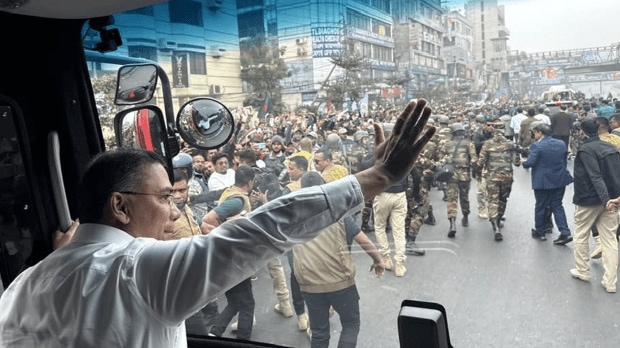
He raised concerns about the reliance on absentee leaders like Tarique Rahman, who has been in exile since 2008.
Tarique Rahman’s arrival in Dhaka was marked by a massive show of strength, with around 50 lakh BNP supporters joining a roadshow from the airport to his residence, according to party claims. The government deployed heavy security, while local media reported that nearly 10 special trains brought more than 3 lakh supporters to the capital.
“This is a defining political moment,” Reuters quoted senior BNP leader Ruhul Kabir Rizvi as saying.
Rahman is expected to contest from the Bogura-6 (Sadar) seat, while Khaleda Zia is set to run again from Bogura-7 (Gabtali-Shajahanpur). However, sources told India Today that radical groups were unhappy with the scale of the roadshow, raising fears of heightened political confrontation in the run-up to polling.
Rahman, who lived in London since 2008, led the BNP from abroad after being convicted in multiple cases during the Hasina era, which the party claimed were politically motivated. He was arrested in 2007, suffered serious health issues in custody, and later secured permission to travel abroad for treatment. He was also sentenced in absentia in the 2004 Dhaka grenade attack case, though courts have acquitted him in all major cases over the past year.
As Rahman steps back onto Bangladesh’s political stage, his challenge will be to unify a party reshaped by years of exile and appeal to a younger electorate in a nation scarred by protests and violence. India, meanwhile, will be watching the developments closely.