



The United States left the world stunned on Friday as it launched missiles towards Venezuela and captured President Nicolas Maduro from his home. It prompted a global outcry with many suggesting the operation violated international laws.
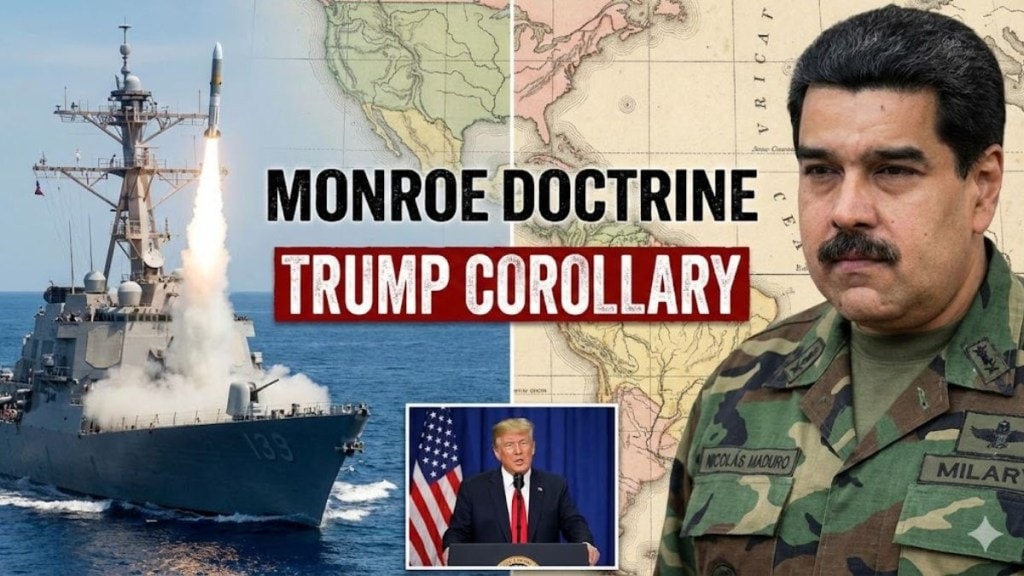
But the White House remains defiant, insisting their actions were a ‘Trump Corollary’ to the historical Monroe Doctrine.
During his press conference on Saturday, the 47th American president, Donald J Trump accused the Venezuelan leader of engaging in anit-US operations with drug cartels and stealing American assets including oil, infrastructure, weapons and talent.
“All of these actions were in gross violation of the core principles of American foreign policy dating back more than two centuries to the Monroe doctrine,” the POTUS reiterated during a press conference on Saturday.
The nearly 200-year-old policy insists that any foreign intervention in American political affairs can be considered a potentially hostile act against the US. Trump’s re-framed ‘Don-roe Doctrine’ goes a step further, justifying its use to “restore American pre-eminence in the Western Hemisphere.”
What is the Monroe Doctrine?
Originally articulated in 1823 by the 5th US President James Monroe, the Monroe Doctrine was formulated by then US President to ward off European powers from interfering in the affairs of countries in the Western Hemisphere, specifically those located in North and South America.
In simple terms, the doctrine proposed a truce between global powers that promised a global situation where European nations would stay out of the Americas and The US would stay out of European conflicts.
At the time, many Latin American countries had just gained independence from European empires. The doctrine was meant to prevent Europe from reclaiming influence while also asserting the United States as the dominant power in the region.
Since its origin the doctrine has been invoked repeatedly by subsequent presidents angling to justify U.S. intervention in the regions across the western hemisphere.
Looking at the history of the Monroe Doctrine
Although initially ignored by Europe, the Monroe Doctrine later became a justification for US intervention. However, since its inception, the Monroe Doctrine has been invoked by several US presidents to ‘safeguard unstable countries in Latin America’ and assert American interests. A brief timeline mapping the evolution of the doctrine has been posted below.
1860s: The US invoked the doctrine to pressure France into withdrawing its forces from Mexico after the states had installed Emperor Maximilian in the region.
1904: In 1904, President Theodore Roosevelt’s argument that the U.S. should be allowed to intervene in unstable Latin American countries became known as the Roosevelt Corollary, a justification invoked in a number of places, including supporting Panama’s secession from Colombia, which helped secure the Panama Canal Zone for the U.S.
Cold War: The Cold War era saw the Monroe Doctrine invoked as a defence against communism, such as the U.S. demand in 1962 that Soviet missiles be withdrawn from Cuba, as well as the Reagan administration’s opposition of the leftist Sandinista government in Nicaragua.
2026: Donald J Trump invokes the Monroe doctrine to partially justify the arrest of Venezuelan leader Nicolas Maduro, stating that the doctrine would now govern many aspects of US foreign policy under his administration going forward.
Over time, the doctrine shifted from blocking European powers to policing the region in line with US strategic and commercial interests, political scientists told Reuters.
What did Trump say?
On Saturday, a doctrine proposed by America’s fifth president was cited by the 47th president while explaining the rationale that governed the capture of a foreign leader, who is now facing criminal charges in the United States. Trump even quipped that the doctrine is now called by many as ‘the Don-roe Doctrine.’
Trump said that Venezuela, under Maduro’s rule, had been “increasingly hosting foreign adversaries in our region and acquiring menacing offensive weapons that could threaten U.S. interests.”
Reiterating how his administration plans to respond to these actions, Trump said that “under our (his) new national security strategy, American dominance in the Western Hemisphere will never be questioned again.”
The national security strategy released by the White House in December portrayed European allies as weak and aimed to reassert America’s dominance in the Western Hemisphere.
Laying out a series of military strikes on alleged drug trafficking boats in the Caribbean Sea and the eastern Pacific Ocean as “a ‘Trump Corollary’ to the Monroe Doctrine, the document said it aimed to combat the flow of narcotics and control migration.
The idea of a “Trump Corollary”
The White House has gone a step further by framing current policy as a “Trump Corollary” to the Monroe Doctrine. According to the administration’s national security strategy, this approach aims to reassert US influence in the Western Hemisphere and battle drug trafficking and counter anti-US powers operating in the region.
When Trump was questioned by a reporter on Saturday about how the U.S. ‘Running’ a country represented his “America First” mentality, Trump defended in a similar fashion as ex-president Monroe by stating that the move was aimed at strengthening America itself.
The Monroe Doctrine began as a warning to Europe. Over two centuries, it has become a flexible tool used by successive US presidents to justify action in Latin America. By invoking it to explain Maduro’s arrest, Trump has placed a modern geopolitical move within a long historical tradition — one that continues to shape how the US disproportionately influences developments in the Western Hemisphere.
(With inputs from Reuters)