



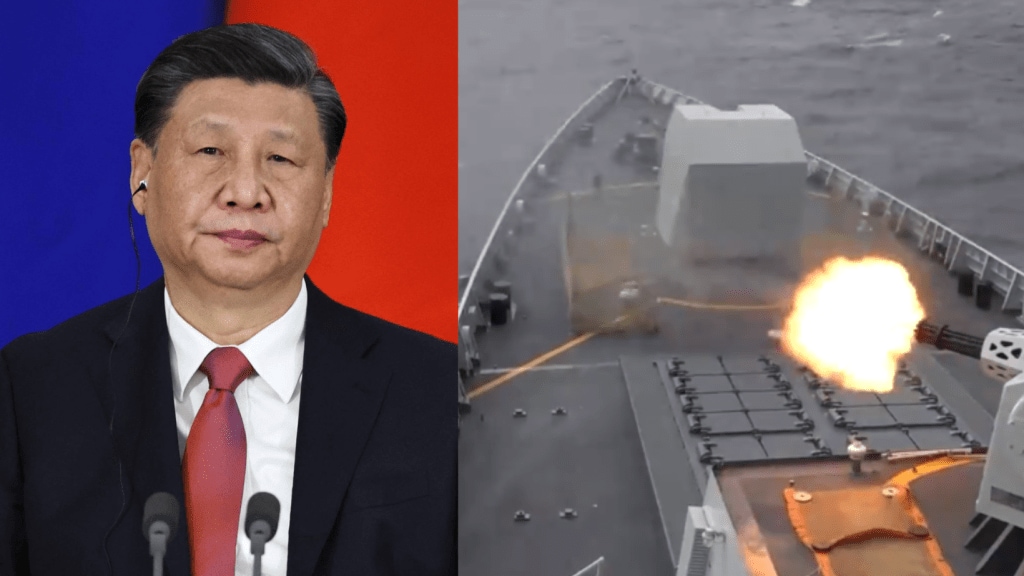
China has completed two days of large-scale military exercises around Taiwan, raising tensions in Asia. The drills, called Justice Mission 2025, are the sixth major round of war games China has conducted near Taiwan in recent years. They involved live ammunition, warships, fighter jets, bombers, missiles and rockets fired into waters surrounding the island. Taiwan says the exercises were highly provocative and disrupted air and sea traffic, and experts say they were designed to rehearse a possible blockade of the self-ruled island.
What are these drills?
According to China’s People’s Liberation Army, the exercises took place over two days in waters and airspace surrounding Taiwan, including the north, south, east and southwest of the island. Chinese authorities released a map showing five large zones encircling Taiwan where the drills were conducted. Live-fire exercises were held on Tuesday between 8am and 6pm local time.
The drills involved the army, navy, air force and rocket forces, using destroyers, frigates, fighter jets, bombers, drones and long-range missiles. China said the drills simulated attacks on maritime targets, critical infrastructure and mobile ground targets. They also practiced blockading Taiwan’s major ports especially Keelung in the north and Kaohsiung in the south. A Chinese military spokesperson said the exercises focused on combat readiness patrols, seizing “comprehensive” control over adversaries and deterring aggression beyond the Taiwanese island chain.
Taiwan’s response
Taiwan closely monitored the drills and released detailed figures showing the scale of China’s military activity. Taiwan’s Ministry of Defence said it detected 130 Chinese military aircraft near the island in the 24 hours to 6am on Tuesday. Ninety of those aircraft crossed into Taiwan’s air defence identification zone, known as the ADIZ. This was the second-largest incursion since 2022, close to the record of 153 aircraft detected in October 2024.
In a statement on Tuesday, Defence Minister Wellington Koo said, “[Beijing’s] highly provocative actions severely undermine regional peace and stability [and] also pose a significant security risk and disruption to transport ships, trade activities, and flight routes.” Koo described the exercises as a form of “cognitive warfare” aimed at weakening Taiwan through both military and non-military pressure.
Taipei also detected 14 Chinese navy ships and eight unspecified government vessels during the same period. Taiwan’s coastguard said seven rockets were fired into two drill zones around the main island. Because of the live-fire exercises, Taiwan cancelled more than 80 domestic flights and warned that over 300 international flights could be delayed due to rerouting.
Why is China doing this?
The main reason is China’s claim that Taiwan is part of its territory, a claim Taiwan strongly rejects. The two sides have been governed separately since 1949, when Communist forces took control of mainland China and the defeated Nationalist government fled to Taiwan.
China has refused to rule out using force to achieve what it calls “reunification” with the island of 23 million people. It strongly opposes any move toward Taiwanese independence and objects to foreign countries supporting Taipei. Beijing said the drills were a response to “separatist forces” and “external intervention”.
China vowed “forceful measures” after Taiwan announced that the United States had approved a US$11 billion arms sale to the island earlier this month. China’s Ministry of Foreign Affairs said the drills were a “punitive and deterrent action against separatist forces who seek ‘Taiwan independence’ through military build-up, and a necessary move to safeguard China’s national sovereignty and territorial integrity”.
A message to the US, Japan and others
China made it clear the drills were meant to send a warning beyond Taiwan. After the exercises began, Beijing warned “external forces” against arming the island, without naming the United States.
The drills also followed remarks by Japanese Prime Minister Sanae Takaichi, who said that the use of force against Taiwan could justify a military response from Japan. Japan’s Foreign Ministry responded on Wednesday, saying China’s actions were “an act that escalates tension in the Taiwan Strait”.
“The peace and stability in the Taiwan Strait are important for the entire international community. Japan continues to watch the related development with strong interest,” the ministry said.
The Philippines also expressed concern. Defence Minister Gilberto C. Teodoro Jr. said he was “deeply concerned by China’s military and coast guard actions around Taiwan”. “This heightened scale of coercion has implications that extend beyond cross-Strait relations and into the broader Indo-Pacific community,” he said.
How are these drills different from before?
Experts say Justice Mission 2025 marked a major escalation. Jaime Ocon, a research fellow at Taiwan Security Monitor, said it was the largest war game since 2022 in terms of area covered “These zones are very, very big, especially the southern and southeast zones around Taiwan, which actually breached territorial waters,” he told Al Jazeera. “That’s a big escalation from previous exercises.”
The drills focused more clearly on blockading Taiwan, rather than just surrounding it. “This is a clear demonstration of China’s capability to conduct A2/AD – anti-access aerial denial – making sure that Taiwan can be cut off from the world and that other actors like Japan, the Philippines, or the United States cannot directly intervene,” Ocon said.
Another key difference was the impact on civilian travel.
Alexander Huang, director-general of Taiwan’s Council on Strategic and Wargaming Studies, said the drills interfered with international flight and shipping routes. “For this drill, it actually interfered with international civil aviation routes and also maritime shipping routes. In previous drills, they tried to avoid that, but this time they actually disrupted the air and maritime traffic,” he told Al-Jazeera.
What China and Taiwan leaders said
China’s military declared the drills a success. In a New Year’s Eve announcement, the PLA said the exercises had “fully tested the integrated joint operations capabilities of its troops”. “Always on high alert, the troops of the Theater Command will keep strengthening combat readiness with arduous training, resolutely thwart the attempts of ‘Taiwan Independence’ separatists and external intervention, and firmly safeguard state sovereignty and territorial integrity,” Senior Capt. Li Xi said.
Chinese President Xi Jinping also referred to Taiwan in his New Year’s Eve speech. “The reunification of our motherland, a trend of the times, is unstoppable,” Xi said. Taiwan, however, described the drills as dangerous and destabilising, warning that China’s actions threaten peace across the region.