



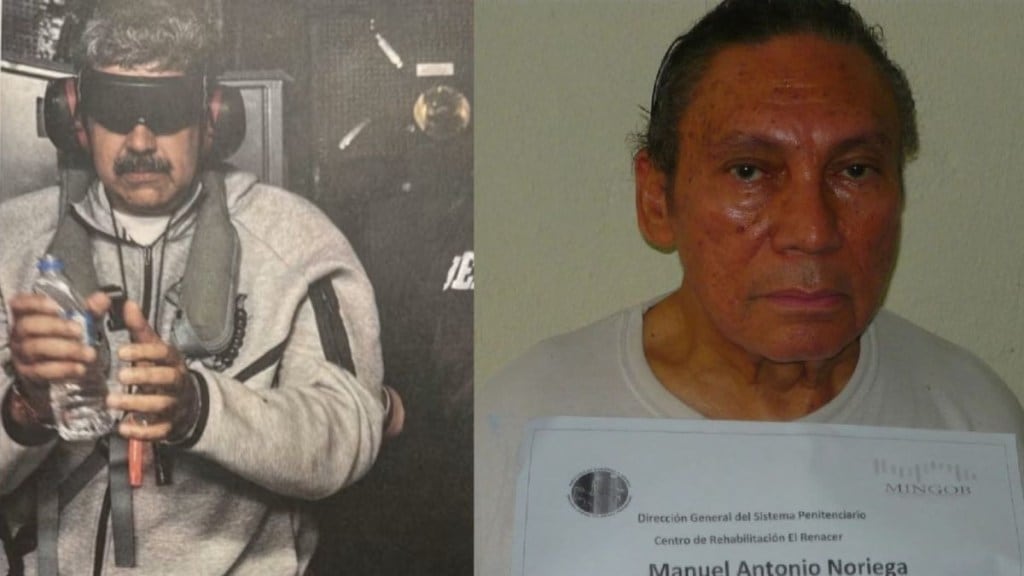
The United States of America launched a large-scale attack on Venezuela where it fired bombs across multiple destinations in the nation including several military bases of the country. Following the attack, the US military also captured the Venezuelan president along with his wife and flew them out of the country.
“The United States of America has successfully carried out a large-scale strike against Venezuela and its leader, President Nicolas Maduro, who has been, along with his wife, captured and flown out of the Country. This operation was done in conjunction with U.S. Law Enforcement,” Donald J Trump posted on Truthsocial earlier today.
The US has long accused Maduro of drug trafficking and working with gangs designated as terrorist organisations. In 2020, Maduro was indicted in the US on corruption, drug trafficking and other charges, with the State Department announcing a $50 million reward for information leading to his arrest or conviction.
Interestingly, this is not the first time that the US has gone into a Latin American country and captured its leader under charges of drug trafficking. Roughly 36 years ago, the US invaded Panama, and arrested its ruler Manuel Noriega. The historic operation not only involved regular military supplies but also involved a long playlist of heavy metal and rock songs.
Panama is a Central American country famous for the Panama Canal, a vital waterway connecting the Atlantic and Pacific Oceans, located on the narrow isthmus linking North and South America.
A deadly friendship
Manuel Noriega first came under the spotlight after he was appointed as the head of military intelligence under Omar Torrijos, who seized power in Panama in a 1968 coup. Known for his street smartness and covert tactics, Noriega oversaw the Army’s off-book deals and concocted the disappearance of numerous opponents of Torrijos.
According to a report published by The Indian Express, Noriega had come on the payroll of the Central Intelligence Agency (CIA) by the 1970s. As per media reports Noriega helped the US curb the spread of communism in Central America by allowing US forces to set up listening posts in Panama, and use the country to funnel aid to pro-American militaries in the region.
After the death of Torrijos in a 1981 air crash, Noriega became the de facto leader of Panama.
A strong ally of Washington at the time, Noriega eventually got involved with numerous Colombian drug lords such as Pablo Escobar, whom he helped smuggle cocaine into the US and launder drug money through Panama’s banks. In return, Noriega received millions of dollars as kickbacks.
As per the Indian express report, US intelligence knew about Noriega’s role in drug trafficking and money laundering but decided against taking any action against him due to his significance in the fight against communism.
In the mid-1980s, he was one of the key players in the Iran-Contra affair. The Iran-Contra affair (1985–1987) was a major U.S. political scandal during the Ronald Reagan administration. It involved a secret, illegal operation where senior officials facilitated the sale of weapons to Iran and used the resulting profits to fund anti-communist rebels, known as Contras, in Nicaragua.
Tensions began to emerge between Noriega and the US soon after this incident. The Americans became increasingly suspicious of the Panamanian leader amid indications that he was selling his services to other intelligence bodies.
These suspicions forced the US government to disown Noriega, and in 1988, he was indicted in a US federal court on drug-trafficking charges. Post this development, Noriega annulled a presidential election in 1989 in which the opposition would have won comfortably to be labeled as the country’s ‘maximum leader’.
On December 15, Panama’s National Assembly named him “maximum leader” and declared that the US and Panama were in a “state of war”. Following this announcement, Noriega strode triumphantly to the podium, wielding a machete. “We the Panamanian people will sit along the banks of the [Panama] canal to watch the dead bodies of our enemies pass by.”
The next day, Panamanian forces shot and killed a US marine in Panama City and severely beat an American naval officer who witnessed the shooting.
Incoming US invasion
These developments horrified then US President George H W Bush, who was briefly CIA director in the 1970s, when Noriega was considered a valuable intelligence asset. Bush then ordered Gen Colin Powell, then chairman of the joint chiefs of staff, to launch Operation Just Cause, sending 26,000 invasion troops into Panama
On December 20, 1989, US troops entered Panama, looking to capture Noriega. The Panamanian Defence Forces were crushed, and most of the country was held by the American forces within days. Noriega was not found till days after the invasion as he had taken shelter at the Vatican Embassy after several days on the run.
The US troops did not want to break diplomatic protocol and enter the embassy. So, they came up with a plan to employ psychological warfare operations. The troops placed speakers around the perimeter of the Vatican Embassy and started blasting music adverse to Noriega’s taste for days.
While Noriega was known to like opera, he was made to listen to Public Enemy’s “Fight the Power”, “Panama,” from Van Halen, “Danger Zone,” from Kenny Loggins, and “Refugee,” courtesy of Tom Petty.
After the music was played nonstop for several days, Noriega finally surrendered on January 3, 1990. He was taken to Miami, tried and convicted of drug trafficking.
“The court refused to allow Noriega’s defence to present any evidence relating to his work for the CIA, his payments from the US government, his knowledge of US subversion in Central America, his contacts with senior figures such as Bush, and their knowledge of his activities as Panama’s dictator,” The Guardian report said.
He spent nearly two decades in US prisons. Noriega died in 2017, at the age of 83.