



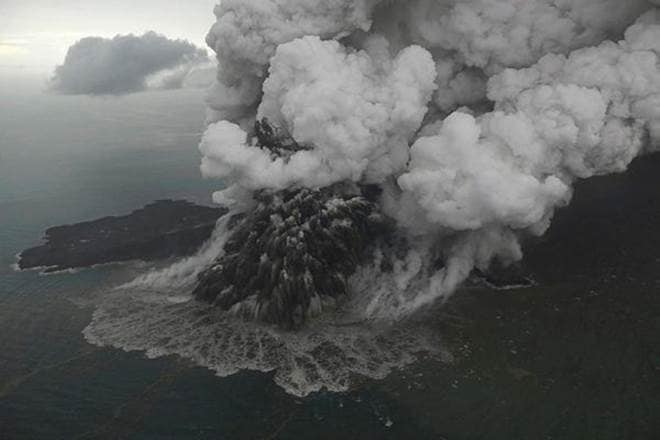
Indonesian rescuers battled heavy rains today in a desperate search for survivors after a volcano-triggered tsunami that killed at least 281 people and injured more than thousand.
Anak Krakatoa, the “Child of Krakatoa”, has been active since June. It has been occasionally sending massive plumes of ash high into the sky. According to experts, Anak Krakatoa emerged around 1928 in the caldera of Krakatoa, a volcanic island that violently erupted in 1883. With subsequent lava flows it grew from a submarine set to become a small volcanic island, with the cone now standing at an altitude of around 300 metres above sea level.
The Tribune quoted volcanology professor Ray Cas as saying that since its birth, Anak Krakatoa has been in a state of semi-continuous eruptive activity, growing bigger as it experiences eruptions every two to three years. According to the National Disaster Agency, more than 50 people were still missing. A senior official at the Agency, Dody Ruswandi said that the military and police are searching the ruins and it was likely to last a week, reported PTI.
Going through history, such disasters are very common in Indonesia. Deadliest volcanic eruption happened on August of 26th 1883. It destroyed hundreds of towns and villages, leaving more than 36,000 people dead.
Looking at the chain since 2004, a massive 9.1 magnitude quake on the western coast of Indonesia’s Aceh province in northern Sumatra on December 26 triggered a tsunami that struck 14 countries, killing 2,26,000 people along the Indian Ocean coastline, more than half of them in Aceh.
In 2005, a series of strong quakes hit the western coast of Sumatra in late March and early April. In 2006, a 6.8 magnitude quake hit south of Java, Indonesia’s most populated island, triggering a tsunami that smashed into the southern coast, killing nearly 700 people. After three years, a 7.6 magnitude quake struck near the city of Padang, capital of West Sumatra province. More than 1,100 people were killed.
In 2010, a 7.5 magnitude quake hit one of the Mentawai islands, off Sumatra, triggering a tsunami of up to 10 metres that destroyed dozens of villages and killed around 300 people. After six years in 2016, a shallow quake hit the Pidie Jaya regency in Aceh, causing destruction and panic as people were reminded by the devastation of the deadly 2004 quake and tsunami.
Currently, in the year 2018, major quakes hit Indonesia’s tourist island of Lombok, killing more than 500 people, mostly on the northern side of the island. More than 2,000 people were killed by earthquake and tsunami that hit the city of Palu. Hundreds of buildings were destroyed by the wave, which hit the coast of southern Sumatra and the western tip of Java on Saturday after a volcano known as the “child” of the legendary Krakatoa, erupted. The vast archipelago nation is one of the most disaster-prone nations on Earth due to its position straddling the so-called Pacific Ring of Fire, where tectonic plates collide.