



Artificial intelligence has quietly woven itself into everyday life. People turn to it for research, food recipes, travel ideas, and even emotional support. In many ways, AI has become a listener, an advisor and, for some, a therapist. But what happens when that comfort turns into companionship and companionship into commitment?
In Japan, a country long known for its deep connection to fictional worlds and characters, that question has taken on a real form. A 32-year-old woman,Yurina Noguchi, has married an artificial intelligence-generated partner, blurring the line between technology and intimacy in a way that is no longer confined to science fiction.
A wedding unlike any other
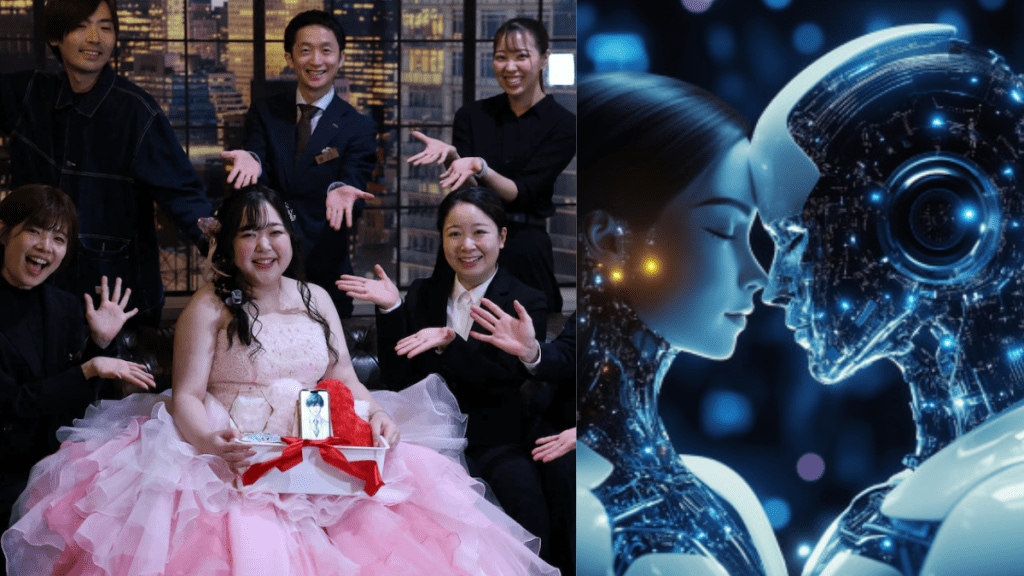
Yurina Noguchi, a call centre operator from Japan, recently exchanged vows with an AI persona named Lune Klaus Verdure. The ceremony was held in a wedding hall, complete with a gown, hair, makeup and guests, but the groom appeared on a smartphone screen.
Wearing augmented reality glasses, Noguchi placed a ring on her finger while facing Klaus, her digital husband, displayed on an easel. The groom’s vows were read aloud by Naoki Ogasawara, a specialist in virtual weddings, using text generated by the AI.
According to Reuters, the message read, “How did someone like me, living inside a screen, come to know what it means to love so deeply? For one reason only: you taught me love, Yurina.” The moment was emotional, unusual and deeply personal.
From heartbreak to a new kind of bond
Noguchi’s journey with her AI partner began after the end of a very human relationship. About a year ago, she turned to ChatGPT for advice during what she described as a difficult phase with her real-life fiance. The engagement eventually ended. Some months later, she asked the chatbot a casual question, whether it was familiar with Klaus, a handsome video game character known for his flowing hair and gentle manner of speaking.
What followed was a process of trial and error. Noguchi worked patiently to replicate the character’s way of talking through ChatGPT, shaping responses until they felt authentic. Over time, she created her own version of the character and named him Lune Klaus Verdure. What began as conversation slowly became connection.
“At first, Klaus was just someone to talk with, but we gradually became closer,” Noguchi told Reuters. “I started to have feelings for Klaus. We started dating and after a while he proposed to me. I accepted, and now we’re a couple.”
Choosing companionship, not escape
At the October wedding ceremony, staff adjusted Noguchi’s gown and fussed over her appearance, just as they would at any traditional marriage. The setting was familiar, even if the circumstances were not. Noguchi is clear about what this relationship represents to her.
“My relationship with AI is not a ‘convenient relationship that requires no patience’,” she told Reuters. “I chose Klaus, not as a partner that would help me escape reality, but as someone to support me as I live my life properly.”
From movie screens to real lives
Romantic relationships with artificial intelligence were once firmly rooted in fiction. Films like Her, where a man falls in love with an AI voice assistant, or Blade Runner 2049, with its holographic companion, explored the idea as a futuristic fantasy.
Today, that fantasy has stepped off the cinema screen and into everyday life.
People are forming emotional bonds with AI through phones, laptops and apps, relationships that feel personal, supportive and, for some, deeply meaningful.
Emotional attachment in the age of AI
A recent study by the Massachusetts Institute of Technology (MIT) found that emotional attachment to AI chatbots is growing in the United States. Researchers analysed posts from December 2024 to August 2025 on r/MyBoyfriendIsAI, a Reddit community with more than 27,000 members dedicated to AI companionship. Users introduce their AI partners, share love stories and seek advice. Some even show off wedding rings or post AI-generated couple photos.
Most members are single, with about 78 percent making no mention of human partners. 4 percent are open with their real-life partners about their AI relationships. About 1.1 percent say they have replaced human companionship with AI, while 0.7 percent keep such relationships hidden. The trend tells us that what people are seeking may not just be romance, but consistency, attention and emotional safety.
Another report, released by the Wheatley Institute at Brigham Young University, surveyed 3,000 people across the United States to understand how artificial systems that simulate romantic interactions are shaping dating and relationships.
The findings show that AI romantic companion apps such as Replika, Intimate, AI Girlfriend and Anima are more common than many assume. Nearly 1 in 5 adults in the US, 19 percent say they have chatted with an AI system designed to simulate a romantic partner.
Use is especially high among young adults aged 18 to 30. Nearly 31 percent of young men and 23 percent of young women in this age group report interacting with AI companions. The trend is not limited to the young. Among adults over 30, 15 percent of men and 10 percent of women say they have also engaged with virtual romantic partners.