




A LinkedIn post describing the rejection of a planned year-end leave by a US-based employee has sparked fresh debate around workplace culture, managerial discretion and the gap between company policies and on-ground reality.
The post, shared by a user on the professional networking platform, recounts the experience of a friend working in the US who had applied for year-end leave well in advance. According to the user, the employee informed her team nearly a month and a half ahead, followed all formal procedures, and made travel plans to return to India after a long gap.
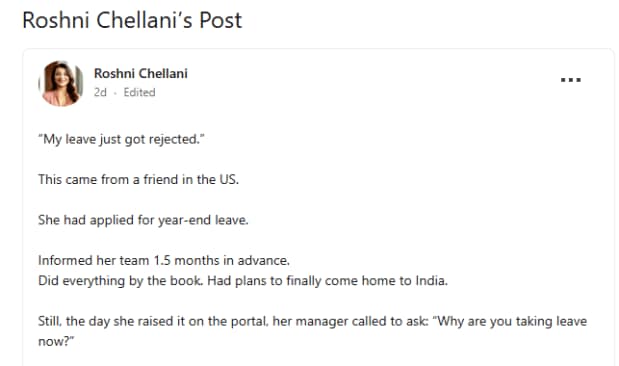
“My leave just got rejected.”
The post says the employee was called by her manager on the very day the leave request was raised on the internal portal and questioned about the timing. Despite advance notice, she was told there was “too much work” and that “too many people are already on leave”.
Leave rejected despite advance notice
The post claims the conversation soon turned uncomfortable, with what it described as subtle guilt-tripping and references to future career prospects. The employee was allegedly “requested” to either cancel her leave or convert it into unpaid time off.
With flight tickets already booked at a cost of around Rs 1.5 lakh, the employee chose unpaid leave, losing nearly half a month’s salary to keep her travel plans intact.
The incident is particularly striking, the post notes, because it involves a well-known multinational company with a generous paid time off (PTO) policy and a publicly stated culture that encourages employees to take breaks.
‘Policies don’t matter, managers do’
According to the LinkedIn user, the episode highlights a reality many professionals realise late in their careers: written policies often mean little if a manager does not support them.
“If your manager doesn’t believe in taking leave, there is no policy in the world that will protect you,” the post states, adding that the real determinant of workplace experience is often the immediate reporting manager rather than the organisation’s stated values.
As a takeaway, the user suggested that employees consider switching teams internally when possible and, while evaluating new job opportunities, research prospective managers as carefully as the company itself.
The post concluded by underlining that while a supportive manager can make even a difficult workplace manageable, a poor manager can turn an otherwise ideal organisation into a stressful environment — a factor no offer letter clearly spells out.
Disclaimer: This story is based on a post shared by a social media user. The details, opinions, and statements quoted herein belong solely to the original poster and do not reflect the views of Financialexpress.com. We have not independently verified the claims.