



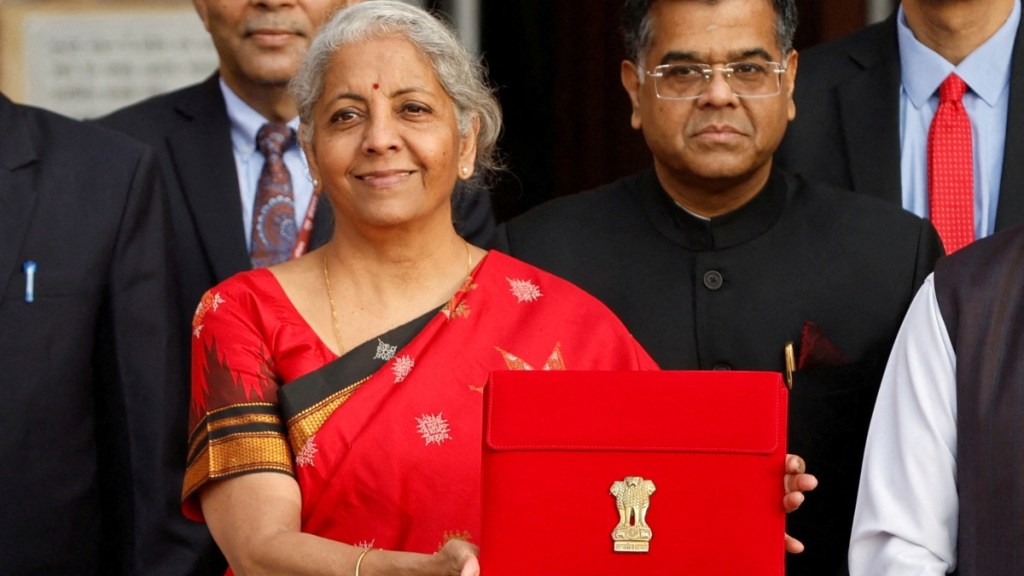
Despite the divergent takes on the state of the economy, prime minister Narendra Modi has reposed faith in Nirmala Sitharaman. As finance and corporate affairs minister for a second straight term, she may accord top priority to addressing the rural distress. It is also likely that welfare programmes get a renewed focus even as capital expenditure pace is maintained to spur job creation.
In her sting as Finance Minister in the Modi 2.0 (2019-2024), Sitharaman brought in fiscal transparency, ended off-budget borrowings and successfully undertook fiscal consolidation after the pandemic.
In the interim budget in February this year, the government has projected a further reduction in fiscal deficit to 5.1% of GDP in FY25. While the medium-term goal was to bring down to 4.5% by FY26, analysts said the deficit should be brought down to the prudential level of 3% in the subsequent 2-3 years. The fiscal deficit had hit a record high of 9.2% in the Covid-hit FY21. Similarly, the Central Government’s debt-to-GDP ratio fell from 61.4% in Covid-hit FY21 to 57.1% in FY24.
In the upcoming Budget session next month, the Centre may push pending reforms, including creating a national financial information registry, liberalising the insurance sector and further streamlining the insolvency framework.
Among the options before the government are a strengthening of the existing schemes, and new ones specifically targeted at the rural sector. Moderate tax reliefs are also likely as part of the plan to boost consumption demand.
The extension of PM Awas Yojana (PMAY), extension of PM Svanidhi to small towns and villages and free electricity to poor households under PM Surya Ghar Muft Bijli Yojana are expected to further prop up rural demand. On Monday, the first Cabinet meeting approved an additional 30 million rural and urban houses under PMAY with central financial assistance.
Consumption in rural areas remains tepid largely due to negative growth in real rural wage, high rural inflation, and shortfall in crop output due to below-normal monsoon. Data from the Centre for Monitoring Indian Economy (CMIE) showed that real rural wages contracted in 25 of the 27 months to February 2024, suggesting that the recovery in the hinterland could take longer than expected.
The higher-than-expected dividend of Rs 2.11 trillion from the Reserve Bank of India (RBI) as against the budget estimate of Rs 80,000-90,000 crore could let the Centre reduce its market borrowings and fiscal deficit in FY25 or pump in more money into schemes and capex. The extra transfer by the RBI is almost 0.4% of GDP and may help the Centre bring down further to 4.8%-4.9% of GDP from the interim budget estimate of 5.1% for FY25 if additional spending is not undertaken.
Analysts said higher non-tax revenues would make available more funds for capex in FY25, the additional spending on this account may be difficult to incur within the eight-odd months left after the Final Budget is presented to Parliament in July.
During the budget session, the government may take up the National Financial Information Registry (NFIR) Bill, which seeks to provide a 360-degree information system to lending institutions to quicken the process and reduce the cost of credit.
For individuals or enterprises which want a lower interest rate, the banks will ask for their consent to access data about their business volume, electricity consumed, GST paid, etc, from NFIR. If consent for data is not given, banks will likely ask for collateral and loans may also be costlier.
Similarly, big-ticket reforms in the insurance sector will also likely be pushed including the introduction of composite insurance licence, differential minimum capital and captive insurance.
The Insurance Act, 1938, and the regulations of the Insurance Regulatory Development Authority of India (IRDAI) do not allow composite licensing for an insurer to undertake life, general, or health insurance under one entity. Allowing composite licensing could provide further impetus to the insurance sector owing to its various benefits such as reduction of costs and compliance hassles for insurers. It can also offer customers more choice and value, such as a single policy that covers life, health, and savings.
To further streamline insolvency law, the government will likely introduce a bill to amend the Insolvency and Bankruptcy Code (IBC) to introduce cross-border and group insolvency norms. It will also seek to remove the interim moratorium for personal guarantor assets as well as introduce project insolvency under a real estate and creditor-led resolution plan (CLRP).