



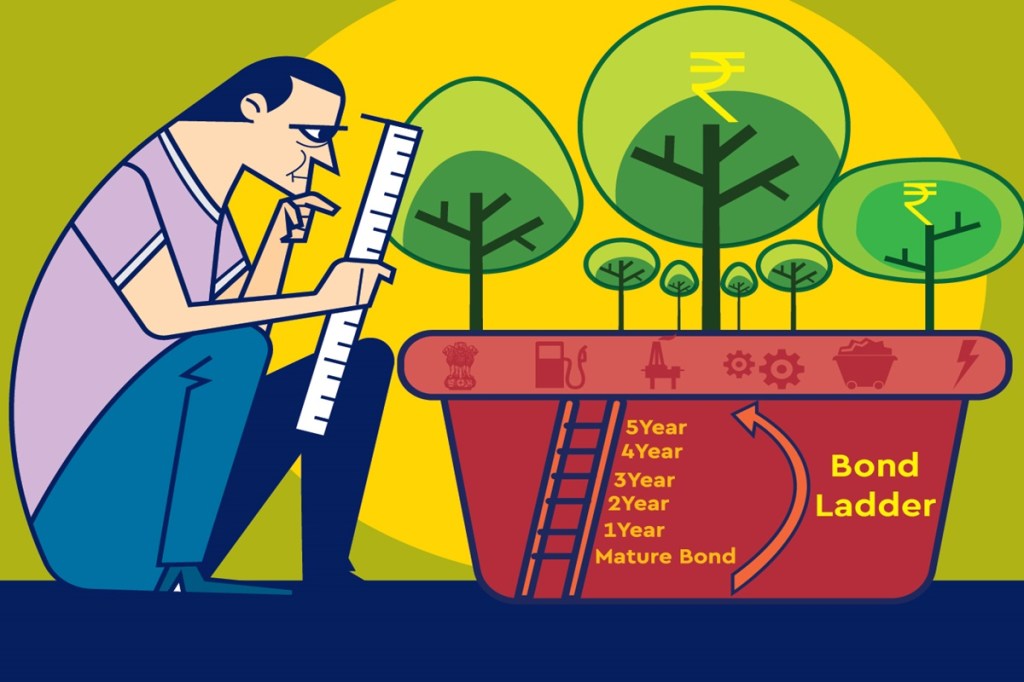
Income-seeking but risk-averse investors prefer to invest in fixed income instruments. They do invest in bonds through various investment vehicles such as mutual funds, exchange-traded funds and also individual bonds. A popular way to hold individual bonds is by building a ladder investment strategy. Let us discuss the same in detail.
What is a bond ladder?
A bond ladder is a concept of creating a portfolio of individual bonds that mature on different dates. Such an investment strategy is designed to provide current income while minimising exposure to interest rate fluctuations. Under this method, instead of buying bonds that are scheduled to mature during the same year, investors invest in bonds that mature at staggered future dates.
Helps to mitigate interest rate risk
By staggering maturity dates, investors avoid getting locked into a single interest rate. A bond ladder investment strategy helps to smoothen out the effect of fluctuations in interest rates because the bonds in your portfolio are maturing every month, quarter, year, depending on the number of rungs in the ladder.
When a bond matures, an investor could reinvest that principal in a new longer-term bond at the end of a ladder. If interest rates have risen, they will benefit from a new, higher interest rate and keep the ladder going. If interest rates were expected to fall, the maturing bonds would be reinvested at lower rates, but the bonds at the end of the ladder will have most likely been locked in higher yields already.
Helps to manage cash flow
Apart from interest rate risk mitigation, this strategy also helps in managing the cash flow. As interest on the bonds are payable semi-annually on dates that generally coincide with their maturity date, investors can structure predictable monthly bond income based on coupon payments with different maturity months as well as years.
Constructing your bond ladder
Construction of your bond ladder is fairly straightforward to create. The overall length of time, spacing between maturities, and types of securities are primary considerations when building a bond ladder.
Rungs of ladder: Take the total amount that you plan to invest, with the goal of extending the ladder as long as possible. For instance, if you plan to invest `1,00,000 to buy individual bonds, it could be invested with 10 rungs of Rs 10,000 each. It is advisable to have at least six rungs so that an investor can create a ladder structured to generate income every month of the year.
Spacing of ladder: The distance between rungs should be decided by the span of time between the bond maturities of the respective bonds, which can range from months to years. The spacing should be roughly equal. Bonds with longer maturities tend to offer higher yields, though shortening the bond maturities generally reduces income and interest rate risks.
Materials for ladder: Similar to a real ladder, investors can build their ladders with different materials. In other words, by investing in different types of bonds or certificate of deposits, etc. Further, investors can also invest and utilise the potential tax advantages associated with certain bonds and also higher yields of investment-grade corporate bonds.
To conclude, even in a low or rising interest rate environment, bond ladders can help to balance the need for income while managing interest rate risk.
Up the rungs
- A bond ladder is a concept of creating a portfolio of individual bonds that mature on different dates
- You can structure predict-able monthly bond income based on coupon payments with different maturity months as well as years
- By staggering maturity dates you avoid getting locked into a single interest rater
- Utilise tax advantages associated with certain bonds and higher yields of investment-grade corporate bonds
The writer is a professor of finance & accounting, IIM Tiruchirappalli