



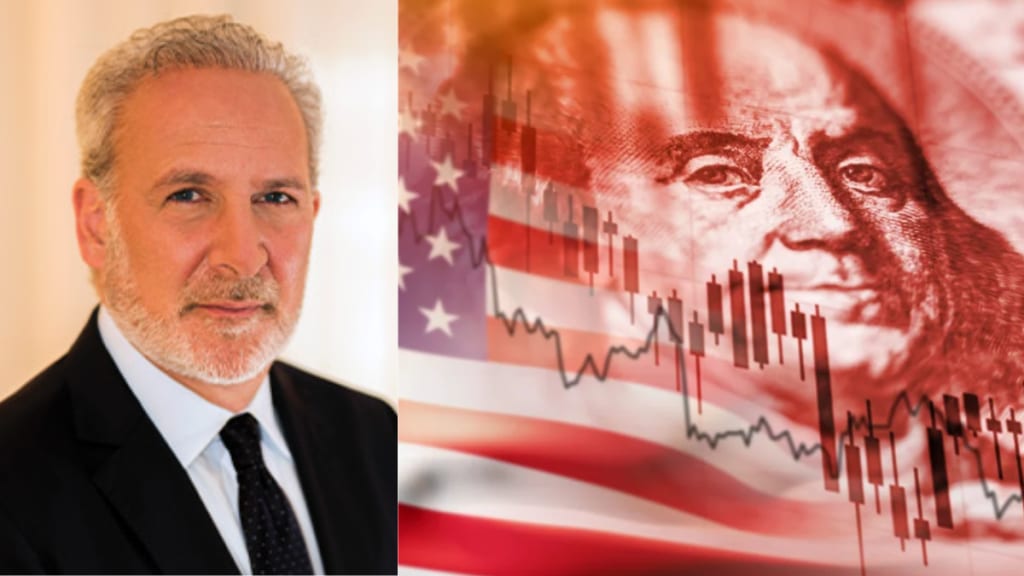
Economist Peter Schiff is back with another strong warning on the future of the US dollar. He says, “King dollar’s reign is coming to an end. Gold will take the throne as the primary central bank reserve asset.” Schiff also believes that the “US dollar will crash against other fiat currencies, and America’s free ride on the global gravy train will end. Prepare for a historic economic collapse.”
King dollar’s reign is coming to an end. Gold will take the throne as the primary central bank reserve asset. That means the U.S. dollar will crash against other fiat currencies, and America’s free ride on the global gravy train will end. Prepare for a historic economic collapse.
— Peter Schiff (@PeterSchiff) December 26, 2025
For him, this is no longer a distant possibility. He says that what markets are seeing today, surging gold prices, central banks selling US Treasuries, and a weakening greenback.
Dollar’s safe-haven status
Schiff has earlier warned that the US dollar is approaching a critical breaking point, as its image as the world’s safest currency continues to reduce. One key reason, he points out, is the dollar’s 14-year low against the Swiss franc, a currency traditionally seen as one of the most stable in the world. For Schiff, this shows a declining investor confidence in the dollar. He blames the weakness on a combination of persistent inflation risks, rising interest rates, and growing economic and fiscal instability.
US Dollar Index has fallen over the past year. By late December 2025, it has come to around 97.94, about 9.4% lower than a year ago. Dollar is on track for its worst yearly performance in more than 20 years. As reported by Reuters, investors believe the Federal Reserve may be able to cut interest rates further next year, though some other major central banks may raise rates instead. Even strong US GDP data failed to support the dollar, as markets are now expecting about two more Fed rate cuts in 2026.
The dollar has seen a volatile year. President Donald Trump’s unpredictable tariff policies earlier this year hurt investor confidence in US assets. In addition, concerns have grown about the Federal Reserve’s independence due to Trump’s increasing influence. According to HSBC analysts, the recent weakness in the dollar tells us not only expectations of lower interest rates, but also worries about whether the Fed can act independently.
Central banks turn to gold
In July, gold overtook the euro to become the world’s second-largest reserve asset, behind only the US dollar. But a major moment came in October 2025.For the first time in nearly 30 years, global central banks now hold more gold than US Treasuries. Data from the European Central Bank and the World Gold Council shows that central banks hold about 36,000 metric tons of gold, worth roughly $4.5 trillion. US Treasury holdings stand at about $3.5 trillion. The gap is the widest since the mid-1990s. Since April 2025, foreign central banks have cut exposure to US Treasuries by nearly $183 billion, shifting that money into gold.
Record gold prices as a warning sign
Gold and silver prices hitting record highs may look like a strong market rally, but Schiff sees a much darker signal. In an earlier post on X, he wrote, “The US economy is teetering on the brink of the biggest economic crisis of our lifetimes. Gold and silver prices skyrocketing to new highs will ultimately pull the rug out from under the US dollar and Treasuries, sending consumer prices, bond yields, and unemployment soaring.” For Schiff, the rising precious metal prices are not a sign of strength, but a warning that investors are steadily losing faith in the foundations of the world’s largest economy.
What are the reasons for this shift?
A major reason behind this shift is concern over America’s fiscal position. The federal budget deficit totaled $1.74 trillion between November 2024 and October 2025 according to estimates from the Congressional Budget Office (CBO). The rolling deficit is $38 billion lower than the Fiscal Year (FY) 2025 deficit of $1.78 trillion. National debt has ballooned beyond $37 trillion. These numbers have pushed many central banks to question whether US Treasuries can still be treated as the world’s ultimate “risk-free” asset. Behind the gold rush lies a broader global trend, de-dollarisation.
After the US froze Russia’s dollar assets in 2022 and used financial sanctions as a geopolitical weapon, many countries began reassessing their dependence on the dollar-based system. Many countries are now increasing gold allocations, reducing exposure to US debt, diversifying reserves to avoid sanctions risk
Macro strategists say today’s environment looks uncomfortably familiar. Tavi Costa, macro strategist at Crescat Capital who spoke to Reuters, sees strong parallels with the 1970s, when inflation, monetary instability, and geopolitical shifts pushed central banks toward gold. He calls the fact that foreign central banks now hold more gold than US Treasuries a “significant milestone” that points to a deeper, long-term structural change in global reserve management. “What we are witnessing,” Costa tells Reuters, “may well represent the early stages of a major realignment in global reserve composition.”
Can the dollar still hold on?
Not everyone agrees with Schiff’s doomsday view. Journalist Paul Blustein argues that predictions of the dollar’s collapse have been told for decades and been wrong before. He believes the dollar’s dominance, and America’s power to impose devastating sanctions, will remain intact for years to come. But Schiff insists this time is different. In his view, once central banks lose faith in US Treasuries and the dollar’s safe-haven role collapses, America’s “free ride” on global demand for its currency ends.
Disclaimer: This article provides factual analysis only and is not, and should not be construed as, an offer, solicitation, or recommendation to buy or sell securities. Investors must conduct their own independent due diligence and seek advice from a registered financial advisor in the respective jurisdiction.