



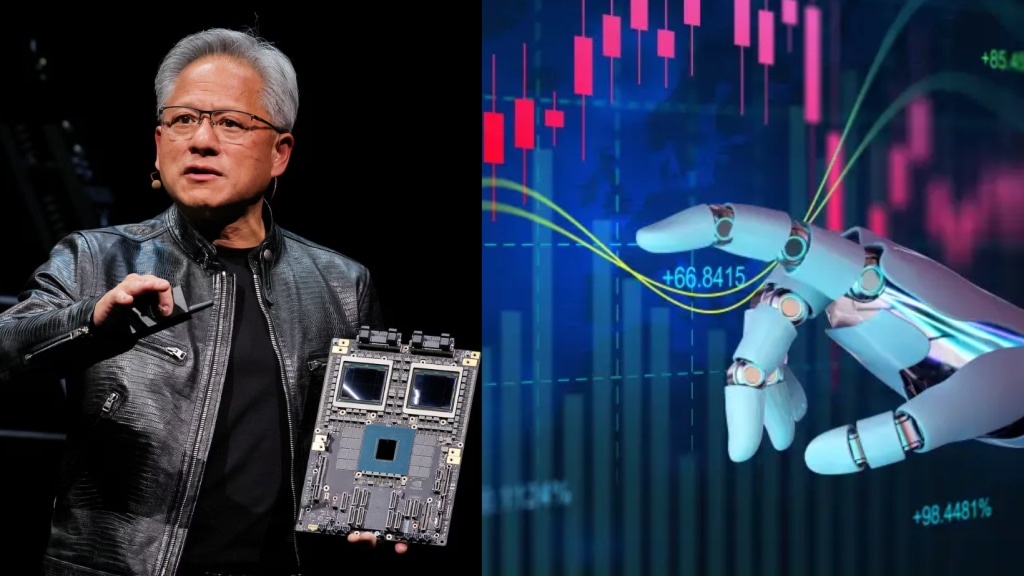
A turbine maker just crushed the AI poster child. Here’s how.
While everyone was obsessing over Nvidia’s AI chips in 2025, a little-known General Electric spinoff called GE Vernova quietly delivered a 92% return—crushing not just the S&P 500, but even the mighty Nvidia itself.
Yes, you read that right. Gas turbines outperformed graphics cards.
The plot twist nobody saw coming
When GE Vernova spun off from General Electric in April 2024, analysts yawned. This was GE’s old power division—the problem child that everyone wanted to forget. Gas turbines? In an age of solar panels and wind farms? Please.
The stock opened at around $115 per share. Fast forward to December 2025, and it’s trading at $653, hitting a 52-week high of $731. That’s a 92% gain while the broader market sputtered.
What changed? ChatGPT happened. And everyone realized something crucial.
The power behind the power
Here’s what the market missed: AI doesn’t run on hope and dreams. It runs on electricity. Massive, always-on, never-fail electricity.
Every time you ask ChatGPT to write an email or generate code, somewhere a data center is consuming as much power as a small town. Microsoft, Amazon, and Google are building AI data centers faster than they can plug them in. And they all need one thing: reliable baseload power.
That’s where GE Vernova comes in. The company makes gas turbines, the unglamorous workhorses that keep the lights on when the sun doesn’t shine and the wind doesn’t blow. While Nvidia was the poster child of the AI boom, companies like GE Vernova were the unsung heroes making it all possible.
The numbers that shocked Wall Street
At its December 9, 2025 investor day, GE Vernova dropped some jaw-dropping numbers that sent the stock soaring 15.9% in a single day to $725:
Revenue projections: $52 billion by 2028, up from previous guidance of $45 billion. For context, 2025 revenue is expected to be $36-37 billion.
Free cash flow: Cumulative FCF of $22 billion for 2025-2028, up from earlier guidance of just $14 billion. That’s a 57% increase in expected cash generation.
Backlog: Expected to reach $200 billion by 2028 versus current backlog of $135 billion. The order book is exploding.
The company responded by doubling its quarterly dividend from $0.25 to $0.50 per share and increasing share buybacks from $6 billion to $10 billion. This isn’t a company scraping by—it’s minting money.
Why it beat Nvidia (And everyone else)
Look at the backlog growth in Q3 alone:
- Power segment: up 18% to $84.1 billion
- Electrification segment: up 38% to $30.2 billion
- Wind segment: down 14% to $21.5 billion
The market spoke, and it said: we want reliable power, not intermittent power.
While Nvidia’s success depends on continued AI chip demand (which can be cyclical and faces competition), GE Vernova benefits from an unavoidable fact: AI needs electricity, and lots of it. The company is also collaborating with the U.S. government to secure supplies of yttrium—a rare earth element critical for turbines and jet engines—reducing dependence on China.
Here’s the kicker: GE Vernova expects its Power business EBITDA margins to explode from 7% in 2025 to over 20% by 2028. That’s not incremental improvement—that’s transformation. Analysts project cash earnings growth exceeding 30% annually through 2028.
Some analysts are now targeting $1,000 per share. J.P. Morgan’s Mark Strouse believes the stock can hit that milestone. At $653 today, that’s another 50%+ upside.
The renewable energy paradox
Here’s the twist that makes this story fascinating: GE Vernova also has a renewable energy business, specifically wind power. And it’s losing money.
The Wind segment posted a negative 6.1% EBITDA margin in 2024, weighed down by unprofitable offshore wind contracts signed years ago. But management isn’t panicking—they’re executing existing contracts while focusing on profitable onshore wind, expecting the segment to reach 10% EBITDA margins by 2028.
What does this tell us? The energy transition is happening, but not in the simplistic way many investors imagined. Back in 2015-2020, everyone thought gas turbines were dead and renewables would take over. But surging costs and reliability concerns have changed the narrative. Natural gas isn’t disappearing—it’s becoming more valuable as a reliable complement to intermittent renewables.
The real winner of the AI boom
Nvidia makes the chips. Microsoft and Google build the software. But GE Vernova? It makes the electricity that powers it all.
The company went from being GE’s weakest link—deemed destined for “at best, low single-digit growth”—to trading at the highest valuation multiples among all the GE spinoffs. Its enterprise value to EBITDA ratio now exceeds both GE Aerospace and GE HealthCare.
This isn’t hype. This is fundamentals. Data centers need power. Electrification needs infrastructure. AI needs energy. And GE Vernova is selling all three, with massive margin expansion on the horizon.
The bottom line
While the world obsessed over semiconductor stocks and AI software companies, the real winners of the AI boom might be the companies nobody talks about at cocktail parties. Power generation. Grid infrastructure. Electrical equipment.
Boring? Absolutely. Profitable? You bet.
GE Vernova’s 92% rally in 2025 wasn’t luck—it was recognition of a simple truth: before you can run AI models, you need to keep the lights on. And in a world hungry for electricity, the companies that generate, transmit, and manage power aren’t just relevant—they’re essential.
The stock trades at around 50x forward earnings—expensive on the surface, but reasonable for a company growing cash earnings at 30%+ annually with expanding margins. If AI demand continues (and all signs suggest it will), this rally might just be getting started.
Sonia Boolchandani is a seasoned financial writer She has written for prominent firms like Vested Finance, and Finology, where she has crafted content that simplifies complex financial concepts for diverse audiences.
Disclosure: The writer and her his dependents do not hold the stocks discussed in this article.
The website managers, its employee(s), and contributors/writers/authors of articles have or may have an outstanding buy or sell position or holding in the securities, options on securities or other related investments of issuers and/or companies discussed therein. The content of the articles and the interpretation of data are solely the personal views of the contributors/ writers/authors. Investors must make their own investment decisions based on their specific objectives, resources and only after consulting such independent advisors as may be necessary.