



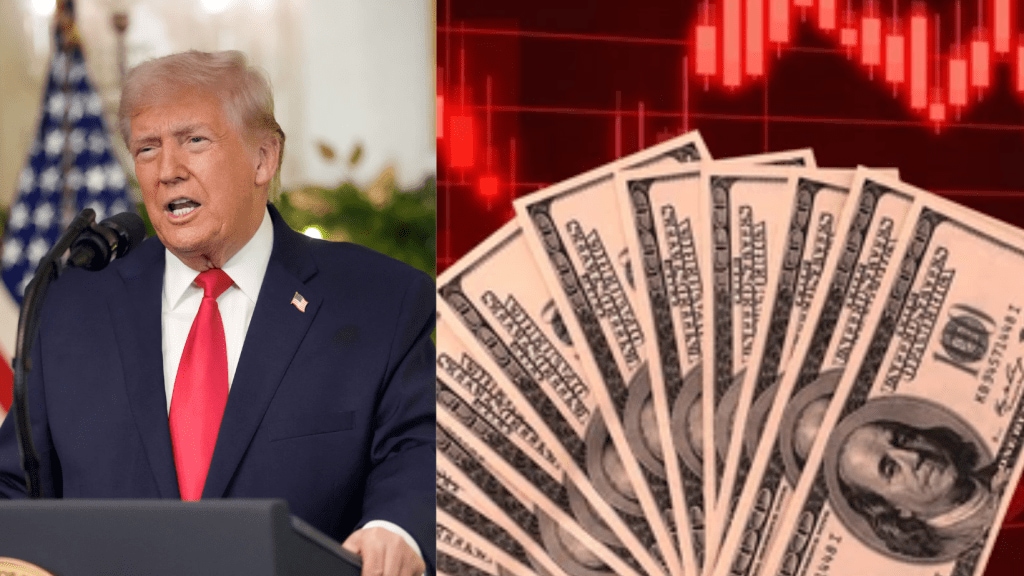
In 2025, the US dollar had a tough year. US Dollar Index, which tracks the dollar against major global currencies like the euro and yen, fell nearly 10%. That is one of its worst performances in more than 50 years. Why did this happen, and why does it matter to people around the world?
Trump’s trade policies
One of the major reason was uncertainty around President Donald Trump’s economic plans. His proposed tariffs shook markets, especially in the first half of the year. Investors worried that higher tariffs could slow down growth and create confusion in global trade. That uncertainty made the dollar less appealing.
Even though Trump later reversed some tariff plans, the damage to confidence had already been done. As Harvard economist Kenneth Rogoff put it, “I think we’ll see a period of a lot of financial volatility, largely centered around the chaos in the United States,” he told Business Insider.
Over the year, tariffs were announced, paused, raised, lowered, and sometimes reversed. This back and forth made it hard for investors to understand where the US economy was headed.
Tariffs can sometimes make a currency stronger. But this time, something else mattered more. Barry Eichengreen, professor of economics and political science at UC Berkeley told CNN, “Investors don’t like uncertainty,” Eichengreen told CNN.
He further added, “The consensus out there is that US growth is slowing owing to uncertainty around Trump’s tariffs and other things.The weakness of the dollar may also reflect new doubts about the currency’s safe haven status.”
Some experts say the dollar’s fall is not just about trade or numbers. It is about trust. “The dollar’s decline reflects a crisis of confidence in the United States,” said Arun Sai, senior multi asset strategist at Pictet Asset Management told CNN.
For global investors, knowing what comes next is important. “If you cannot with certainty take a view on the position of the US administration, it’s hard to commit capital,” Sai told CNN.
He added that something bigger is changing. “What we’ve seen with the current administration in the last few months is that this notion of the US being a default destination for global capital is being challenged.”
In early April, when tariff fears peaked, US stocks, bonds, and the dollar all fell at the same time. “That’s very peculiar. It doesn’t usually happen in the US,” Sai told CNN. “For us, that’s indicative of a loss of confidence.”
While markets struggled, ordinary Americans felt the impact in daily life. Companies passed on 67% to 100% of tariff costs to consumers. This slow rise in prices is often called sneakflation. By July, prices were up 2.7% compared to a year earlier. Everyday items, including cars and goods sold by companies like Walmart and Nike, became more expensive.
The uncertainty also affected jobs. Unemployment rose by 0.3 percentage points by the end of 2025 and is expected to rise further in 2026. By November, it reached 4.6%, the highest level since 2021. Since April, the sector lost 59,000 jobs. Factories cut 11,000 jobs in July alone as rising costs and policy confusion froze hiring plans. Job openings in manufacturing dropped by 76,000, showing how deeply uncertainty slowed decision making.
Lower US interest rates
Throughout the year, the Federal Reserve cut interest rates several times. When interest rates fall, holding that country’s money becomes less attractive for investors. They earn less by keeping money in dollars, so many move their money elsewhere. This reduced demand for the dollar and pushed its value down.
A weak dollar is not all bad news
While a falling dollar sounds scary, it has some positives too. As reported by Reuters, a weaker dollar makes US exports cheaper for other countries. This helps American factories, farmers, and companies that sell goods abroad.
The US exported $125 billion more goods and services in the nine months leading up to September compared to last year, according to the Census Bureau. That is a 5% increase.
President Donald Trump even stated this benefit, saying the US could “make a hell of a lot more money” when the dollar is weak. Joseph Brusuelas, chief economist at RSM, explained it clearly, “Pushing down the dollar’s value has been a policy priority for the administration as it sought in part to make exports more attractive,” he told Business Insider.
For decades, the US dollar was seen as the safest place to keep money. That belief is now being questioned. Global investors are slowly reducing their dependence on the dollar. Some central banks, including in China, are diversifying their reserves away from it.
Joseph Brusuelas described the current phase as the start of a “multi-year unwinding” of the dollar’s long bull run to Reuters. Erik Nelson of Wells Fargo summed it up by saying, “It’s US exceptionalism basically falling by the wayside and the rest of the world playing catch-up.”
Inflation worries
A weaker dollar also has downsides. Imported goods become more expensive for Americans. This adds pressure to inflation, especially when tariffs are already pushing prices higher. US consumer prices rose 2.7% year over year in November. That is lower than expected, but still above the Federal Reserve’s 2% target. This keeps policymakers cautious even as the economy grows.
Dollar vs Indian Rupee explained
Even though the US dollar weakened globally, the Indian rupee did not gain much strength. In fact, the rupee weakened against the dollar in 2025. The USD/INR rate started the year near Rs.85.56 and ended around Rs.89.87
The Indian rupee endured its sharpest fall in three years, including a wave of record equity outflows and the absence of a US trade deal. This left the rupee on the sidelines as other Asian currencies surged. With a year-end close at 89.87, the currency recorded a 4.72% annual decline, its biggest dip since 2022, when it dropped nearly 10%. Throughout the year, the rupee hit new record lows, briefly breaching the 91 level at one point.
“The rupee’s performance this year was largely a capital-flow story, with the RBI adopting a more pragmatic and flexible approach to the exchange rate and allowing the currency to weaken,” said Gaura Sen Gupta, an economist at IDFC First Bank to Reuters.
This economic strain, coupled with geopolitical tensions and a lack of trade agreements, has left the rupee vulnerable. Yet, a potential US trade deal could offer temporary respite, potentially lifting the rupee to around 88.50 by March. However, as Sen Gupta cautioned, these pressures are likely to resurface, causing the currency to weaken once more.
Will the Dollar stay weak forever?
Not everyone agrees that the dollar’s fall will continue. Daniel Tobon of Citigroup told Reuters, “We foresee signs of a ‘dollar cycle resurgence’ potentially emerging in mid-to-late 2026.” Others, like Deutsche Bank’s George Saravelos, say the dollar is still too expensive compared to how the US economy looks today. Goldman Sachs analysts also note that as other economies grow together, the dollar usually weakens.