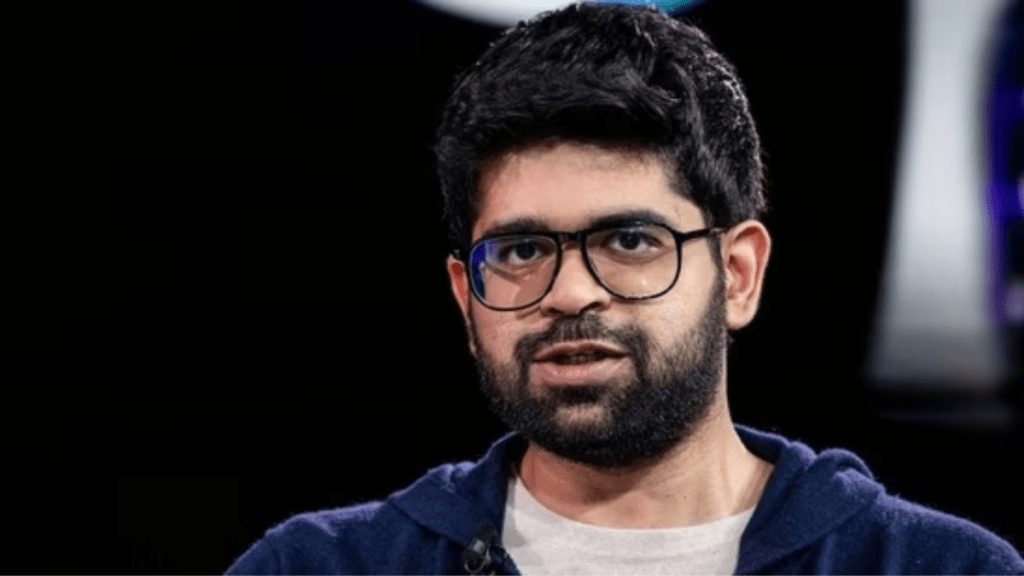
Aravind Srinivas, CEO and co-founder of AI-powered search engine Perplexity, has reinforced the critical distinction between artificial intelligence (AI) as a powerful tool and human ingenuity as the driving force behind true innovation, asserting that AI’s strengths lie in execution while humans alone possess the curiosity to define meaningful problems.
In a wide-ranging conversation on the popular podcast hosted by writer and entrepreneur Prakhar Gupta, Srinivas dived into the philosophical and practical boundaries of current AI systems, arguing that genuine breakthroughs come from human-driven questions rather than autonomous machine discovery.
The human edge: Curiosity and problem identification
“AI could help humans solve an existing problem but it is very different from AI solving it autonomously,” Srinivas told Gupta in the interview. “I think the edge lies with the humans because it was a human who identified the problem in the first place.”
He illustrated this with a reference to mathematical conjectures, “Did AI pose a question and try to go to solve it? No,” he said. “The curiosity of the human that led to even considering that it is important for them to think about conjecture.” Srinivas stressed that while AI can outperform humans in optimisation, verification, and scaling solutions, the act of deciding what deserves attention remains an irreplaceable human trait. This perspective positions AI as an amplifier of human intent rather than a replacement for it.
Future belongs to on-device AI and energy efficiency
During the discussion, Srinivas also shared forward-looking insights on AI infrastructure and personalisation. He identified on-device processing as a potential disruptor to the data-center-heavy model, “The [biggest threat] to a data centre is if the intelligence can be packed locally on a chip that’s running on the device, and then there’s no need to run inference on all of it on one centralised data centre.”
Comparing biological and artificial systems, he highlighted the human brain’s remarkable efficiency, stating, “The brain runs on 20 watts, while large AI models require massive energy in data centers.” Looking ahead, Srinivas envisioned AI evolving into deeply personalised assistants, similar to how smartphones transformed daily life, making advanced tools accessible and tailored to individual needs.
Balancing hype and reality of AI
Srinivas’s comments come at a time when the AI industry is grappling with expectations, massive investments, and debates over long-term capabilities. By highlighting collaboration between human curiosity and AI execution, he advocates for a grounded approach that prioritises real-world impact over speculative autonomy.