By Soma Das
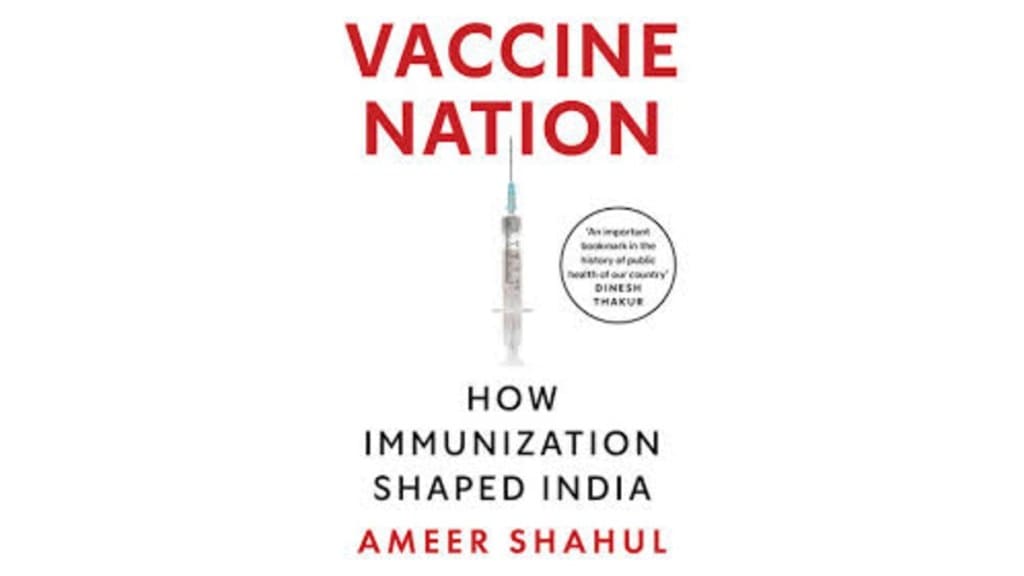
If our freedom fighters had known that Muhammad Ali Jinnah was suffering fast-deteriorating and life-threatening tuberculosis in the mid 1940s with less than a few years to live while he was negotiating breaking up of the nation, could it have averted the Partition? Had Cyrus Poonawalla’s mare not died due to bureaucratic delay in allowing anti-venom to be used, would Serum Institute of India, one of the country’s largest private vaccine majors, still be formed? Packing such rich side stories as segways to enter a narration of a highly scientific subject, former journalist Ameer Shahul attempts an ambitious broad-arc history of vaccines and vaccination in India in the book Vaccine Nation: How Immunization Shaped India.
The book traverses India’s active role in global vaccine research landscape from 1890s to 1940s; the next two decades—1950s and 60s—that can be dubbed as the dark ages for vaccine research, during which the focus on this critical public health tool fell off the map of priorities of policymakers in a newly independent country; and then the journey of the country regaining its eminent position as a vaccine-producing global leader in the decades that followed, ending just after Covid-19 during which India played a significant role in making vaccines for the world, vaccinating its own people and in vaccine-diplomacy, at a time when vaccine, a scarce resource, became a weapon in geopolitics.
Historically, the story begins in 1893, when Soviet-born French British scientist WMW Haffkine lands in Calcutta with plans to carry out large-scale field trials for cholera vaccines, after governments of Russia and Thailand turned down his pleas for the same. What follows are his exchanges with French scientist Louis Pasteur that result in the development of a cholera vaccine, how he pivots his vaccine research work on the dreaded plague after an outbreak in Bombay that starts to spread across the country, his fall from grace as a scientist after an adverse effect of vaccine in Mulkowal, a village in Punjab, ruins his reputation.
However, it is too late to revive his sinking career by the time his name is cleared and he is reinstated. What stands out in these pages is the passion of these research scientists for their work. Both Haffkine and his Spanish rival Ferran are seen testing their vaccines on themselves first, indicating how confident they were in their research, and how important it was for them to instil trust for their vaccines.
The book then goes on to cover battles against diseases fought by vaccination, including rabies, smallpox and polio, among others. In the chapter on smallpox, an interesting description of how the vaccine material travelled from country to country, ‘arm to arm’ in early years, almost in a relay race pattern, shows how every inoculated individual became a link in vaccinating the next. The narration also covers the making of eminent institutions and individuals leading vaccine research and vaccine-making in this country and also global figures whose work proved to be relevant for India. For instance, it covers stories of US-based virologists Jonas Salk and Albert Sabin, both credited with different versions of polio vaccines.
In a remarkable anecdote reflecting what true innovators really yearn for, when Salk was asked who would own the patent of his polio vaccine, he replied, “Well the People, I would say. There is no patent. Could you patent the Sun?” Sabin, too, didn’t patent his vaccine, saying: “It’s my gift to the world’s children”. Ironically, both these scientists were from the US—the chief protector of patent regime today. It is due to the spirit of these scientists that India and other parts of the world could script the end of polio.
In the second half of the book, the author devotes chapters on the polio end game in India, battling measles, universal immunisation programme for children and its acceleration, the dominant players in the space, the rotavirus vaccine, the undoing of public sector vaccine-making units in India due to a heady cocktail of politics and greed, the tragedy of botched up HPV vaccine clinical trials in Andhra Pradesh and Gujarat and development of vaccines during Covid-19, among other themes.
Shahul squeezes over a century of vaccine history in his book by painstakingly documenting fact by fact, nugget by nugget, weaving them into a coherent narrative, making the book a salient contribution to public health literature in India.
Compared to other academic books on the subject, it is eminently readable. But it doesn’t seem engaging enough to make the subject mainstream. This fact-dense account is more documentation than discovery. And at times one misses the journalist in the author. For instance, in large parts of the narration, the account takes on a ‘this happened’ tone rather than leaving behind unanswered questions and offering multiple perspectives of a single thread, which is inevitable while dealing with such a complex territory, particularly around policies and politics of vaccines and vaccination.
Though omissions are expected while dealing with such a wide-arc subject, there are some notable ones. For instance, on the controversial death of five girls in the HPV vaccine trial by not-for-profit PATH in Andhra Pradesh and Gujarat in 2009 (where experts concluded that informed consent had not been taken properly), the chapter ‘Daughters of the Trial’ skips mentioning that it was also funded by the largest global public health foundation.
In the very next chapter, ‘Philanthropy, Power and the Global South’, one misses reading about the internal policy debate and discomfort on years of foreign foundation funding of the Immunisation Technical Support Unit, described as “a designated extended arm of the Ministry of Health and Family Welfare” that had a strong sway on policy decisions on vaccination starting 2012. Many twists and turns and behind the scenes controversies during Covid-19 policymaking, including the topic of adverse effects of Covid-19 vaccines, have been dealt summarily.
These areas of lack, however, do not take away from the overall endeavour of demystifying a subject of national relevance and creating a coherent whole that can become reference material for policymakers, public health practitioners and students of healthcare. The book succeeds in letting heroes of India’s vaccine history—Haffkine, Sahib Singh Sokhey, Jacob John, some of them born seven decades apart to inhabit the same space, just pages apart. Where it succeeds a little less is to effectively depict the vaccine history as a tug of war—between medical advances on one side, and mistrust and conspiracy theories on the other.
Soma Das is the author of The Reluctant Billionaire and an adviser to agencies in the development sector
Vaccine Nation: How Immunization Shaped India
Ameer Shahul
Pan Macmillan
Pp 478, Rs 699