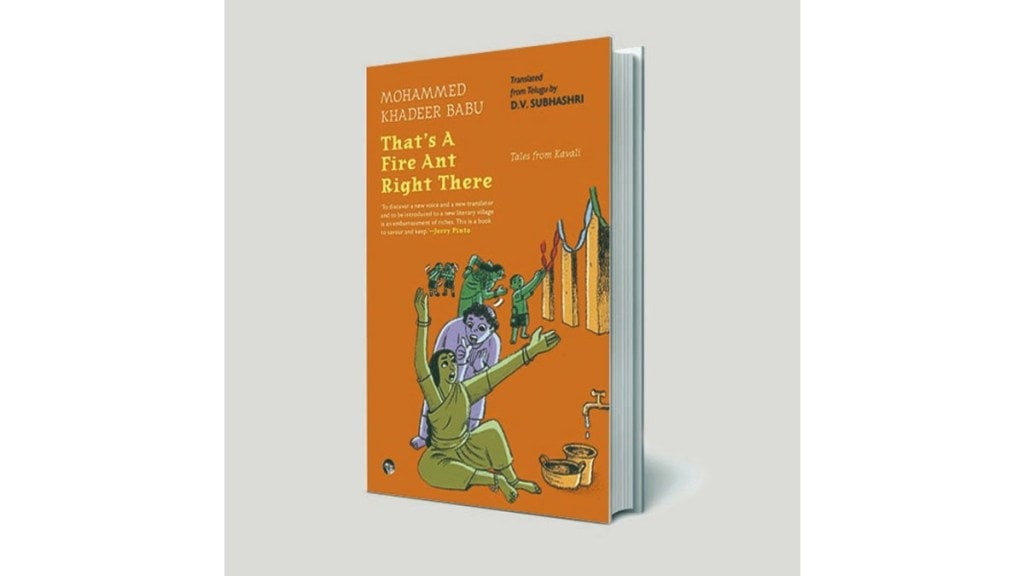
Telugu writer Mohammed Khadeer Babu swears his literary allegiance to a small town in Andhra Pradesh. It is Babu’s home town, called Kavali. Nearly a decade ago, he published a bouquet of stories about Kavali in Telugu. Babu’s tales about his fascinating town are now available in an English translation, titled That’s a Fire Ant Right Right There.
Divided into two parts, to equally share the author’s sentiments for his family and friends, the collection of a whopping 50 short stories from his childhood narrates life in a coastal town in the ’90s when the country was slowly beginning to make forceful new changes in the economic, political and social milieu. Babu tells tales of his home and around in a straightforward manner. The home is that of an ordinary Muslim family. The father is an electrician, the mother, a homemaker. They have four children. The father’s mother completes the family. The ordinariness of an Indian family is always complicated like that of the country. Babu’s stories confirm that it doesn’t matter whether the family is Muslim or Hindu, Sikh or Christian. It is still complicated.
Beyond the Surface
The ordinary and the complex feed into each other like the mouthwatering rice dish in Babu’s short story, The Case of the Vanishing Palav Chunks on Eid. His narrative skills spring from the tip of a stick to beat a character with the good-natured banter that is a recurring theme of his fun-filled rainbow banner. In this case, it is his father, who prises out the right of eating the palav first during Ramzan from his family. That is because he fills the tiffin carrier with the rice dish every time the family prepares to feast, for transporting it to Pendem Ravi, Palavenkareddy and Subbareddy, his friends in Kavali. “Thanks to my father, not a single Ramzan did we have the good fortune of being the first to eat the palav,” writes Babu.
Tribute to Resilience
In My Dadima, His Nanamma and a Bamma in Between, the often unacknowledged stewardship of struggling families by their women in the face of suffocating patriarchy comes to the fore. Dadima is Babu’s grandmother, Nanamma is his friend Ketireddy Sridharreddy’s grandmother who raised her teenage son after her husband’s untimely death, and Bamma, his neighbour Murali’s grandmother who never forgot to give Babu “a puppuchekka (a popular fried snack) or two” to eat even when she was busy.
My Mother the Sinner reveals the secret behind the author’s mother suddenly falling ill as the time for fasting approaches in the month of Ramzan. “Do you see, ma,… her cunning ploys? The month of Ramzan is starting in two days and she’s already begun with her acting. All this is only to skip the Roza fasting, no?” Babu’s father tells his mother. The complaint soon begins an examination of each other’s ability to observe or skip fasting. Babu’s brother is keen to observe Roza because he sees the benefit of breaking the fast by eating pomegranates, watermelons, grapes, payasam and ambali porridge at the mosque for iftar. “I will make mincemeat of you, haram-my-son, even if you think of it,” warns his mother. “You want to fast in these burning summer days and do what? Kill yourself? It becomes apparent who holds the family together in good times and bad times and in between… its women.”
That’s a Fire Ant Right Right There pays tribute to the unswerving spirit of its dominant characters whose reward for selflessness is camaraderie rather than camouflaged gains. “Kavali, Kavali, Kavali, three times. Those were his last words,” reads a note from the author at the beginning of the book, which refers to his father’s death nearly three decades ago.
“My father didn’t care about gathering assets while he was alive. He gathered friends,” continues the note. Bengaluru-based writer and translator DV Subhashri, who translated the tales into English, brings Kavali and its culture alive by retaining the original Urdu and English words. Through Kavali, Babu builds another Malgudi for his readers, only it is real.
Faizal Khan is a freelancer