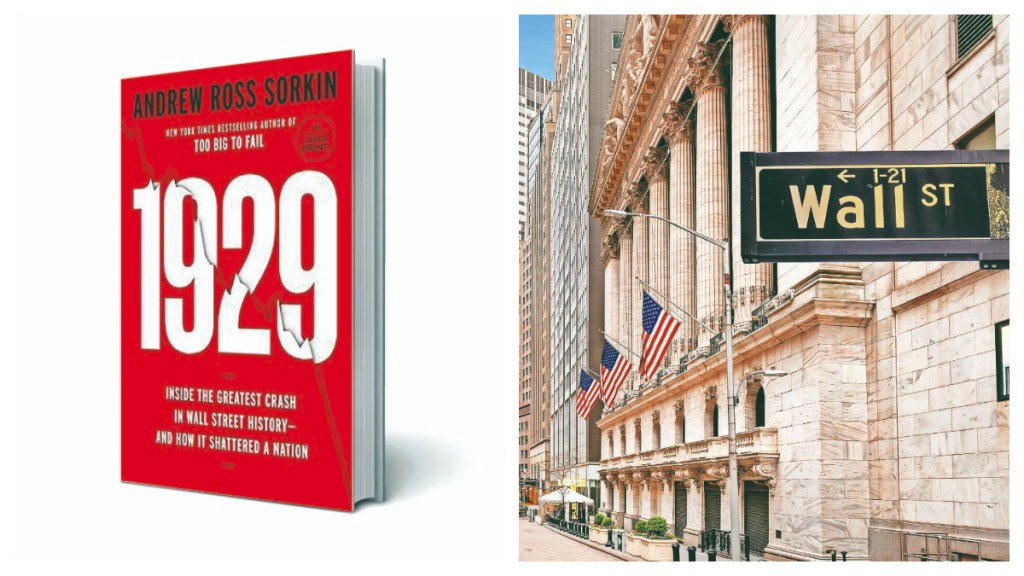
By Srinath Sridharan
There are moments in financial history that refuse to remain historical. They return not as anniversaries or archival curiosities, but as behavioural patterns that reappear whenever confidence outpaces caution. The crash of 1929 is one such moment. Nearly a century later, it continues to shape how markets are regulated, how risk is misunderstood, and how power behaves when intoxicated by prosperity. In 1929, Sorkin does not simply retell a famous market collapse. He examines the mindset that made it possible, and in doing so, raises uncomfortable questions about whether modern finance is any wiser than it was then.
This is a book about belief. Belief that markets self-correct. Belief that leverage is innovation. Belief that good times can be engineered to last forever. Sorkin takes readers into the late 1920s, an era when America was convinced it had discovered a new economic rhythm. Credit was abundant. Speculation was normalised. Regulation was viewed as an obstacle to progress. The stock market was no longer a venue for capital allocation. It had become the emotional centre of national optimism. Participation was framed as patriotism. Scepticism was dismissed as timidity.
Read FE 2026 Money Playbook: Your Ultimate Investment Guide for the new year
Sorkin captures this mood with precision and restraint. He shows how easy credit and minimal oversight allowed a financial ecosystem to flourish that rewarded speed, secrecy and scale. Stock pools—legal yet deeply manipulative— enabled powerful financiers to accumulate shares quietly, inflate prices artificially and exit profitably while drawing small investors into the illusion of rising wealth. Market opacity was a feature.
The book’s narrative spine is its cast of characters. Bankers, lawmakers, financiers, celebrities and statesmen dominate the stage. Charles Mitchell, whose aggressive credit expansion came to symbolise excess. Senator Carter Glass, architect of landmark banking reform, yet ambivalent about key elements of his own legislation. Even cultural figures like Groucho Marx and Winston Churchill, drawn into Wall Street’s gravitational pull and humbled by it. These characters are shown as complex, ambitious and often contradictory, capable of both insight and blindness. Reading this book is like reading a story book—easy and smooth.
Some readers may wish for more space devoted to ordinary Americans whose lives were devastated by the crash and its aftermath. Farmers ruined by collapsing prices. Families displaced by unemployment. Millions pushed into hunger and insecurity. Sorkin largely leaves these voices in the background. This is not a failure of empathy so much as a narrative choice. His focus is on power, because it is power that shapes systems, delays accountability and sets the conditions for catastrophe.
What elevates 1929 beyond familiar accounts is the depth and seriousness of its research. Sorkin draws on diaries, weather reports, architectural records, private papers and an extraordinary range of newspapers to reconstruct the era in fine detail. He dismantles popular myths along the way.
The crash did not immediately trigger the Great Depression. Many contemporaries believed recovery was imminent. The most prominent news story of 1929 was not the market collapse but an expedition to the South Pole. Even the enduring image of brokers leaping from windows turns out to be largely fictional. Reality, as Sorkin shows, was slower, more complex and ultimately more destructive.
The book is particularly strong on inequality. The 1920s were marked by a sharp bifurcation of American society. Technological change disrupted agriculture while urban wealth surged. Credit fuelled consumption but masked fragility. Wall Street wealth became culturally detached from the lives of most citizens. The market’s rise was celebrated as national success even as its foundations narrowed dangerously. This dislocation between financial elites and the broader economy becomes one of the book’s most resonant themes.
When the system finally broke, the consequences extended far beyond the trading floor. Banks failed by the thousands. Trust evaporated. Unemployment soared. What began as a financial crisis metastasised into a social and political one. Sorkin follows the story into Washington, where attempts to hold Wall Street accountable collided with institutional hesitation and ideological resistance. Policy responses lagged. Protectionist measures such as the Smoot Hawley Tariff Act deepened global distress. The crash, he makes clear, did not act alone, but it exposed a system already weakened by denial.
Readers familiar with Sorkin’s earlier work, Too Big to Fail, will recognise his long standing fascination with moments when complex systems fail under the weight of their own arrogance. His background as a financial journalist, founder of DealBook and chronicler of modern capitalism, gives him an instinctive feel for how power speaks, evades and justifies itself. That sensibility serves this historical narrative well. The book reads not like distant history, but like a case study whose relevance refuses to fade.
What gives 1929 its enduring force is how contemporary it feels without ever straining for relevance. Sorkin does not draw crude parallels, yet the echoes are unmistakable. Easy credit. Novel financial instruments. Regulatory blind spots. Concentrated power. The seductive belief that markets have evolved beyond old risks. His observation that no matter how many warnings are issued, people will always find new ways to believe that prosperity is permanent feels more like present tense diagnosis.
This is, at its core, a book about human behaviour. About greed recast as sophistication. About fear disguised as confidence. About how intelligence and experience do not immunise against collective folly. Sorkin trusts his readers enough to let the evidence speak. He empowers them to decide whether today’s financial world is genuinely different or merely repeating old patterns with new tools.
For business leaders, investors, policymakers and anyone working in finance, financial services or economics, 1929 is essential reading. It should remind us that progress, inclusion and regulation often coexist with deeply old human instincts, and that few lessons about risk and behaviour have truly been learnt, not even by the financial sector or the supposedly innovative technology evangelists who package speculation, including crypto, as comfort food. If there is any comfort to be found, it lies in the fact that Indian financial regulators have, so far, remained far more conservative than the market participants and moods they are tasked with containing. This is one of those heavy-to-hold books that quietly builds forearm strength, proving that financial history can be physically demanding too. It is not friendly to crowded commutes or casual, one handed reading. You will need a table, time and perhaps the occasional pause to introspect. But the inconvenience feels appropriate. Some histories demand to be felt in the hands as well as the mind. In the end, 1929 is a reminder that financial crises are also about choices, incentives and the enduring illusions we build around growth. Read it not only to understand the past, but to recognise how easily the same story can begin again.