



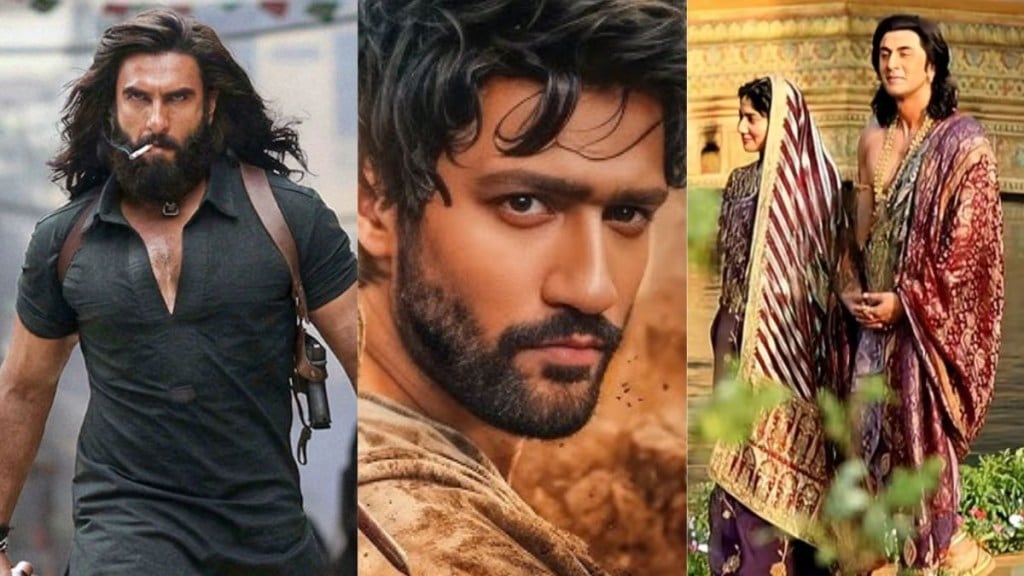
Even as the Dhurandhar frenzy is on, a buzz is already building up about a sequel to the spy actioner, as is being revealed in the post-credit scene of the film. ‘Dhurandhar to be continued,’ reads the title card, followed by the word ‘Revenge’ and a release date, March 19, 2026. The instant sequel strategy, involving back-to-back production, clearly attempts to create a franchise-building model and to capitalise on the first film’s momentum, which, in Dhurandhar’s case, helped mint Rs 27 crore on its opening day, becoming actor Ranveer Singh’s best opener yet.
The film, directed by Aditya Dhar, continues to perform strongly at the box office, becoming the highest grossing Indian film of 2025 and entering the prestigious Rs 1,000-crore club at the global box office. The film has also secured a massive Rs 130-crore digital distribution deal with OTT major Netflix for both its chapters.
The year that’s about to go by was undoubtedly all about sequels, the film industry’s most dependable commercial cushion, with filmmakers leaning into them for guaranteed plots and safe franchises. In a highly competitive market driven by box-office collections, critical reception, and audience footfalls, sequels capitalise on pre-built brand value and franchise engine, ensuring instant recognition, built-in audience curiosity, and guaranteed strong openings.
Read FE 2026 Money Playbook: Your Ultimate Investment Guide for the new year
War 2, released on August 14, for instance, collected Rs 50 crore on its opening day. Though a box-office failure, the action-thriller film—the sixth instalment in the YRF Spy Universe and sequel to the 2019 film War—emerged as the sixth highest-grossing Indian film of 2025.
Similarly, Housefull 5, a comedy thriller film marking the fifth instalment of the Housefull franchise, was released on June 6, and had a commercially average run, grossing Rs 300 crore at the box office. Despite this, it emerged as the eighth highest-grossing Hindi film of 2025.
The list goes on. Raid 2, a sequel to Raid (2018) and starring Ajay Devgn, Riteish Deshmukh and Vaani Kapoor along with a special appearance by Tamannaah Bhatia, grossed about Rs 250 crore worldwide since its release on May 1 and is now the the ninth-highest-grossing Hindi film of 2025. Similarly, Sitaare Zameen Par, a spiritual successor to Aamir Khan’s 2007 film Taare Zameen Par, grossed about Rs 265 crore worldwide and emerged as the sixth highest-grossing Hindi film of 2025. It was released on June 20.
Fighting for survival
Even though several sequels in the past, such as Tanu Weds Manu Returns (2015), Dhoom 2 (2006), Krrish series (2006, 2013), Lage Raho Munna Bhai (2006), Baahubali 2 (2017) and KGF 2 (2022), became massive pan-Indian blockbusters, a pre-built brand value and franchise engine strategy is not enough to sustain the success as most sequels fail to meet box-office expectations. Relying solely on the brand is a deeply flawed strategy, feel industry experts.
Take for instance, Mastiii 4 and Baaghi 4, both of which got released this year. Mastiii4 bombed at the box office, grossing Rs 15 crore worldwide and becoming the lowest-grossing film in the Masti film series. The film’s day 1 collections (Rs 2.75 crore) were significantly low compared to its previous installments, especially the super-hit Grand Masti (2013) (Rs 12.51 cr). Critics call it a tired franchise relying on loud, lazy, and cringe-worthy humour, highlighting the issue of sequels failing due to a lack of original content.
Baaghi 4 met a similar fate, amassing Rs 66 crore worldwide at the box office and becoming the lowest grossing film in the Baaghi film series. The film is another example of a sequel with poor script and tired humour. Legal comedy Jolly LLB 3, which released on September 19, also underperformed, failing to meet the benchmark set by its predecessors.
Film critic and trade analyst Taran Adarsh attributes the failure of recent sequels to a lack of conviction and quality. He states that franchises, especially those reaching a fourth instalment, are “bound to misfire” if they don’t aim to surpass the earlier, successful parts. “A sequel must have genuine excitement stemming from the original’s success, rather than being made just for the heck of it to capitalise on market sentiments,” says Adarsh, who cites the failures of Mastiii 4, War 2, Sons of Sardaar 2, and De De Pyaar De 2 as examples.
He emphasises that the audience is smart and quick to reject a recycled plot despite a huge star cast like De De Pyaar De 2 and Son of Sardaar 2. “The rejection of these films serves as a crucial learning lesson for filmmakers. You can’t really put out anything in the market and expect people to come in,” adds Adarsh.
Even putting in a multi-starrer film does not seem to work. This year’s major disappointments include War 2, Housefull 5, Son of Sardaar 2, Baaghi 4, and Mastiii 4, proving that even Bollywood’s biggest stars (Hrithik Roshan, Akshay Kumar, Ajay Devgn) cannot save a weakly written film. The collective rejection of these sequels has made it clear to the industry that strong, original storytelling is essential for franchise survival, not just star power or a familiar title.
Housefull 5 had a massive worldwide gross of over Rs 300 crore. However, its reported budget was extremely high (approximately Rs 250 crore). Due to its massive production cost, analysts classified its performance as ‘average’ because the revenue did not generate the significant profits expected from a clean hit, especially for distributors. At the same time, it was a major crowd-pleaser that capitalised on the franchise name, proving the initial strength of the sequel strategy, but ultimately falling short of a hit status.
Another case in point is the Golmaal franchise. For any successful sequel, it is clear that the story is paramount. But what works in the favour of a sequel is the characters are already known. One doesn’t have to establish the characters. The challenge for actors is to make sure to maintain the same level of authenticity of that character and the same level of energy. Audiences like the characters, and they come with some expectations from the sequel to perform better than the first but they will love it only when they have a great story or reason to back it.
When actor-director Shreyas Talpade joined the franchise as Laxman in 2008’s Golmaal Returns, replacing Sharman Joshi, and continued through Golmaal 3 (2010) and Golmaal Again (2017), he describes his entry, after films like Iqbal and Dor, as a ‘big opportunity,’ acknowledging the pressure of the mass entertainer franchise.
“Sharman (Joshi) had done a fantastic job in the first one. I either had to be on a par or at least cross it,” Talpade tells FE, as he credits the team’s support for his performance and freedom to improvise in the comedy, else “I could have failed in my attempt as a comic actor.” He also cites a key line from the film Golmaal Again, which made it a successful franchise.
“‘No logic, only magic,’ said actor Tabu in the film, where only the five main characters can see the ghost, no one else. This one question even the audience had in their mind, and people will believe to a certain extent, considering those who believe in God, and that explanation worked for the sequel, connecting the viewers with the film,” says Talpade, who has also worked in Housefull 5 and Baaghi 4, and the upcoming title, Welcome to the Jungle, the third installment of the Welcome franchise, which has been directed by Ahmed Khan and is expected to be released in 2026.
Play, rewind
So, why do most sequels fail? “Ninety-eight per cent of sequels fail. The makers try to improve the original, and in doing so, they destroy its soul,” director and screenwriter Priyadarshan, who doesn’t believe in making sequels, tells FE.
The maker of cult blockbusters like Hera Pheri (2000) and Bhool Bhulaiyaa (2007) reveals that Phir Hera Pheri, a sequel to Hera Pheri directed by Neeraj Vora, was a “cheap replica”.
“Actor Paresh Rawal himself told him that he hated working on the sequel. But because of the hype of the first film, people went to see the second film. Now if I make the third part, it will certainly die. Unless and until I land up with a good script or a better story than the original, I will never ever attempt it.”
Hera Pheri was a word-for-word remake of the Malayalam cult film, Ramji Rao Speaking, which itself is inspired from the English film, See the Man Run. “I didn’t change anything. Just the dialogues, the ambience. The soul must remain intact. When you remake a south film into a north film, it must look north. Culture matters, ambience too,” says the veteran director.]
Citing Manichitrathazhu and its Hindi remake Bhool Bhulaiyaa as examples, where cultural transformation, not narrative alteration, made the film successful, he says, “Manichitrathazhu is south based while Bhool Bhulaiyaa has Manjulika from Bengal as the ghost performing to Bharatanatyam with Odissi elements, making it look like a genuine north Indian film.”
Experts observe that over the past six decades it has been the similar pattern for movies to succeed at the box office. “Every year 10% are hit, 15% cover cost of films and 75% flop,” says Ramesh Taurani, executive director, Tips Music, and MD, Tips Films, who is working on the script of Soldier 2, confirmed to FE that a sequel to the popular 1998 Bollywood film Soldier is “work in progress”.
While franchise films remain major traffic drivers for predictability and scale, original stories will continue to break through as long as they are well-made and well-marketed, says Taurani. “The first part of the sequel has a brand value, so the sequel does not need that recognition. But if a sequel as an individual film does not have a script, however big a brand it is, it can fail. We have to be extra cautious. Failures happen as individual films have encashed the name of the original one but the story wasn’t good. I’m cautious of the fact that the movie is good if the script works with overall casting,” he adds.
Films like Pushpa, KGF, Kantara and Bahubali have created the hype for the part 2 version in terms of the story and the content. Even Hollywood films like Mission Impossible and Jurassic Park have franchises but have been reinvented in terms of content, star cast, and stories.
But Karan Taurani, executive vice president of expert advisory firm Elara Capital, feels, “The success rate of franchises is high as they already have a recall with the audience. Also, the secret sauce is the relatability between part 1, 2 and 3. We have seen that in Pushpa 2, and Kantara, etc.”
Audience expectations have also changed. “They want to watch larger-than-life kind of films and only sequels can do justice with that. If they look at the likes of other genres like drama and comedy, we don’t see larger-than-life films being created in that genre. Action, crime, thriller have the hype to make larger-than-life films, so there is a demand for sequels in this category,” adds Karan Taurani.
“Some people just take the title and make it into a brand new space. A sequel is like a brand which is already established. The credibility and goodwill may work but there is a lot of homework that you will have to do to cater to the kind of audience that will watch the film,” says Talpade.
The key is to treat the sequel as an opportunity, not an obligation. “Filmmakers need to invest time in developing a story that feels necessary, one that adds value to the world rather than repeating what worked earlier. It must have its own identity. When the focus shifts from recreating moments to crafting new ones, the film naturally finds its strength,” says Rahul Puri, MD of production house Mukta Arts that has control over approximately 100 screens through its subsidiary companies, including Mukta A2 Cinemas, Mukta A2 Multiplex WLL in Bahrain.
For any sequel to work, Puri feels the audience must feel that the world and characters they loved have genuinely moved forward. “That means retaining the essence of the original while offering fresh conflicts, new emotional beats, and a clear creative vision. Authentic character growth, compelling storytelling, and high production values all play crucial roles,” adds Puri.
Across Hindi and south films—when a sequel invests in better writing, deeper character arcs and a stronger emotional core, the audience responds, a trend that Bhuvanesh Mendiratta, MD, Miraj Cinemas, a multiplex arm of Miraj Group, operating 248 screens across 71 locations in 49 cities in 16 states, has seen.
Mendiratta says, “When the pressure to scale up replaces the need for a solid story, it shows immediately in the weekend drop. War 2 and Baaghi 4, for example, showed sharper-than-expected Saturday declines in some circuits. Retaining the creative spine of the original, giving the script enough time and keeping the universe consistent help filmmakers raise the bar instead of repeating beats from earlier parts. When this balance works, sequels often deliver 8-12% better weekend holds at the cinema.”
Fast forward
The new year is going to be even more sequel-heavy. Hindi cinema has multiple returning IPs—Border 2, Mardaani 3, Dhamaal 4, Awarapan 2, and Welcome to Jungle, to name a few. The south continues to expand its big Telugu, Tamil and Malayalam universes with G2, a sequel to Goodachari, Drishyam 3, and Jailer 2. Their Hindi-dubbed versions have built a steady fanbase too. Rajkumar Hirani has locked the scripts of 3 Idiots 2, and the film is set to go on floors in 2026 with Aamir Khan, Kareena Kapoor Khan, R Madhavan and Sharman Joshi joining the star cast again.
Director Nitesh Tiwari’s Ramayana: Part 2 will be released in 2027 after the Part 1, which is aiming for a Diwali 2026 release. As Bhool Bhulaiyaa 3 in 2024 became the second-highest-grossing Hindi film of the year, and the biggest hit of actor Kartik Aryan’s career, earning Rs 421 crore worldwide, filmmaker Anees Bazmee revealed that production of the fourth instalment has started. “If the content stays strong, 2026 could be one of the biggest years for multi-film worlds and long-form franchises,” adds Mendiratta.
“With audience tastes evolving and the theatrical experience becoming more event-driven, sequels are simply aligning with how people choose entertainment today,” says Puri.
“India’s film audience is expanding, and with it, the appetite for ambitious, long-form storytelling. Sequels and franchises offer continuity, while original films bring novelty and innovation. As the industry strengthens its writing culture and embraces diverse genres, we will see a healthy mix of both,” adds Puri.