



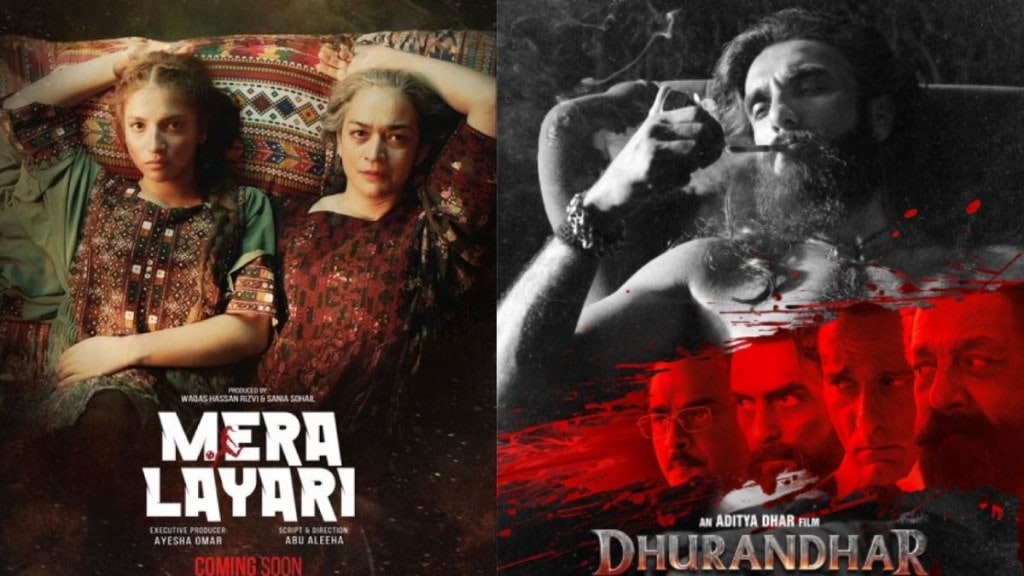
Ranveer Singh’s Dhurandhar has grossed nearly Rs 600 crore at the worldwide box office. Shattering multiple records, it became one of the biggest Bollywood releases of 2025. Surpassing the biggest romantic drama, Saiyaara, it opened to Rs 28 crore and maintained its trailblazing box office report even in its second week. However, it faced a ban in six Gulf countries for its alleged ‘anti-Pakistan’ sentiments during the first week of its release.
Days later, the Sindh Information Department, as per an Indian Express report, announced its own film ‘Mera Layari’, a response to Ranveer Singh’s spy thriller. Sharing on social media, their handle read, “Misrepresentation cannot erase reality. Lyari stands for culture, peace, and resilience—not violence. While Dhurandhar spreads propaganda, Mera Lyari will soon tell the authentic story of pride and prosperity.” Pakistan’s reply to Dhurandhar is set to release in January 2026, months ahead of Dhurandhar’s sequel, scheduled for March 2026.
Dhurandhar’s view on Lyari
Lyari, a small town in Pakistan, is portrayed as a violent neighbourhood. A regular for gang wars, racketeering, police raids, drug trafficking, arms race, and terrorism, Ranveer Singh infiltrates some of these operations under the alias Humza Ali Mazari. Finding his way into Rahman Dakait’s gang, he officially enters as Akshaye Khanna’s sidekick. The Aditya Dhar directorial describes Lyari as one of the most dangerous cities in Pakistan.
Also shown as Rahman Dakait’s birthplace, Lyari birthed him to a drug peddler father, Mohammad and his second wife, Khadija. Starting young in the crime world, he became one of the biggest goons in the area.
Lyari’s history
As per several historic reports, Lyari is Karachi’s oldest inhabited area. Often referred to as the ‘Mother of Karachi’, the name is derived from the Sindhi word ‘lyar’ – a tree that once grew along the banks of the Lyari River. The land of fishermen, the area was largely Hindu before partition.
Lyari was one of the first to kickstart a vibrant local scene, called ‘Lyari Disco’. Eventually, in the 1960s, the land grew as a centre of drug trafficking and weapon trade after the Soviet-Afghan war.