



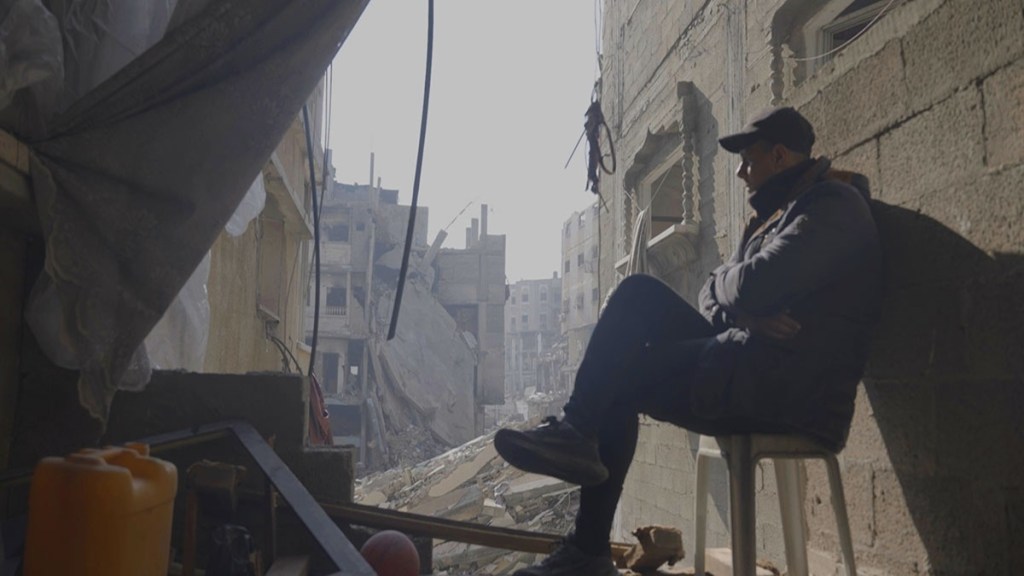
Standing in front of a mound of debris from buildings bombed by the Israeli Defence Forces in Gaza, Hana Eleiwa is trying hard to explain her existence as an artist. “Whether they are beautiful or difficult, we have to tell our stories,” says the Palestinian filmmaker, who searched through the ruins to discover a subject that speaks of joy for her movie.
Eleiwa’s short film, No, in which a gaggle of children sings songs in the middle of war, is part of an art exhibition, Intaj: From Ground Zero Experience, in Doha, Qatar that aims to capture life under the constant threat of death and destruction. An artistic response to the war in Gaza that has killed 43,846 people, according to the Hamas-run Gaza health ministry, and displaced two million more, the exhibition assembles 22 short films made during the war.
Part narrative and part experimental, the short films use such mediums as puppetry, animation, drawings, documentary and fiction to portray the grim reality in Gaza. “As much as 95% of my city is in ruins,” says Reema Mahmoud about Khan Younis in Southern Gaza. “This war feels like annihilation,” adds Mahmoud, whose short film, Selfies, describes her life as a refugee in her own land in a letter to an unknown friend. Her father and 17 members of their family were killed when their home was destroyed in a bomb attack by the Israeli military. “The only news everyone is waiting for is ceasefire.”
Eleiwa’s No and Selfies by Mahmoud were first gathered in a collected work, called From Ground Zero: The Untold Story From Gaza, by 22 Palestinian filmmakers living in Gaza that premiered at the Amman International Film Festival in Jordan in July this year.
“We decided to show all the 22 short films in an exhibition with an additional element of each director narrating their experience of making the film,” says Khalifa Abdulla Al-Thani, curator of Intaj: From Ground Zero Experience.
A pop-up exhibition at the redeveloped Msheireb area in downtown Doha, Intaj exudes a minimalist exhibition philosophy with two dark rooms having symmetrical wall-to-wall screens playing the 22 short films and experience of the filmmakers in a loop. The large screens lie close to the viewers to create an intimate setting while the minimalism reflects respect for the filmmaker and the viewer. “These filmmakers made something out of nothing,” says Al-Thani, a Doha-based filmmaker-curator.
“These short films are not just stories of survival but represent the enduring strength of artistic expression even in the most challenging circumstances,” says Fatma Hassan Alremaihi, Doha Film Institute’s CEO and festival director of Ajyal Film Festival, held in Doha during November 16-23, which mounted the Intaj exhibition as part of its official programme.
Produced by celebrated Palestinian director Rashid Masharawi and co-produced among others by the Sharjah Art Foundation with support from the Doha Film Institute and Royal Film Commission of Jordan, the 112-minute film of 22 short films stretches the limits of artistic imagination, labour and creativity. In Out of Frame, one of its short films directed by Neda’a Abu Hassnah, the filmmaker, also an artist, hunts sculptures made by her for an exhibition at a university that was destroyed in an Israeli air strike. “The war has spared no one,” says Hassnah.
Everything Is Fine, a four-minute film by Nidal Damo, tells the story of a stand-up comedian in Gaza who wants to stage his acts suddenly realising there is no performance stronger than staying alive. In Flashback by Islam Al Zeriei, a young girl decides to wear headphones to escape the constant buzzing of Israeli military drones flying over her house. The Teacher by Tamer Nijim shows the springing up of a mobile phone charging industry in Gaza in the absence of electricity while A School Day by Ahmed Al-Danaf is about a school student who wakes up every morning to go to a cemetery to study at the grave of his teacher killed in an Israeli attack in January this year.
Palestine’s official entry for the Best International Feature Film Oscar for this year, From Ground Zero also features the heart-rending tale of a young man buried alive thrice under the debris in 24 hours. He was rescued by relief workers each time as shown in the seven-minute short film, 24 Hours by Alaa Damo. Recycling by Rahab Khamis shows a single mother recycling a bucket of scant water in kitchen, bathroom, laundry, toilet and even a flower pot.
Gaza-based filmmaker Etimad Washah, who began shooting her short film, Taxi Wanissa, named after a donkey-driven cart, stopped the production after hearing news of the death of her brother and his family in Israeli bombing. In the film, the donkey, called Wanissa, wades through crowded streets carrying food parcels undaunted by the roars of the Israeli planes above. “I was just starting, but couldn’t continue filming,” says Washah in a testimony offered to end her short film.
“I want to make a feature film in Gaza, if I am alive,” says television actor Aws Al-Banna, who directed Jade and Natalie, a short film about a young couple who were planning their wedding and even the names of their children when the war in Gaza took their lives. The war, which began in October last year following the Israeli invasion of Hamas that killed 1,200 people, has also spread to Lebanon displacing more than a million people. Hamas also took 250 Israelis hostages during the invasion on October 7.
From Ground Zero: The Untold Stories From Gaza, which was withdrawn from the Dharamshala International Film Festival early this month after it failed to receive central government permission for screening, is among several Palestinian movies made this year on the war with no signs of a ceasefire. Intaj: From Ground Zero Experience is the second exhibition on Palestine in Doha, which has a sizeable Palestinian refugee population, in the last three years. Twenty-seven local artists participated in We Will Not Leave, an exhibition at the 2021 Ajyal Film Festival in downtown Msheireb, to express solidarity with the Palestinian people.
Faizal Khan is a freelancer.