



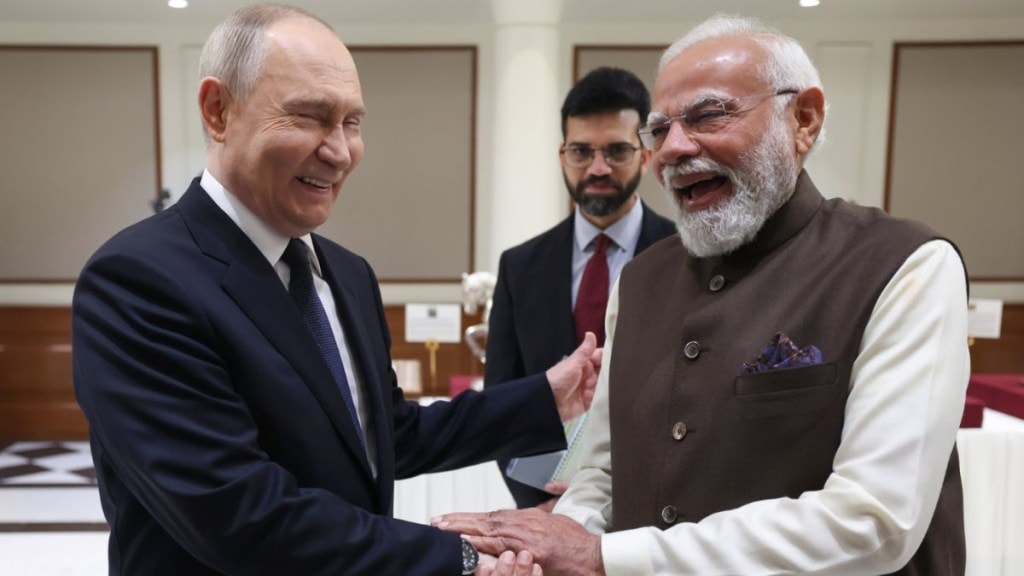
Russian President Vladimir Putin’s two-day visit to India has drawn global attention, especially from the US and Europe, due to mounting pressure on New Delhi to reduce its energy trade with Moscow. But during the joint press meet, the two leaders made their stance unmistakably firm, energy ties remain strong, and the partnership is future-focused. Here are some major takeaways from the presser:
Energy cooperation
Russian President assured India of reliable and continuous fuel supply despite geopolitical headwinds. “Russia is a reliable supplier of oil, gas, coal, and everything that is required for the development of India’s energy,” Putin said, adding, “We are ready to continue uninterrupted shipments of fuel for the fast growing Indian economy.”
This commitment comes as some Indian refiners scale back purchases to avoid secondary sanctions. Putin said he is confident about keeping the current bilateral trade “at more than $60bn” and ramping it up to $100 billion in the coming years.
Nuclear expansion
Putin explained ongoing collaboration at the Kudankulam Nuclear Power Plant, India’s largest such project: two reactors are operational and four more are under construction. He said the project will greatly strengthen India’s supply of clean energy. “We could also talk about cooperation in construction of small modular nuclear reactors and floating nuclear power plants,” he added.
He also announced a large Russian–Indian pharmaceutical facility in the Kaluga region to produce advanced anti-tumour drugs using Indian technology. Russian companies will also increase participation in manufacturing under the Make in India initiative.
Vision 2030
Prime Minister Narendra Modi and Putin also put out an ambitious Economic Cooperation Programme till 203 at the 23rd India–Russia Annual Summit at Hyderabad House. Modi said, “We agreed on India-Russia economic cooperation programme till 2030. Taking India-Russia economic partnership to new heights is our common priority.”
Building secure supply chains is a major goal, “Energy security has been a strong pillar of our partnership, and we will continue this win-win cooperation. Our collaboration in civil nuclear energy has spanned decades and contributed to clean energy. Our cooperation in critical minerals is essential for maintaining a diverse and reliable global supply chain,” he said.
Both sides also reaffirmed progress on connectivity projects such as the International North–South Transport Corridor, the Northern Sea Route, and the Chennai–Vladivostok Maritime Corridor. “Building connectivity between both countries is our priority. We will start working on the International North–South Transport Corridor, the Northern Sea Route, and the Chennai–Vladivostok Maritime Corridor with new zest,” said PM Modi.
Russia Today (RT) will officially launch in India. Putin said this will help Indians learn more about Russia through “objective information.” Modi announced two new Indian consulates in Russia and two new tourist visa schemes for Russian citizens to boost manpower mobility and people-to-people contacts. PTI and Russian agency TASS signed a cooperation agreement to enhance exchange of news and content, strengthening media collaboration.
Putin noted that cultural and educational ties continue to grow stronger, describing the evolving partnership as “independent, strategic and future-focused.”
Ukraine conflict
Modi said India has “stood for peace since the beginning” and welcomed ongoing diplomatic efforts. “We have been holding discussions following the start of the Ukraine conflict. As a close friend, you have been regularly apprising us on the situation. I think trust is a major strength. We all should find the path of peace. I am aware of the latest efforts and I am confident that the world will turn to peace,” he added.
Joint stand against terrorism
On security, Modi reaffirmed a unified stance with Russia: “India and Russia have long supported each other, and worked shoulder to shoulder in the fight against terrorism,” he said. “Whether it is the terrorist attack in Pahalgam or the cowardly strike at the Crocus City Hall, the root cause of all these incidents is the same.”
Putin reiterated that both countries pursue independent foreign policies and cooperate through BRICS to promote a “more just” and “multi-polar” world.
India and Russia released a joint statement agreeing to realign defence cooperation toward India’s self-reliance goals, “In response to India’s aspirations for self-reliance, the partnership is currently being reoriented toward joint research and development, as well as the production of advanced defence platforms.”
Modi summed up the relationship, noting decades of stability despite shifting geopolitics. He said the India–Russia partnership has remained steady “like a pole star.”
Putin expressed confidence that his visit, and the agreements signed, would deepen cooperation across energy, economy, trade, nuclear technology, connectivity, culture and foreign policy.