



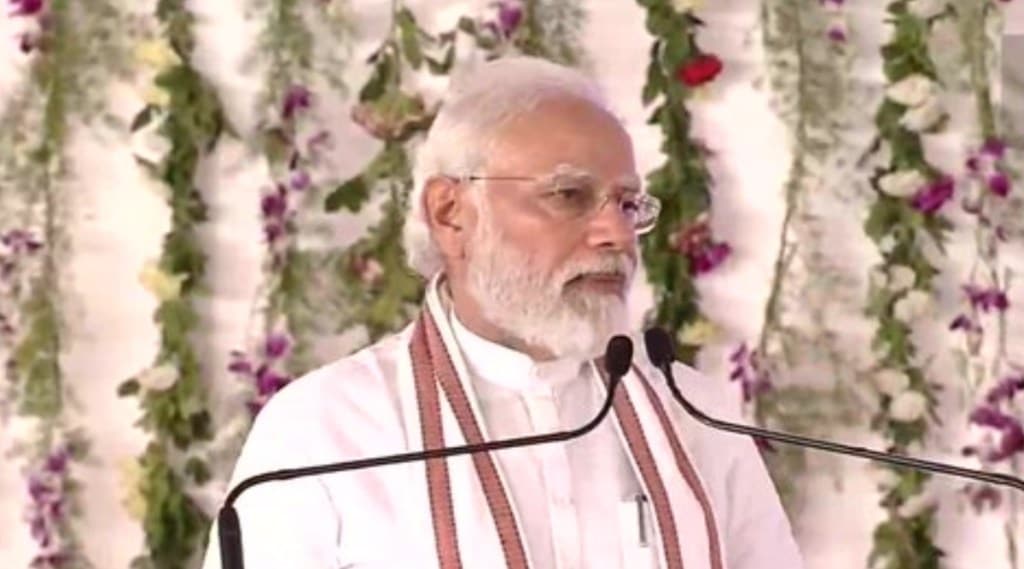
PM Narendra Modi in Jammu and Kashmir Highlights: Prime Minister Narendra Modi on Sunday visited Jammu and Kashmir — his first official visit after the BJP-led central government scrapped Article 370, which conferred special status to J&K, in August 2019. Modi was travelling there to participate in the celebration for the National Panchayati Raj Day and address ‘Gram Sabhas’ across the country, the Prime Minister’s Office (PMO) said in a statement. He also visited Palli Panchayat in Samba district. The Prime Minister addressed a gathering including more than 30,000 Panchayati Raj Institution (PRI) members of Jammu and Kashmir whereas PRIs from across the country will be connected virtually for the Prime Minister’s address.
Top business leaders from the UAE also accompanied the PM during the visit. The UAE firms are expected to propose investments amounting to over Rs 3,000 crore. A multi-tier security setup was put in place for Modi’s visit to Samba. An alert had been sounded along the border and a high degree of vigilance is being maintained at vital installations in J&K in view of the visit. “A multi-tier security setup has been put in place in Samba and adjoining areas as a part of foolproof security,” a senior official told PTI.
Here are the highlights of the mega event:
PM Modi J&K Visit Live Updates, PM Modi in Jammu Live News
When I speak about 'Ek Bharat, Shreshtha Bharat', our focus is on connectivity and bridging distances. Our aim is to provide all-weather connectivity to J&K: PM Modi addresses Gram Sabhas across the nation from Jammu - ANI
Be it democracy or development, today Jammu and Kashmir, is setting a new example. New dimensions of development have been created in Jammu and Kashmir in the last 2-3 years: PM Modi on National Panchayati Raj Day
PM Modi says that today is the day that will herald the beginning of development in the region.
PM Narendra Modi lays the foundation stones for the 850 MW Ratle Hydroelectric Project & 540 MW Kwar Hydroelectric Project to be constructed on the Chenab river in Kishtwar District
PM Narendra Modi receives a warm welcome at Palli village in Samba district.
With proposals worth Rs 38,082 crore, this is the largest-ever investment in the Jammu and Kashmir region in the last 75 years.
Located in Samba district, Palli is being hailed as India's first carbon-neutral panchayat. Local officials say that all its 340 houses are now getting solar power.
A suspected blast was reported in the Laliana village of Bishnah in Jammu. The blast occurred just 12 kilometres away from the area where PM Modi is scheduled to address a gathering today. The nature of the blast is being verified.
"Since the introduction of constitutional reforms with regards to J&K in August 2019, the government has been focused on bringing about wide-ranging reforms to substantially improve governance and enhance ease of living for the people of the region at an unprecedented pace… The projects being inaugurated and whose foundation stone is being laid in this visit will go a long way in facilitating provision of basic amenities, ensuring ease of mobility and development of infrastructure in the region": PMO
Top business leaders from the UAE will accompany the PM, underlining the backing of industrialists and investors from a leading Islamic block as the BJP government seeks to pitch a new phase for J&K post-Article 370. Besides, the PM’s address, from Samba bordering Pakistan, coincides with the National Panchayati Raj Day, and will see participation of members of rural local bodies from across the state as a projection of grassroots democracy in the state.
After abrogation of Article 370, the PM had briefly visited J&K to celebrate Diwali with armed forces in Nowshera district on November 4, 2021. This is his first visit since.
Modi will inaugurate the Banihal-Qazigund road tunnel, built at a cost of over Rs 3,100 crore. The 8.45-km-long tunnel will reduce the road distance between Banihal and Qazigund by 16 km, and reduce journey time by around one and a half hours.
It is a twin tube tunnel, one for each direction of travel, and the tubes are interconnected by a cross passage every 500 m for maintenance and emergency evacuation. The tunnel will help establish all-weather connection between Jammu and Kashmir, and bring the two regions closer, the PMO said.