



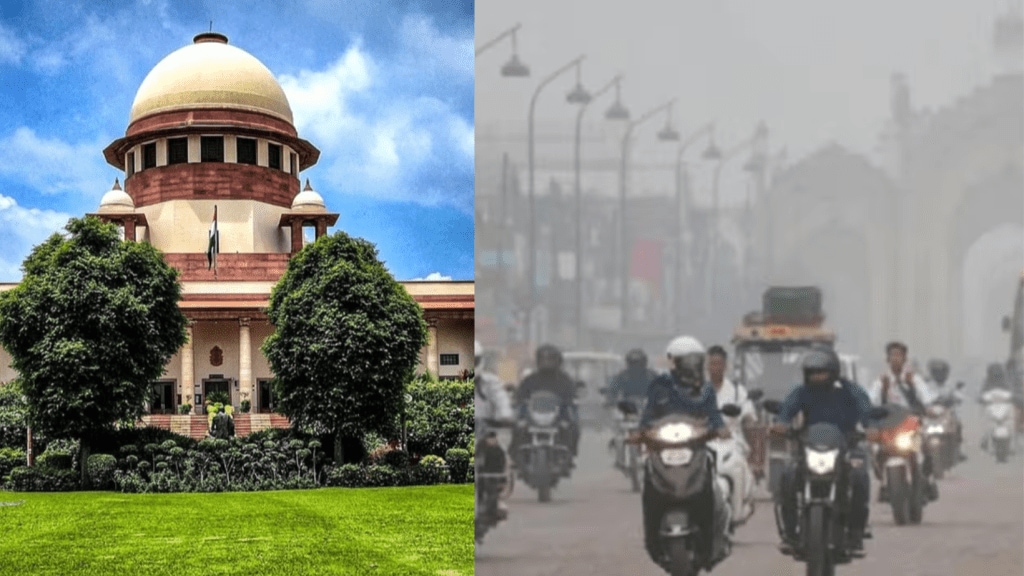
With Delhi’s air quality remaining in the ‘poor’ category at an average AQI of 293, the Supreme Court on Tuesday increased its scrutiny of the Commission for Air Quality Management (CAQM), criticising it for delays in identifying the causes of pollution. Hearing a batch of matters on Delhi’s air pollution, a bench led by Chief Justice of India Justice Surya Kant said expert bodies must first identify the reasons behind worsening air quality before proposing solutions. The court made it clear that it would not act as a “super expert” but would ensure expert-driven decisions are taken in a transparent and time-bound manner.
‘The reasons should be in the public domain’
The court directed CAQM to place its findings on the causes of Delhi’s air pollution in the public domain, stressing the need for transparency and accountability.
“The reasons should be in the public domain,” the CJI said, adding that people must know what expert bodies consider the primary contributors to pollution. The bench also said that once reasons are disclosed, public suggestions could be invited to strengthen credibility. Pulling up CAQM, the court explained that the body appeared to be “in no hurry” to either identify the causes of the deteriorating AQI or work towards long-term solutions.
Experts must be brought ‘under one umbrella’
The Supreme Court directed CAQM to shortlist domain experts and convene a meeting within two weeks to arrive at a considered, and if possible, unanimous opinion on the causes of air pollution. The court said CAQM is obligated to bring experts from relevant domains “under one umbrella” to determine why air quality is worsening. Warning against delays, the bench observed that inaction would lead to “further complications,” especially as Delhi faces the pollution crisis every year. “As an expert body, have you been able to find causes is the first question, finding solutions would be a second stage,” the CJI said.
Court flags construction, vehicles; cautions against blame game
During the hearing, the bench flagged construction activity and vehicular emissions as areas requiring expert assessment, and also acknowledged social realities. “There is a dire need for housing, so construction will go on. But if construction is causing a problem, what will be done?” the CJI asked, calling for estimated pollution contributions from each factor.
On vehicular pollution, the court noted it contributes nearly 40 per cent, but warned against simplistic solutions. “It’s easy to say buses and trucks cause pollution. If buses are stopped, how will the common man travel?” the bench said. The court also observed that farmers are often blamed disproportionately, explaining that during the pandemic, when stubble burning was high, Delhi still witnessed blue skies, stating the need for data-backed evaluation rather than selective attribution.
SC’s earlier hearing
Additional Solicitor General Aishwarya Bhati told the court that a status report could be filed on the issues raised, including the ECC toll issue, while seeking time on certain aspects. The Supreme Court, in an earlier hearing on December 17, had sharply criticised the handling of Delhi’s pollution, observing that ad-hoc and short-term measures such as blanket school closures and construction bans cannot replace a coordinated long-term policy response.
The bench of Chief Justice of India Surya Kant, Justices Joymalya Bagchi and Vipul M. Pancholi heard multiple applications relating to school closures, the impact on poor children, the livelihood of construction workers, and the role of toll plazas in worsening congestion and pollution.
Senior Advocate Menaka Guruswamy had flagged that shutting schools up to Class 5 led to learning loss and disruption of the mid-day meal scheme, disproportionately affecting poor children. Responding, the CJI said decisions on school closures are temporary policy matters and added that the court cannot be expected to decide whether commuting to school or staying at home poses a greater health risk.