



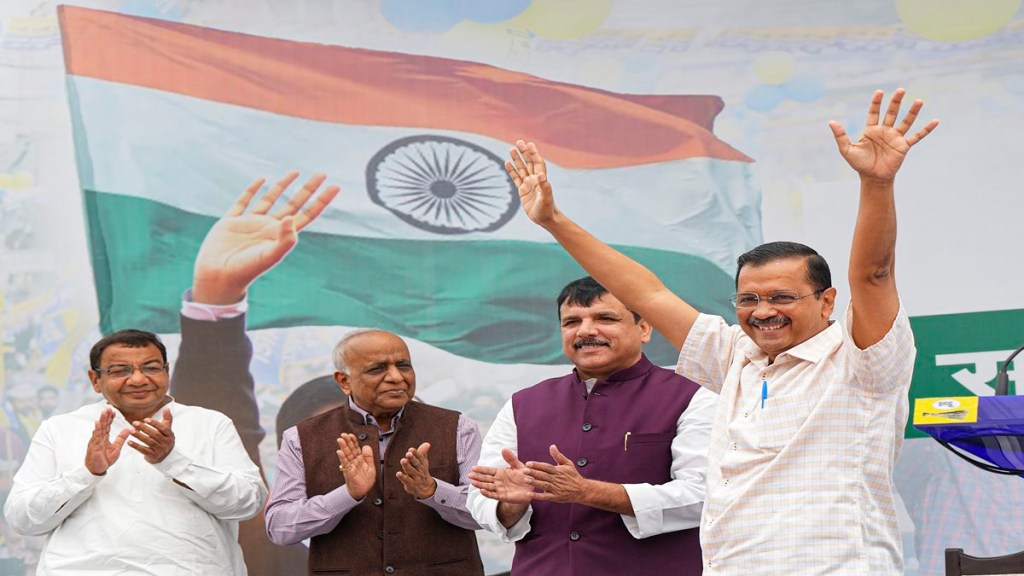
The Election Commission of India on Monday recognised the Aam Aadmi Party (AAP) as a national party while the All India Trinamool Congress (TMC), the Nationalist Congress Party (NCP) and the Communist Party of India (CPI) lost the coveted tag.
The poll panel registers various political outfits and recognises them as national and state or regional parties on the basis of their performance in the elections.
Who gained?
The election body granted AAP the national party status on the basis of its electoral performance in four states — Delhi, Goa, Punjab and Gujarat. AAP rules both Delhi and Punjab.
Who lost?
Trinamool Congress received the coveted tag in 2016 while the NCP in 2000 and the CPI was accorded the status in 1989.
For TMC, the tag was withdrawn due to the party’s poor performance in Goa, Tripura and Meghalaya; and for CPI due to its dismal results in West Bengal and Odisha polls. The NCP lost its state party status in Goa, Manipur and Meghalaya, as per the EC order.
What is the criteria for receiving national party status?
The conditions for being registered as a national or state party are specified under the Election Symbols (Reservation and Allotment) Order 1968.
To be recognised as a national party, a registered party has to fulfil any one of the following three conditions:
- The party wins 2% of seats in the Lok Sabha (as of 2014, 11 seats) from at least three different states.
- At a General Election to Lok Sabha or State Legislative Assembly, the party polls 6% of votes in four States in addition to 4 Lok Sabha seats.
- A party is recognised as a state or regional party in four or more states.
What are the perks of a national party tag?
When granted the national party status, the entity is entitled to certain privileges and perks.
Reserved symbol: A national party is given the right to use a reserved symbol for its candidates contesting across the country. This symbol is exclusive to the party and cannot be used by any other party. The pictorial symbol, which is allocated by the Election Commission, enables the large percent of illiterate voters to easily identify the party they want to vote for on the ballot.
National Presence: A national party can fight elections pan-India and can field candidates in any state, which helps in expanding its base and influence.
Single Proposer: Candidates from national parties require only one proposer at the time of filing of nomination. The party gets two sets of voter list revisions by the Election Commission and candidates also get access to the voter list.
Star Campaigners: National parties can field a maximum of 40 star campaigners. Expenditure on the star campaigners will not be included in the election expenditure of the party candidate
Government Land Allocation: National parties are given a government bungalow in New Delhi for its national president and office space at a subsidised rate in the national capital.
Free airtime on public broadcasters: National parties also get free airtime on public broadcasters such as Doordarshan and the All India Radio during the general elections to address the masses and convey their message.
What happens when the national party status is lost?
Once the Election Commission withdraws the coveted status:
- The party symbol will no longer appear at the beginning of the electronic voting machine (EVM) or the ballot
- The number of star campaigners will be reduced from 40 to 20 during elections
- The party may not be given free airtime on Doordarshan and All India Radio to connect with the masses
- The party will have to use a separate symbol to contest elections in states
Which are the remaining national parties in India?
- Bharatiya Janata Party
- Indian National Congress
- Communist Party of India (Marxist)
- Aam Aadmi Party
- Bahujan Samaj Party
- National People’s Party (NPP)