



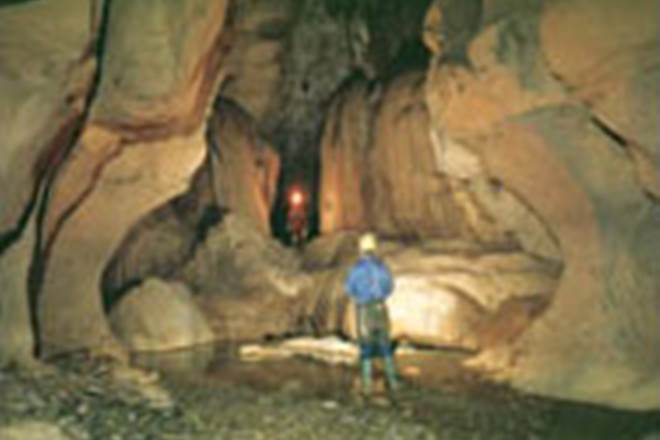
Known for several caves hidden under its undulating hills, the north-eastern state of Meghalaya now boasts of the longest sandstone cave in the world, Krem Puri. With a length of 24,583 metres, Krem Puri was discovered back in 2016 but the actual length of the cave was obtained by the Meghalaya Adventurers’ Association (MAA) during one of its recent expeditions. According to Hindustan Times, a founding member of the MAA, Brian Daly Kharpran said that the expedition was conducted between February 5 and March 1 this year to measure and map the Khem Puri cave.
The team that went on the expedition comprised of 30 seasoned cavers from all over the world including the United Kingdom, Ireland, Austria, Romania, Switzerland, Poland, the Netherlands and also had four Italian scientists from La Venta and members of the MAA. The scientists on the expeditions had been invited to provide insights on the structure and genesis of Krems, which in the Khasi language means cave, in Mawsynram, which is known for its record-breaking rainfall as the wettest place on earth.
The underground cavern of Khem Puri is over 6,000 metres longer than Cueva Del Saman in Edo Zulia, Venezuela, the world record holder, which is a quartzite sandstone cave measuring 18,200 metres. Kharpran, who also won the Tenzing Norgay National Adventure Award in 2002, said that the cave had become India’s second longest, the Krem Liat Prah-Umim-Labit system being the first which lies in the Jaintia Hills in Meghalaya and measures over 31 kilometres.
Located near the village of Laitsohum in the Mawsynram area of East Khasi Hills district, Krem Puri possesses features that attract even paleontologists other than mere cave enthusiasts. The cave system has fossils of dinosaurs, especially of the Mosasaurus, a giant reptile that lived 66-76 million years ago.
Kharpran said that the exploration, which continued for 25 days, mapped most of Krem Puri, with little leads left open. Apart from that, nine other unexplored and partially explored caves were mapped too. Kharpran, who has been exploring and mapping caves since 1992, said that the expedition this year explored and mapped over 22 kilometres of new cave passages. More than a thousand caves have been completely or partially explored in Meghalaya out of the 1,650 known caves and cave locations. An official data stated that Meghalaya had around 491 kilometres of surveyed caves out of which many more were still on their way to be discovered.