



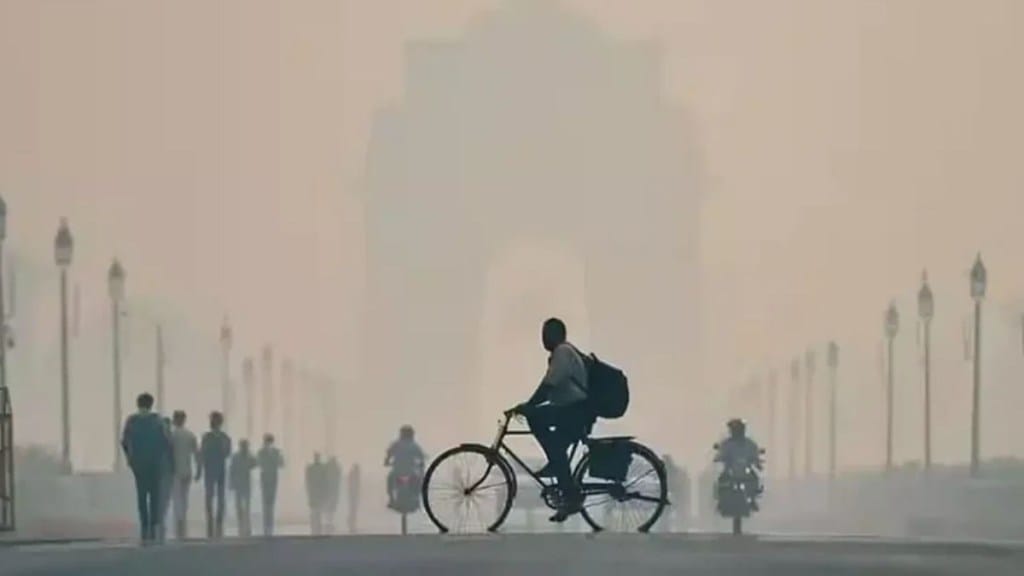
Delhi woke up under a heavy blanket of smog on Monday, November 17. The air felt thick, visibility was low, and breathing was uncomfortable for many people heading out early. At 6:05 AM, the city’s overall AQI touched 360, which falls under the ‘very poor’ category. Out of 38 monitoring stations, six stations recorded ‘severe’ air quality, showing just how bad the situation has become.
Delhi-NCR AQI level today
Delhi has been struggling with polluted air for more than a month now. Even cloud-seeding attempts failed to bring artificial rain, which the government was hoping would help clear the air. According to AQI.in, some of the worst-affected spots today are: Civil Lines (437), Mukherjee Nagar (490), Mayur Vihar (315), Mandir Marg (318) and Safdarjung Enclave (418).
#WATCH | A layer of toxic smog continues to linger over Delhi this morning. Visuals around Abdul Kalam Road area. Air Quality Index (AQI) in the area is 394, categorised as 'Very Poor', as claimed by Central Pollution Control Board (CPCB). pic.twitter.com/RTAt3IGHtR
— ANI (@ANI) November 17, 2025
Here’s how different parts of Delhi looked on Monday morning: (1) Alipur: 386, (2) Anand Vihar: 384, (3) Ashok Vihar: 392, (4) Chandni Chowk: 383, (5) ITO: 394, (6) Lodhi Road: 337, (7) Mundka: 396, (8) Nehru Nagar: 389, (9) Sirifort: 368.
Stations Showing ‘Severe’ Air Quality: (1) Bawana: 427, (2) DTU: 403, (3) Jahangirpuri: 407, (4) Narela: 406, (5) Rohini: 404, (6) Wazirpur: 401.
Understanding AQI: (1) 51–100: Satisfactory, (2) 101–200: Moderate, (3) 201–300: Poor, (4) 301–400: Very Poor, (5) Above 400: Severe.
On Sunday as well, several locations crossed AQI 400. Delhi’s 24-hour average stood at 386, which is still in the ‘very poor’ zone, according to the CPCB.
Supreme Court raises a red flag
On Thursday (November 13), Justice P.S. Narasimha advised lawyers to join court hearings virtually instead of appearing in person. He warned that Delhi’s toxic air could cause permanent health damage, and asked everyone to avoid unnecessary outdoor exposure.
By Monday morning, the Air Quality Early Warning System showed an AQI of 361, while private monitor AQI.in reported the AQI at 422. A dense haze covered the sky, buildings and main roads were barely visible.
GRAP stage III still in place
With pollution levels refusing to lower, the Commission for Air Quality Management (CAQM) has continued with its plan of implementing Stage III of the Graded Response Action Plan (GRAP) across Delhi-NCR.
This stage involves bans on several types of construction, restrictions on brick kilns, closure of stone crushers and curbs on high-emission industrial activities.