



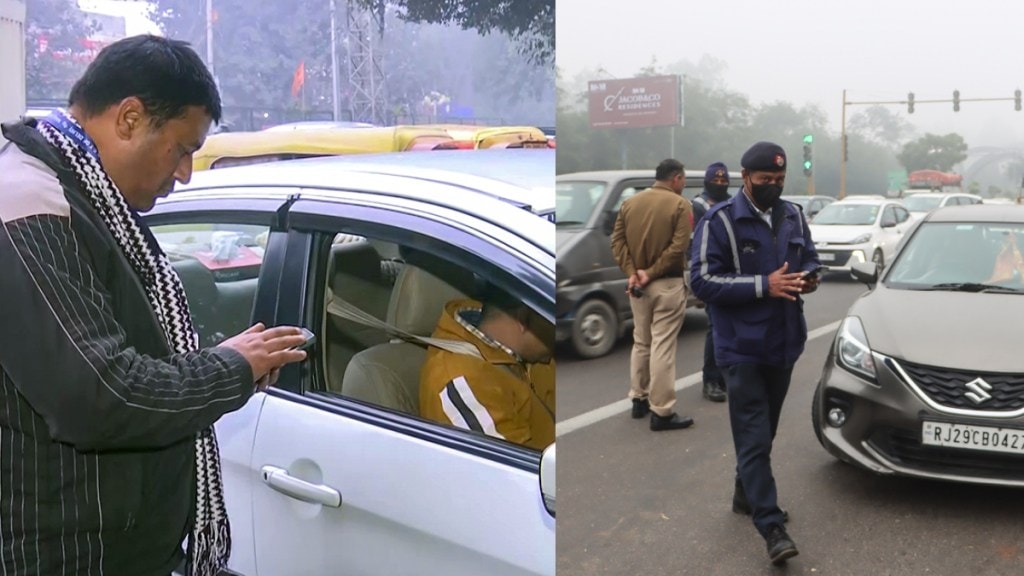
Residents and commuters across Delhi-NCR faced fines, long waits at emission testing centres and turn-backs at borders as authorities strictly enforced vehicle restrictions on Thursday. Despite this, the city’s air quality worsened, reaching an index of 373, showing what critics say is the failure of last-minute pollution control measures.
In 24 hours, around 3,746 vehicles were fined for not having valid pollution certificates, and hundreds were stopped at border crossings for not having newer, low-polluting, or Delhi-registered cars, fuel stations in the city also turned away dozens of drivers according to a report by PTI.
The Delhi government has stepped up its fight against air pollution with the launch of the ‘No PUC, No Fuel’ campaign, issuing more than 61,000 Pollution Under Control Certificates (PUCC) within 24 hours, said an official press release on Thursday.
The disruptions affected daily commuters, healthcare workers, and residents across the region, highlighting the human cost of short-term measures. The Supreme Court called these actions a “total failure” earlier this week. Pollution levels remained in the hazardous range for the eighth day in a row, reaching 398 by 11 pm. Thursday’s air quality index was the second-worst December reading since 2015 and the worst since 2018.
Environment Minister leads inspections
Environment Minister Manjinder Singh Sirsa conducted surprise inspections at fuel stations near the Delhi-Gurgaon border and in central Delhi. “This is a people’s movement to protect the health of Delhiites. We will succeed in this war against pollution only when every citizen joins hands with the government,” Sirsa said, urging people to follow emission rules and work-from-home advice.
At petrol pumps, he told attendants to enforce rules firmly but politely. “You are the first interface of this campaign on the ground. Please do not get into arguments with people; politely explain that this rule is for their own health and for the health of our children,” he said. He also asked staff to ensure clear signs, regular announcements, and smooth queues.
“Every valid PUCC issued today is a small victory in our war against pollution,” Sirsa told commuters during his inspections.
Traffic police turn back older vehicles
At the Kalindi Kunj bridge connecting Delhi and Uttar Pradesh, a team of seven traffic police checked vehicles coming from Noida. “We stop cars that appear to be of older models or look damaged and check their details on the app. If they are not BS-VI compliant, we ask them to take a U-turn,” HT reported quoting a traffic official. By mid-morning, about 100 vehicles had been turned back.
Enforcement was lighter at some other points. At the Badarpur border with Haryana, only two to three cars were stopped in the morning, showing either better compliance or less traffic.
Joint teams from traffic police, the transport department, and local police used handheld devices, smart plate readers, and e-challan apps to check vehicles in real time at entry points, tolls, and major intersections.
However, the rules caused confusion and difficulties for people trying to get around the city.