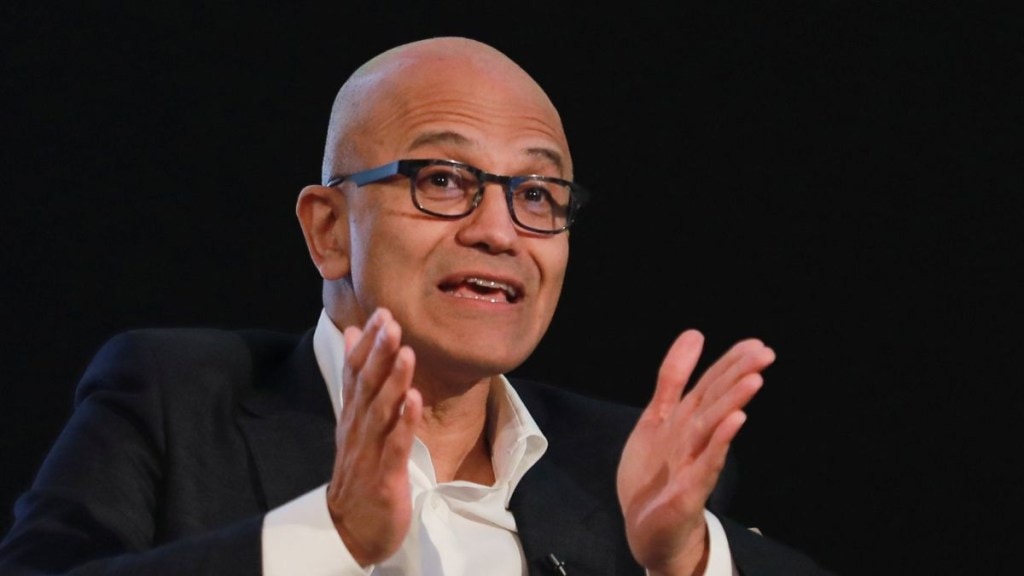
Microsoft chief executive Satya Nadella on Wednesday said that the winners of the global AI race will be determined by how quickly countries and companies adopt the technology rather than who invents it. “People have studied past technological waves and found that the countries, companies, and communities that pulled ahead weren’t the ones that invented the leading tech, but the ones that adopted it the fastest and used it to create the next wave of innovation,” Nadella said at an event in the Capital.
Speaking a day after Microsoft announced a $17.5 billion investment in India over the next four years, Nadella warned that merely possessing advanced technology was not enough. “If you even have leading tech in the country, but you just talked about it or just consumed it but didn’t use it to create other leading tech, you fall behind,” he said.
Reiterating Microsoft’s commitment to India’s AI ambitions, Nadella highlighted the company’s plans to upskill 20 million Indians in AI by 2030 and enable more than 300 million platform and gig workers. He told an audience of entrepreneurs, developers and industry leaders that India stands at a critical juncture where rapid AI adoption could transform outcomes across sectors. “I am excited about what’s happening with GitHub. India will be home to the largest developer community by 2030,” he said, as he showcased demonstrations of Microsoft’s agentic AI systems for deep research.
Virtuous Cycle of Indian Policy
Nadella said India’s momentum was supported by a virtuous cycle created by public digital infrastructure, policy frameworks and a large domestic market. “One thing India has done very uniquely is bring together a virtuous cycle from the policies, the programmes, the technology stack, and the market,” he said, adding that widespread private-sector participation had strengthened the ecosystem. “It’s not about any one thing. That entire stack is magic”.
Scaling AI Adoption
He outlined Microsoft’s AI strategy, led by Copilot, which he described as providing “everyday agent-ing experiences” that are already reshaping how people work. He said the company’s IQ Layer aims to address India’s data fragmentation, while tools such as Copilot Studio and Microsoft Foundry will allow non-developers to build AI applications using natural language. He added that “it’s no longer about any one model” as the company now offers more than 11,000 models through Foundry for enterprises to choose from.
Nadella said AI’s impact in India was already visible. He cited Apollo Hospitals’ use of a Clinician Copilot to help doctors focus more on patient outcomes, Khushi Baby’s deployment of AI tools for ASHA workers and ONGC’s use of multi-agent systems to support field engineers.
On data sovereignty concerns, he said Microsoft now offers several deployment models, including public cloud with sovereign controls and private cloud partnerships. “If you are sovereign, but the first threat actor who shows up at your door can get in, then that’s a problem,” he said, arguing that cybersecurity must not be compromised. He added that Copilot now processes all data within India.
Microsoft’s infrastructure expansion includes new data centres in Hyderabad powered entirely by renewable energy.