



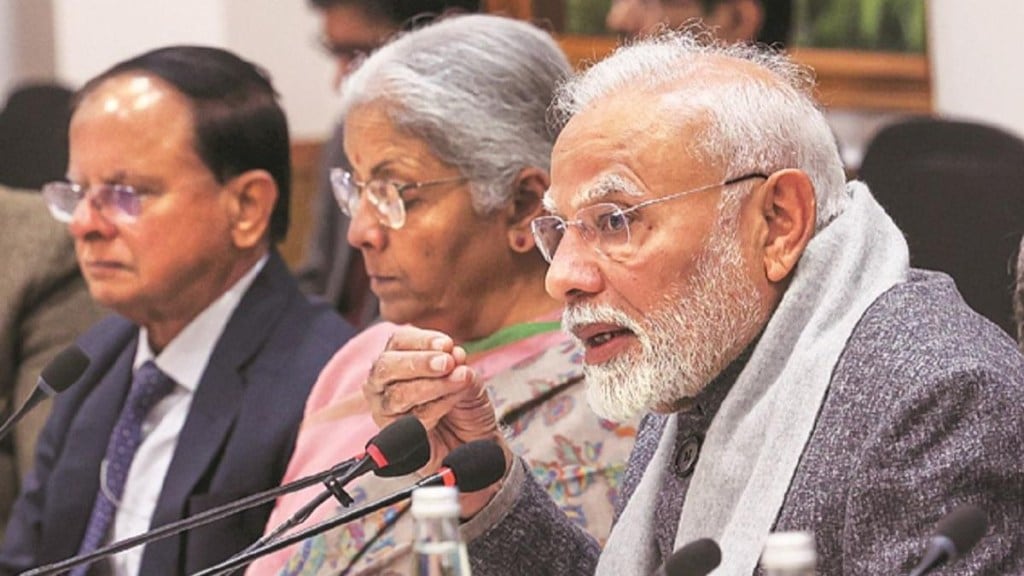
Prime Minister Narendra Modi on Tuesday signalled that the Budget FY27 to be unveiled early February would carry the flavour of “Viksit Bharat” and underlined that a key priority for the government at this juncture would be to meet the aspirations of the 250 million people who have been lifted out of poverty in the last decade.
Education, health and jobs will be accorded precedence in policy-making and fiscal allocations, Modi indicated, while interacting with a group of economists here on Tuesday.
‘Mission-mode reforms’
The PM stressed the need for “mission-mode reforms” in diverse sectors to build global capability, attain global integration and sustain long-term growth. Modi said India’s policymaking and budgeting must remain anchored with a vision for 2047. He also spoke about the need for ensuring that the nation remains a vital hub for the global workforce and international markets.
The meeting, convened ahead of the Budget for FY27, and amid fiscal constraints and external headwinds, including high US tariffs on Indian goods, went beyond the immediate agenda of how fiscal resources will be raised or apportioned in the next financial year. It deliberated on the medium-term economic trajectory and growth strategies, sources said on condition of anonymity.
Economists’ concern
Many of the economists who attended the session are learnt to have expressed concern over the low household financial savings and called for measures to boost these resources, which are critical for capital creation and asset formation in the economy.
While the finance minister Nirmala Sitharaman said in the last Budget speech and thereafter that the anchor of fiscal consolidation over the medium term will be debt reduction, with an emphasis on the keeping the debt-GDP ratio on a declining trajectory, some quarters feel that reversion to the previous FRBM framework where sliding a path of fiscal deficit wa outlined. This, these analysts reckon, will be necessary for providing a clearer view to the market participants about the quantum of government borrowings to be expected over the next few years.
Such clarity is vital for making funds available for the private sector, which is believed to be ramping up capex, especially after the recent tax giveaways whose impact on consumption will probably extend to the next fiscal year.
According to sources, the PM underlined how government initiatives like the National Makhana Board for the fox nut industry have in a short span of time gained much traction among farmers and are likely to boost production, improve processing, and enhance exports.
According to an official statement, during the interaction, the economists shared strategic insights on enhancing productivity and competitiveness across the manufacturing and services sectors. The discussions focused on accelerating structural transformation through increased household savings, robust infrastructure development, and the adoption of cutting-edge technology, it added. The group explored the role of Artificial Intelligence (AI) as an enabler of cross-sectoral productivity and also discussed the continued scaling of India’s Digital Public Infrastructure.
“The participants noted that the unprecedented flurry of cross-sectoral reforms in 2025, and their further consolidation in the coming year, will ensure that India continues to chart its path as one of the fastest growing global economies by strengthening its foundations and unlocking newer opportunities,” it added.
After plunging to a half-century low in FY23 on account of the pandemic-induced income crunch, net financial assets of Indian households recovered in the subsequent two years. But these are still much lower than the trend levels witnessed in pre-pandemie years. The net financial assets of households went up to Rs 19.9 lakh crore or 6% of GDP in FY25, compared with Rs 15.94 lakh crore or 5.3% of GDP in the previous year, as per Reserve Bank of India data. In FY23, net financial assets had fallen to a five-decade low of 4.9% or Rs 13.3 lakh crore. These were 11.4% of GDP in FY21.
Sitharaman, Niti Aayog Vice Chairman Suman Bery, NITI Aayog CEO BVR Subrahmanyam, other members of the Aayog, were present in the meeting.
The finance minister is likely to present the Union Budget for 2026-27 on February 1.
Economists and experts who participated include Shankar Acharya, Ashok K Bhattacharya, N R Bhanumurthy, Amita Batra, Janmejaya Sinha, Amit Chandra, Rajani Sinha, Dinesh Kanabar, Basanta Pradhan, Madan Sabnavis, Ashima Goyal, Dharmakirti Joshi, Umakant Dash, Pinaki Chakraborty, Indranil Sen Gupta, Samiran Chakraborty, Abhiman Das, Rahul Bajoria, Monika Halan and Siddhartha Sanyal.