



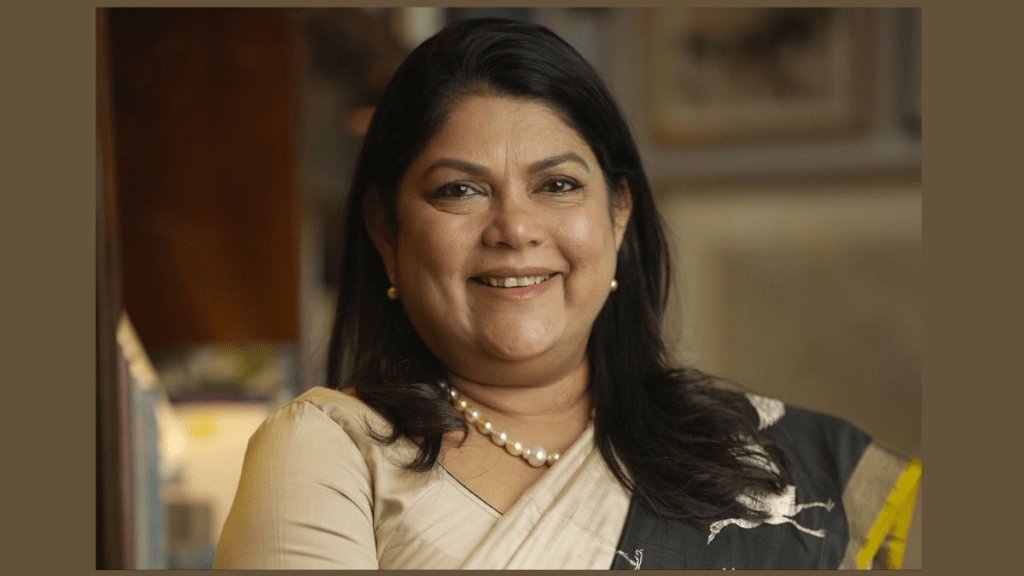
When Falguni Nayar walked away from a senior investment banking career in her late forties, it was not because she had fallen out of love with finance. It was because, after nearly three decades inside the machinery of capital markets, she had grown restless with building other people’s businesses.
By then, Nayar had reached the uppermost tier of Indian finance. She had led mergers and acquisitions, overseen equity capital markets, built institutional relationships abroad and returned to run key businesses at Kotak Mahindra. The professional rewards were substantial. The structure was familiar. What was missing, she would later say, was ownership of the outcome.
Nykaa, the beauty and fashion retailer she founded in 2012, was the result of that dissatisfaction and of a banker’s instinct to spot a market inefficiency hiding in plain sight.
The earliest publicly available data for Nykaa’s revenue dates back to FY 2017-18, when the company recorded a revenue of Rs 574 crore. In FY25, Nykaa’s revenue from operations was Rs 7,950 crore with a net profit of Rs 72 crore, as per the financial statements. (Source: Screener.in)
From boardrooms to a borrowed office
Nayar’s professional discipline was shaped long before Nykaa. Raised in Mumbai in a Gujarati business family, she grew up watching her parents run a small manufacturing enterprise. According to news reports, this experience instilled an early understanding of risk, cash flow, and perseverance.
After completing a commerce degree at Sydenham College, she earned an MBA from IIM Ahmedabad in 1985, specialising in finance. What followed was a methodical climb through consulting and investment banking, including an 18-year tenure at Kotak Mahindra Group. By the mid-2000s, she was managing director of Kotak Mahindra Capital and a director at Kotak Securities, roles that placed her at the centre of India’s equity markets.
Nayar spent years observing consumer behaviour, internet adoption and gaps in the Indian retail system before making her decision.
Why beauty, why now
As an investment banker, Nayar was trained to search for sectors with structural tailwinds. Beauty offered several: rising incomes, increasing internet penetration, aspirational consumers and, critically, a lack of trust in existing retail channels.
What stood out was not demand but dysfunction. The Indian beauty market was fragmented, plagued by counterfeit products and inconsistent quality. Online marketplaces existed, but none offered curation, authenticity or education. To Nayar, this represented a white space large enough to justify risking her own capital.
In April 2012, she invested $2 million of family money into what became FSN E-Commerce Ventures. The early setup was deliberately modest, a small team working out of her father’s office.
When Nykaa swam against the e-commerce tide
Nykaa’s most consequential decision came early. Rather than adopting the marketplace model that was becoming standard in Indian e-commerce, Nayar opted for an inventory-led approach. The model was capital-intensive and operationally complex, but it allowed the company to control sourcing, storage and delivery, and, most importantly, authenticity.
This decision ran counter to the startup operations that prevailed, but it reflected Nayar’s banking background, which ran on reduced risk even if it slowed the scale. Nykaa purchased directly from brands, stored inventory in its own warehouses and sold through its own platforms. The result was a level of trust that competitors struggled to replicate.
Growth, but on banker’s terms
Nykaa’s early years were not easy. Technology infrastructure had to be built almost from scratch. Consumer education required content, not discounts. Investors were sceptical of both the category and the business model.
Funding, when it came, was measured. The company bootstrapped initially, raised modest rounds only after demonstrating traction, and avoided excessive dilution. By the time Nykaa went public, Nayar still controlled roughly 54% of the company.
Profitability, too, was treated as a discipline rather than an afterthought. Nykaa turned profitable before its IPO, a rarity among Indian consumer tech companies. Even when margins later tightened due to expansion, the emphasis on financial balance remained central to Nayar’s philosophy.
Offline, fashion and a family succession
Despite building an online-first brand, Nayar expanded into physical retail in 2015, recognising that beauty products often require touch and trial. Over time, Nykaa developed multiple store formats, blending digital convenience with an in-person experience.
Diversification followed. In 2018, the company launched Nykaa Fashion, placing her daughter, Adwaita Nayar, at its helm. Her son, Anchit Nayar, later took charge of the core e-retail business.
When Nykaa met the public markets
Nykaa’s public listing in November 2021 marked one of India’s most closely watched consumer IPOs. The offering was heavily oversubscribed, 82.5 times, with qualified institutional buyers oversubscribing 92.3 times. The company’s valuation reached approximately $13 billion. Overnight, Nayar became India’s first self-made female billionaire.
As of 17 December, Nayar’s net worth was $ 4 billion as per Forbes. According to a recent Hurun Self-Made Entrepreneur report, Nayar and her daughter maintained their position in the top ten with the company’s valuation at Rs 67,500 crore, marking a 19% increase when compared to last year.
According to the DHRP filing, the company planned to allocate the IPO proceeds to enhancing brand visibility, debt repayment, new retail stores, and new warehouses. The long-term goal, Nayar has said, is not rapid exits but building a company that can endure for generations.
Nykaa’s journey on D’Street
Nykaa’s market capitalisation stood at Rs 69,903 crore as of December 18,
Nykaa made its D’Street debut on 10 November 2021. On listing, the stock had made a strong debut on the bourses, opening at Rs 2,001 per share—up 78%, or Rs 876, from the issue price of Rs 1,125. At that level, the company’s market capitalisation briefly crossed the Rs 1 lakh crore mark in November 2021.
Accolades that followed
Over the years, Nayar’s transition from finance to entrepreneurship has been accompanied by formal recognition from both industry and corporate institutions. She has been named EY Entrepreneur of the Year twice, in 2019 in the start-up category and again in 2021, when she became only the third Indian woman to receive the honour, and has also received the Economic Times Businesswoman of the Year Award and the Woman Ahead Award.
Her standing in corporate India extends beyond Nykaa. She has served as an independent or non-executive director on the boards of companies including Dabur India, Tata Motors, Tata Technologies, ACC and Endurance Technologies, and previously Aviva Life Insurance, roles that reflect her continued presence in governance and capital markets even as she built a consumer-facing business from the ground up.
Entrepreneurship, the banker’s way
What distinguishes Falguni Nayar is not that she entered entrepreneurship late, but that she brought institutional thinking with her. She speaks of compounding, risk taken without full certainty, and the importance of starting small even when thinking big.
In interviews, she repeatedly returns to the same idea: that ambition, particularly for women, should not be accompanied by guilt. Nykaa, in that sense, was not only a commercial bet but a personal one, on independence, ownership and patience.
In an ecosystem often defined by speed and spectacle, Nayar built something slower, more controlled and, ultimately, more durable.