



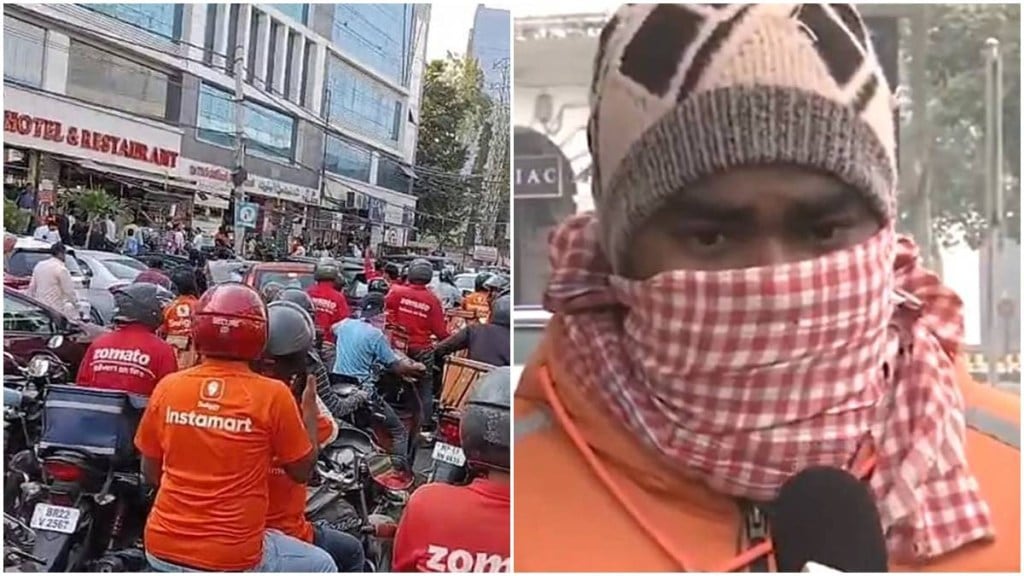
The gig workers’ strike on Wednesday had limited traction with some impact in a few cities due to the unorganised nature of the workforce. As online orders have risen, rider payouts have fallen with companies cutting costs, leading them to protest against low pay & poor working conditions, explains Banasree Purkayastha
l What are the reasons for the strike?
DELIVERY WORKERS OF quick commerce and food delivery platforms went on a nationwide strike on December 31, one of the busiest days of the year for online platforms, to press for higher payouts, safer delivery targets, end to arbitrary account blocking and social security benefits. The strike was called by the Telangana Gig and Platform Workers Union (TGPWU) and the Indian Federation of App-Based Transport Workers (IFAT), with support from regional unions. “As many as 100,000 to 150,000 delivery workers are expected to participate in the strike during peak demand hours today, when order volumes are at their highest,” said Shaik Salauddin, founder president of TGPWU and co-founder and national general secretary of IFAT.
Riders of major food delivery and e-commerce platforms such as Zomato, Swiggy, Blinkit, Zepto, Flipkart, BigBasket and Amazon had earlier carried out a flash strike on December 25 to draw attention to the poor working conditions in the gig economy, which led to notable disruption in services in several cities.
l What are the main demands of the delivery workers?
A LIST OF 15 demands has been submitted to Minister of Labour and Employment Mansukh Mandaviya by the unions. They have demanded a guaranteed minimum monthly earning of Rs 40,000 to riders, a minimum per-kilometre rate of Rs 20 for riders working with online delivery platforms, abolition of peak hours, slot systems and weekend hour limits, and compensation in cases of customer-initiated cancellations. They have also called for discontinuation of 10-minute delivery service model, which they say have led to dangerous driving practices. Other demands include end to algorithmic control, arbitrary account blocking, mandatory pre- and post-task photo uploads and proof-of-work requirements, besides replacing AI-based calls with 24/7 human customer support, and restoration of company hubs.
l Response of online platforms
THOUGH E-COMMERCE COMPANIES did not unveil any contingency plans, amid the strike call food delivery platforms Zomato and Swiggy offered increased payouts to gig workers to ensure minimal disruptions. Zomato offered payouts of Rs 120-150 per order during the six-hour peak period of 6 pm-12 am on New Year’s Eve. It also promised earnings of up to Rs 6,000 over the two critical days of December 31 and January1, subject to order volumes and worker availability. Penalties on order cancellations were paused for this period. Typically, this is done during high-demand festive and year-end periods. Swiggy has also upped the incentives for these two days, promising earnings of up to Rs 10,000 and a peak-hour pay of up to Rs 2,000 for deliveries between 6 pm and 12 am on New Year’s eve. Zepto has also promised higher incentives to delivery personnel for this one day. However, it remains to be seen whether these platforms engage with the unions to work out a solution.
l Daily earnings fall as orders go up
FEE WAIVERS OVER the last couple of months have led to cheaper orders for customers, but riders have had to pay the price. Earnings per order, which had slipped from Rs 34–42 in early 2024 to around Rs 22–30 by the festive season in September 2025, have fallen further to Rs 15-27 in several high-density zones since Zepto and Swiggy’s Instamart removed handling and surge fees in November. “There’s growing concern that base rates are gradually eroding,” Balasubramanian Anantha Narayanan, vice president at TeamLease Services, had recently told FE. “We are seeing dissatisfaction in cities where incentives were irregular or lower than expected.” A 2024 report by the People’s Association In Grassroots Action and Movement (PAIGAM) and IFAT had found that large chunk of gig workers earn less than Rs 15,000 a month after working for over 10 hours a day. Only 10% of them earn more than Rs 800 a day while half of delivery workers make only Rs 200-600 a day.
l Govt attempts to protect gig workers
The number of gig workers is expected to rise to 23.5 million by 2029-30 from 12.7 million in 2024-25, as per NITI Aayog. The food delivery sector alone employed 1.4 million platform workers in 2023-24, as per an NCAER 2025 report. The Labour Code on Social Security that came into effect in November 2025 gave legal recognition to gig workers for the first time, and require online aggregators to contribute 1-2% of their annual turnover to a social security fund designed specifically for this workforce. The contribution is capped at 5% of the total payments made or payable to workers in a financial year. Meanwhile, Karnataka has notified its Platform-Based Gig Workers (Social Security and Welfare) Act, 2025, which imposes a welfare fee of 1–5% per transaction and establishes a state-level Gig Workers Welfare Board and Fund. Telangana has cleared its draft Bill to provide social security coverage to nearly 300,000 gig workers across transport, delivery, domestic work and logistics.