



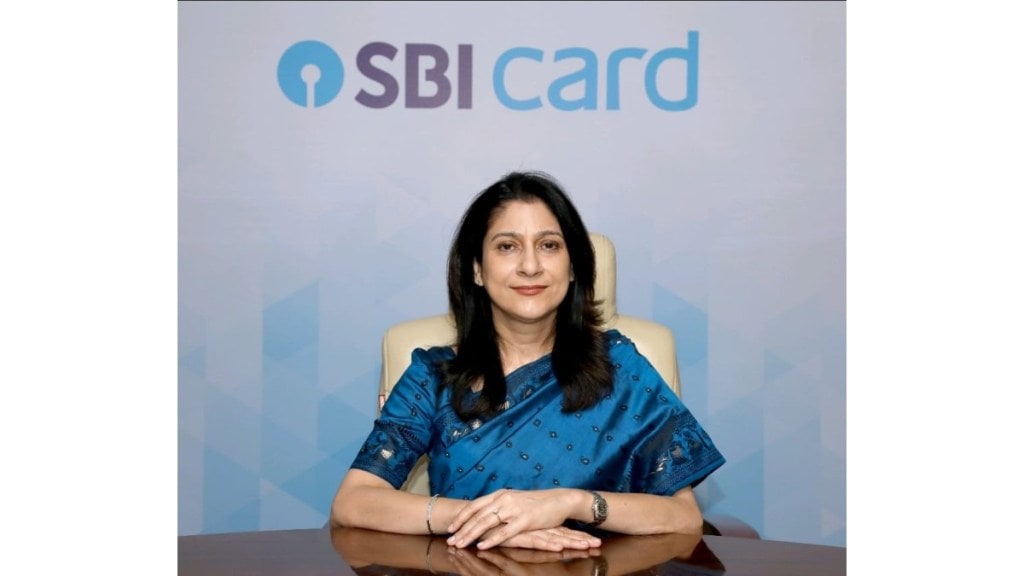
SBI Card crossed the Rs 1 trillion milestone in spends for the first time, buoyed by GST rationalisation, rate cuts, and income tax reforms that lifted disposable incomes and consumer confidence. In a conversation with Mahesh Nayak, Salila Pande, MD & CEO, said the growth momentum should extend into Q1 FY27, led by consumer durables, education, and travel.
Excerpts:
How do you see the current trends in consumer spending, especially given the festive season and recent policy measures?
For the first time, our spends crossed the Rs 1 trillion milestone (Rs 1,07,063 crore), reflecting a 31% year‑on‑year rise, with retail spends growing nearly 17%. This growth was supported by GST rationalisation, rate cuts, and income tax reforms that boosted disposable income and consumer confidence. The festive season added momentum, and while that surge has tapered, spends remain resilient. This resilience highlights the strength of India’s consumer base. In the long term, we see robust expansion across card spends and the broader economy, while in the near term, supportive policies and demographic tailwinds will ensure growth remains healthy and sustainable.
Are there particular segments where you’re seeing these spends, or is it spread across categories?
It is fairly broad‑based. Non‑discretionary spends like fuel remain regular and steady, both during the festive quarter and beyond. At the same time, we have seen strong growth in consumer durables, which is also linked to the partnerships we have built with co‑brand partners. Education is another area showing a healthy uptick, reflecting the priorities of our customers. And of course, with the rising middle class aspiring to travel more, we are seeing increasing interest on the travel side as well. Overall, while spends are spread across categories, these segments stand out in particular.
Do you see the spending trend continuing into FY27?
The festive season gave us a strong push, and we cannot expect that level of spend to continue indefinitely. However, what is encouraging is the overall traction we are seeing. There is clear upward growth when we compare the data, and the spends are holding at a healthy level even beyond the festive quarter. So, while the seasonal surge may taper, the underlying trend remains positive, and the data we are seeing now suggest this momentum will carry forward into Q1 of FY27.
With spends rising, are defaults coming down or are customers shifting more towards EMIs?
Defaults are definitely coming down for us as a company. We are seeing better flows, with lower delinquency rates. In fact, last quarter our slippage ratio improved, and gross NPAs fell to 2.85% — the first time in several quarters we had gone below 3%. Overall, we are seeing a clear improvement in default rates. We have been conservative in new customer acquisition, strengthened our portfolio management, and built early warning systems to identify higher default propensities. We also enhanced our collections infrastructure. Together, these steps have significantly reduced delinquency.
As India’s largest standalone credit card player, how do you see your business evolving in FY26 and FY27?
Being a monoline player gives us focus and brand recognition. Opportunities are tremendous with India’s economy growing, the middle class is expanding, and credit cards are increasingly seen as aspirational, all supporting growth in credit. Digital payments have accelerated, benefiting us. Our RuPay credit card portfolio is strong, and UPI-linked spends grew 16% last quarter. With under-penetration compared to developed economies, the market potential is huge. By 2030, India is expected to have 200 million credit cards, up from 110–116 million today, with volumes growing at a CAGR of 20–21%.
Will SBI Card grow faster than industry projections?
Yes. In September, industry spends grew 6%, while we grew 31%. Transaction volumes also outpaced industry growth. While we may take a calibrated approach at times, our long-term trajectory is faster than the industry.
How do you differentiate from competitors, especially in rewards and cashbacks?
Products can be replicated, but service and trust are harder to emulate. The SBI brand gives us scale, recognition and reach. We focus on customer convenience, safety and value. Rewards are not just a differentiator but a tool for engagement and loyalty. We balance customer preferences with profitability to ensure long-term sustainability. Unlike some players that faced challenges (with aggressive cashback strategies), we take a more measured approach.
How have rate cuts impacted your cost of funds?
We have benefited meaningfully. Our cost of funds declined to 6.4% in Q2 from 7.1%. Bank borrowings remain our primary funding source, supplemented by market borrowings through non-convertible debentures (NCDs). We maintain a balanced mix of short-term and long-term liabilities within policy limits.
Do you expect further declines in the cost of funds?
Yes, though with a lag. A further 25 basis-point cut in December should flow through over the coming quarters.
Provisioning has come down. What drove this?
Provisioning is a function of portfolio quality under the ECL model. Asset-quality challenges in the past led to increased provisioning. But with lower slippages, stronger models, and better portfolio management, provisioning has declined. Stage 2 and Stage 3 exposures have been reduced, improving outcomes.
Your ROA has come down slightly in the last quarter. How do you see this improving going forward?
Yes, there was a slight decline in ROA. The primary reason was impairment in financial assets. If you look at our credit cost, the gross credit cost stood at 9%, which was lower than the previous quarter’s 9.6%, but when compared to the previous year, there was a marginal reduction. Assets grew by almost 8%, yet H1 profit in FY25 versus FY26 was roughly the same, which impacted ROA. That said, we are confident of improvement in the coming days. ROA is a journey — it doesn’t change in a single quarter — but with our growth trajectory and prudent risk management, we expect it to strengthen steadily.
How do co-branded cards fit into your strategy?
Co-branded partnerships are critical. Break-even typically takes 18–24 months, but we don’t expect immediate profitability. Our recent partnership with Flipkart and PhonePe was well-timed with the festive season. Currently, our portfolio is roughly 50:50 between standalone SBI Cards and co-branded cards. Within co-brands, open-market channels contribute another 50%. Overall, we have 25–30 co-branded partnerships, and we see scope for more as customer behaviour evolves.