



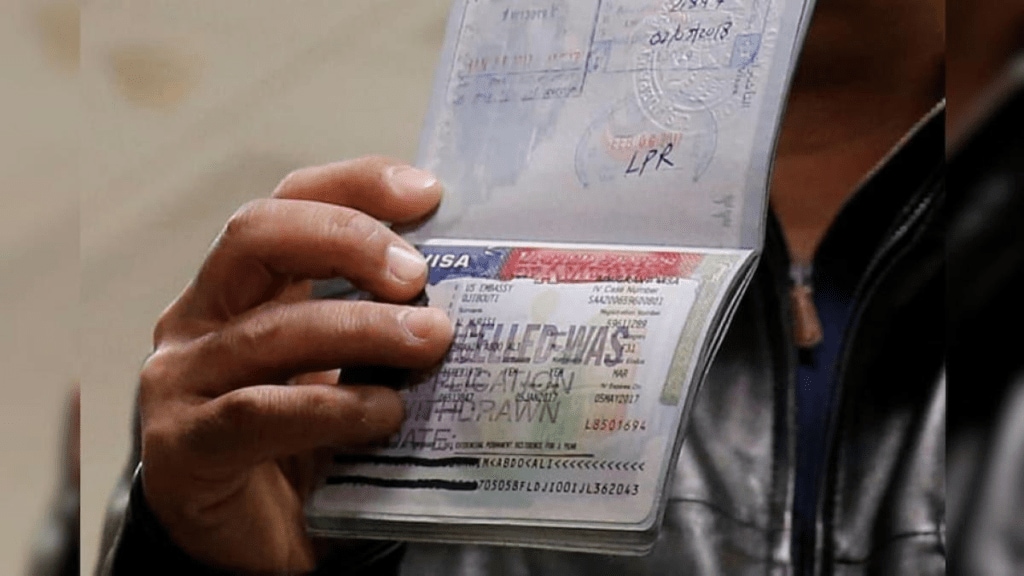
The United States has announced major changes to how it screens visa applicants and travellers. These updates affect people applying for work visas, student visas, immigrant visas, and even travellers who usually do not need a visa to enter the US. Officials say the goal is national security. Critics say it raises privacy and free speech concerns. Here is what has changed.
Social media checks now expanded to H-1B workers and families
Since December 15, the US State Department has expanded its online screening rules. Earlier, social media reviews primarily applied to students and exchange visitors. Now, the same checks will also apply to people applying for H-1B work visas and their family members on (dependents) H-4 visas. “The State Department uses all available information in visa screening and vetting to identify visa applicants who are inadmissible to the United States, including those who pose a threat to US national security or public safety,” according to The US Department of State.
This means applicants for H-1B, H-4, F, M, and J visas are being told to change the privacy settings on all their social media accounts to “public.” The US Department of State, in a statement, said, “We conduct thorough vetting of all visa applicants, including online presence review of all student and exchange visitor applicants in the F, M, and J nonimmigrant classifications.”
New rule on where immigrant visa interviews must happen
The US has also changed where immigrant visa applicants must attend their interviews. Applicants are now required to interview in the consular district of their place of residence. If they ask, they may also be allowed to interview in their country of nationality.
Starting November 1, 2025, the National Visa Centre will automatically schedule immigrant visa interviews in either the applicant’s country of residence or nationality.
What happens if visa services are suspended in a country
For people living in countries where routine visa services are paused or suspended, the US has named specific locations where applications must be processed. For example, Afghan residents will be processed in Islamabad. Iranian applicants may be sent to Abu Dhabi, Ankara, or Yerevan. Russians may be processed in Warsaw or Almaty for certain visa categories. Syrians may be sent to Amman or Beirut in some cases. The full list is available at the official website of the US Department of State. These designated posts apply unless the applicant holds the nationality of another country where services are active.
Important notes for immigrant visa applicants
If someone already has an immigrant visa appointment, it will usually not be cancelled or rescheduled. If an applicant wants to move their case to another country after the National Visa Centre has scheduled the interview, they must contact the National Visa Centre directly. They should not contact the embassy or consulate.
If someone asks to interview outside their assigned location, officials may ask for proof that the place is truly their residence. Exceptions are rare and are mainly allowed for medical emergencies, humanitarian reasons, or foreign policy concerns.
These new rules also apply to Diversity Visa applicants under the DV-2026 program.
New instructions for non-immigrant visa interviews
The State Department has also updated its rules for nonimmigrant visas, such as tourist, student, and work visas. With immediate effect, applicants should schedule their interview in the country where they live or where they hold nationality. People from countries where the US does not run regular visa services must apply at a designated embassy or consulate.
Warnings on fees, delays and proof of residence
Applicants are warned that they must prove they live in the country where they are applying if residency is the basis of the application. The department warned that applying outside one’s country of nationality or residence could reduce chances of approval. Visa fees will not be refunded or transferred if the application is refused.
Applicants should also expect longer wait times when applying outside their home country. Existing non-immigrant visa appointments will generally not be cancelled. Diplomatic visas, NATO visas, and travel covered by the UN Headquarters Agreement are exempt.
Visa-free travellers may soon face tougher checks
The US is also planning stricter screening for people who travel without a visa under the Visa Waiver Program. According to a notice published in the Federal Register, the Department of Homeland Security is proposing to collect five years of social media history from these travellers.
These travellers currently come from about 40 mostly European and Asian countries and use the Electronic System for Travel Authorisation, known as ESTA. Unlike visa applicants, they usually do not attend interviews at embassies.
What extra information DHS wants to collect
Under the proposal, travellers may be asked to share phone numbers used over the past five years and email addresses used over the last ten years. Officials may also collect metadata from uploaded photos and detailed information about family members, including their places of birth and phone numbers.
At present, the ESTA form only asks basic questions, such as parents’ names and a current email address.
Travellers from non-visa waiver countries have already been required to submit social media details since the first Trump administration. That policy remained in place under President Joe Biden. But citizens of visa waiver countries were previously exempt.
Since January, the Trump administration has increased checks on immigrants and visitors, including people already living in the US. Visa applicants are now required to keep social media accounts public, and refusing to do so can be grounds for visa denial.
The new requirements are aimed at foreign nationals who must complete Form I-94, travellers from Visa Waiver Program countries using ESTA, and those using CBP’s mobile app to confirm their exit. US citizens are not required to provide biometrics beyond standard passport checks.