



By Aparaajita Pandey
“We are not tenants, we have recovered what is rightfully ours, brothers and sisters”….. “This will be forever”. The former Bolivian President, Evo Morales had made this statement in a speech in 2009. The journey of Evo Morales from a Coca plant farmer to that of the President of Bolivia can be described as nothing short of an Odyssey and his fall from glory and an exile to Mexico can also probably be found one or the other Greek tragedy.
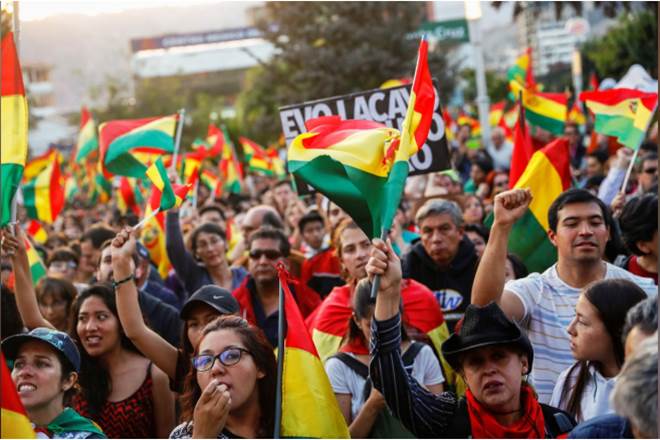
Political unrest in Bolivia grew soon after the result of the first round of presidential elections held in the country on October 20th. Evo Morales has been in power since 2006, in 2016 he tried to bring a referendum to the Bolivian constitution which would eliminate a limit of the number of terms a person could serve as the president, however, he was defeated and he decided to step down. The very next year Morales came back to power as the Bolivian judiciary which consisted of his loyalists eliminated the presidential term limit citing it as an infringement of human rights.
Indian Navy Scorpene class submarine INS Khanderi: It’s a deadly deep-sea predator
However, Morales tried to continue his reign as the Bolivian President in the 2019 presidential elections and the results of the first round came out in his favour despite the strong anti-incumbent sentiment echoing among the Bolivian people, the elections lost their legitimacy. The state descended into unrest with protesters gathering in the streets, often bordering on violence. While the former Bolivian President Morales tried to hold on to his seat with the help of the state’s enforcers, the Bolivian Police and Military soon turned against him too. Losing the support of the Bolivian Military and Police was the last thread and he had to flee to Mexico. While Evo Morales from Mexico has tweeted that he plans to soon return to Bolivia and rise once again for the people of Bolivia, most political analysts believe that this is the end of the road for Morales.
Morales’ ousting from Bolivia has garnered not just attention but also the strategically worded reactions from that country’s Latin American neighbours as well as the US. These comments fit squarely in their political narrative and have cookie-cutter quality to them which supplements and compliment the political ideology that they represent without much concern for facts or dynamics of Bolivian politics. While Nicolas Maduro, the Venezuelan President, AMLO from Mexico, and the new Argentine head of state Alberto Fernandez have labeled the ousting of Morales, a military coup; the openly right-wing Brazilian President Jair Bolsonaro and Donald Trump have lauded it a victory for democracy in Bolivia.
While both these narratives might have elements of truth to them, it is important to understand that they are both acutely superficial in nature and in no way can their overly simplistic character be symptomatic of the multilayered politics of Bolivia. The Bolivian presidency and the challenges to it are a function of a system of institutionalized racism, classism, religious differences, a hunger for power, and an eventual disillusion with a man who was supposed to be the voice of voiceless.
Bolivia, like most Latin American countries, lives with prominently visible race, class, and religious divisions. Morales started his journey as a farmer of the Coca plant, making his way through the ranks of in Coca farmers union to the Presidential corridors. He was also held by the US Drug Enforcement Administration (DEA) officers in 2003 that were in Bolivia trying to stop Coca farming which is the main constituent in Cocaine, however most Bolivian Coca is used medicinally. Upon assuming office in 2006, he took great pleasure in eliminating all DEA interference in Bolivia.
Evo Morales was not just another President; he was watershed in Bolivian history. He was the first President who had a completely indigenous descent and his election to power was an indication of a change in conventional social structures of society. The indigenous peoples have long been marginalized at times killed, their lands taken away and their Gods mocked. However, an indigenous President was supposed to be an answer to their prayers. He was also an authentic Bolivian answer to his predecessor called Gonzalez Sanchez de Lozada or as he was called by the people –El Gringo, since he was raised in the US and spoke Spanish with an American Accent. Lozada who is now in exile in Washington DC was also the President who oversaw the killings of indigenous Aymara people, the community that Morales hails from.
As some of his first actions in office, Morales ousted the DEA, which was previously supported by the Morales’ predecessors and had been the bane of existence for the Coca farmer’s community. In 2006 he also nationalised all Bolivian natural gas resources. These actions endeared him not only to the indigenous communities but also with the general Bolivian population. And, he made his mark as a President who wasn’t ready to bow down to larger and more powerful players who in this situation were: The US with the Global War on Drugs and also Brazil and Chile that had wanted Bolivia to be a part of the Grand South Gas Pipeline aiming to connect South American countries to ensure cheap and stable natural gas supply. While Bolivia did eventually participate in the pipeline it did so at twice the initial cost for their natural gas and a refusal to sell natural gas to the US.
Now with Morales gone, right-wing Bolivian Senator Jeanine Anez Chavez declared herself as the interim ruler; she has also been endorsed by the United States. As she took her oath on the Bible, she did much more than pledge her services to the nation. Anez’s power grab is not just political, its underlying layers are a representation of historical racial, classist, and religious segregation of the Bolivian society. Her social media is filled with videos mocking indigenous practices often coupled with hateful rhetoric.
Bolivia today stands at a crossroads of political uncertainty, widening social chasms, and a paucity of leadership. It is unclear if Bolivia would go back to its traditional socio-politically stratified conventions, or a new leader would emerge from this chaos; the latter, however, seems unlikely.
(The author is an Asst. Professor at Amity University, NOIDA and a Doctoral Candidate at the Centre for Canada, US, and Latin American Studies, Jawaharlal Nehru University. Views are personal.)