



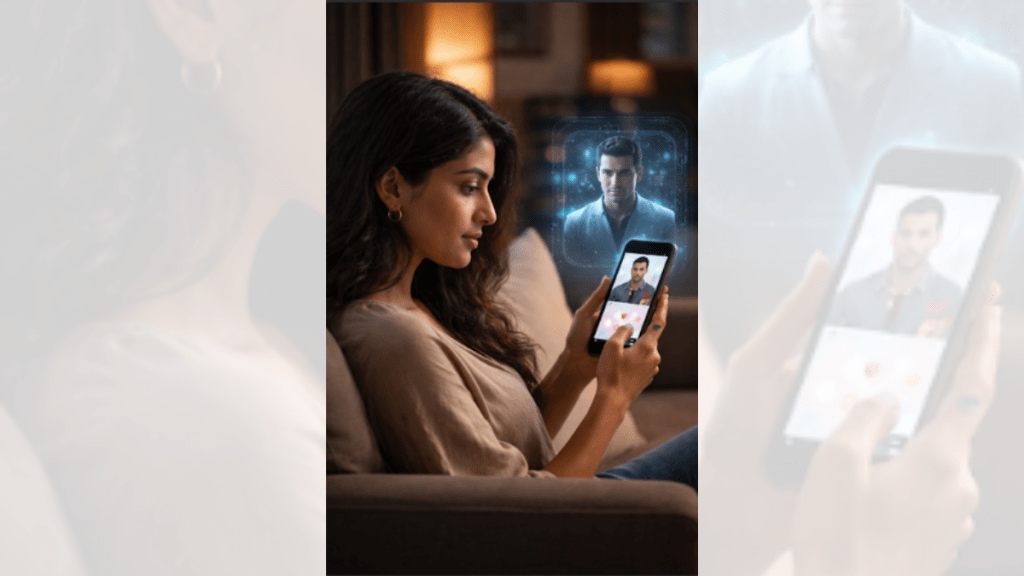
The responses came quick, but polished. Mary, whose name has been changed to protect her identity, was hugely impressed by the emotional depth and articulate nature of the guy on the other side, something she found rarely on a dating app. He asked thoughtful questions, was attuned to her emotional state, and seemed to know just the right thing to say.
But, soon a message came that ended with a strange sign-off: “A few low-key flirty options—pick what feels natural to you… If you want something slightly more playful, here are a few options…” Mary knew instantly. She hadn’t been talking to “him”. She had been talking to an AI chatbot.
Algorithmic Intimacy
Mary’s experience is increasingly familiar to dating app users, who are adapting to the use of generative AI in the business of romance. A 2025 study from Norton, a consumer cyber safety brand by Nasdaq-listed Gen Digital, says 60% of current online daters believe they’ve had a conversation with someone on a dating app that was written by AI.
A study by Tinder-owner Match Group, “Singles in America”, shows that 26% of people are using AI tools in dating, while the share is 49% among GenZs. If we look at global data, a 2025 KPMG survey of over 48,000 people across 47 countries found that two in three people regularly use AI for personal, work or study purposes, with adoption far higher in emerging economies (80%) than in advanced ones (58%).
For many, what began as a tool to clean up grammar or to polish a bio, has evolved into something much more extensive — they are outsourcing entire conversations to AI platforms like ChatGPT or Gemini. Users prompt chatbots not just for clever replies, but for emotionally calibrated ones, such as what to say to appear empathetic, how to increase flirtation, or how to sound emotionally intelligent.
Curated Emotions
While these AI-mediated conversations can feel fluent and charming, it is disconnected from reality. The gap often becomes apparent offline, when the emotional intelligence displayed on screen seem to be absent on the person.
From a clinical perspective, this gap is not accidental. “Humans naturally present curated versions of themselves in relationships,” says Anunka Mondal, a consultant clinical psychologist. AI tools amplify this tendency by helping individuals frame responses that appear more articulate, empathic, emotionally attuned, or self-aware than they may genuinely feel or be able to sustain.
“While this may temporarily enhance the quality of conversations, it interferes with the natural process of relational bonding, which depends on honesty, vulnerability, and emotional imperfection,” she adds.
According to Mondal, reliance on AI-mediated expression can interfere with a person’s ability to access and communicate their own emotional experiences spontaneously. This creates a discrepancy between the presented self and the experienced self, leading the other person to form an emotional bond with a version that is not consistently available.
As online dating apps globally struggle with slowing user growth and widespread decision fatigue, the rise of AI-mediated romance only weakens their promise of genuine connection.