



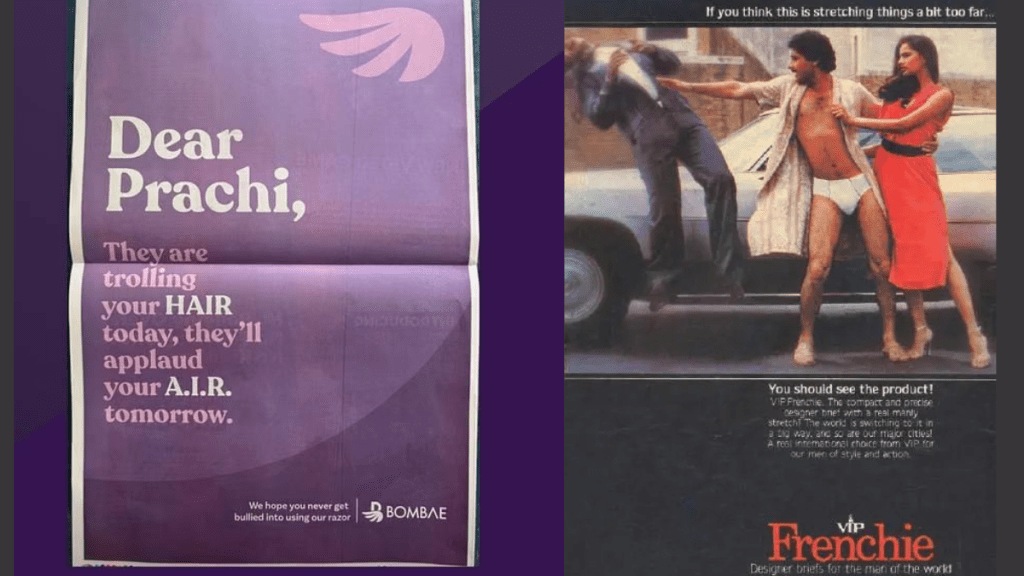
Earlier this week, an advertisement from Bombay Shaving Company sparked off a controversy for its use of a young student who was bullied on social media for not fitting the flawless-female mould we see in advertisements. The ad raised a lot of concerns from commentators and social media users but more importantly, it was indicative of the improvidence of Indian advertising.
In recent years, advertisers and brands have made a concerted effort to appear “progressive” but this campaign was a clear case of how forced inclusivity without empathy can appear hollow and backfire for the brand.
That brings us to the recent findings of a report published by the Advertising Standards Council of India (ASCI) and the UN Women Convened Unstereotype Alliance (UA). Developed in association with global data and analytics firm Kantar, the report reveals that Indian advertising has a long way to go before it can be deemed progressive.
To be sure, Indian advertising scores well on the representation of women (45% of ads feature women) compared with the global average of 25%. And while that is reason to celebrate, the report also says that women characters are more stereotyped and are usually shown as fair and lean.
These conclusions are not too off the mark. Advertising has for decades glorified “perfect” people and women in particular, and shallow attempts at diversity are increasingly being exposed on social media, says Manisha Kapoor, CEO and Secretary-General, ASCI. “Brands with a long-term strategy, genuine conviction, and authentic portrayals can navigate potential criticism. In-depth research on the communities they depict and genuine collaborations are crucial,” she states.
What lessons can advertisers glean from the ASCI report? Ethnic groups, disabled people and LGBTQ communities have dismal representation. Less than 1% of the ads featured members of the LGBTQ community or people with disabilities. About 4% of the ads featured older people above 65 years of age. New-age brands like Swiggy have normalised the portrayal of ordinary elderly people well to woo consumers without backlash. But that brand is an exception to the norm.
Aalap Desai, CCO and co-founder at tgthr, observes that often advertising faces consumer ire when it offers tokenism masquerading as inclusivity. While inclusivity is essential, often brand and agency teams create ads without completely understanding the point of concern yet want to address it because it is a fresh conversation.
While biases have thrived unchecked for years, Desai says it is time to drop the cliches to create new narratives. “When people like the narrative in an ad, they like what you are selling too. We just need to look at our consumers as we always have and discover the conversations for diversity that would make the most sense for the brief,” says Desai.
Another area that advertising must fix is its depiction of the LGBTQ community, which is often regarded as a special needs group, says Desai.
ASCI’s Kapoor concurs, observing that brands who are staying away from true representation are missing an opportunity to make a difference. “Ads with diversity perform better, driving short-term sales and building long-term brand equity. Consumers connect with brands on a deeper level when they see themselves reflected in ads and appreciate progressive portrayals,” says Kapoor.
The ASCI-UA report reveals that brands featuring under-represented groups see a 54% brand equity boost and a 30% sales increase. A good example of these is D2C brands whose main premise is authenticity, compelling marketers of legacy brands to follow suit. Beauty and personal care D2C brands increasingly feature dusky complexions, curly hair and models who are not airbrushed.
Experts argue that Indian audiences are more receptive to advertising campaigns featuring good looking people. Ordinary people don’t make the cut because that means there is nothing aspirational in the ad, notes Sandeep Goyal, CMD at Rediffusion. Therefore, barring some notable exceptions like Dove, very few brands feature ordinary, everyday people. The industry is still some years away from true inclusivity.
That said, signs of change are visible. “Women are no longer confined to certain categories and more ads today feature men donning aprons and taking on household tasks. We also see far more women in auto and banking ads,” says Goyal.
Soumya Mohanty, managing director & chief client officer, South Asia, Insights Division at Kantar, also points out that the portrayal of women has improved in advertising because the female consumer today is more influential in purchase decisions than ever.
To ensure better representation from ethnic groups, LGBTQ communities and senior citizens without consumer backlash, brands must test their ads before roll-out. Mohanty explains, “Testing cannot separate the average campaign from the great, but it definitely weeds out the bad. It can keep inauthentic information and advertising out. Brands invest a lot in ad campaigns and testing can serve to maximise that investment and limit damage.”
Inclusivity scorecard
- 45% of commercials feature women alone, higher than the 25% global average
- 3% of Indian ads had representation from ethnic groups versus the global average of 19%
- 4% showed diversity of skin tone versus the global average of 27%
- Less than 1% feature LGBTQ or disabled people; these are underrepresented globally too
Source: ASCI-UA report, Kantar Link Database