



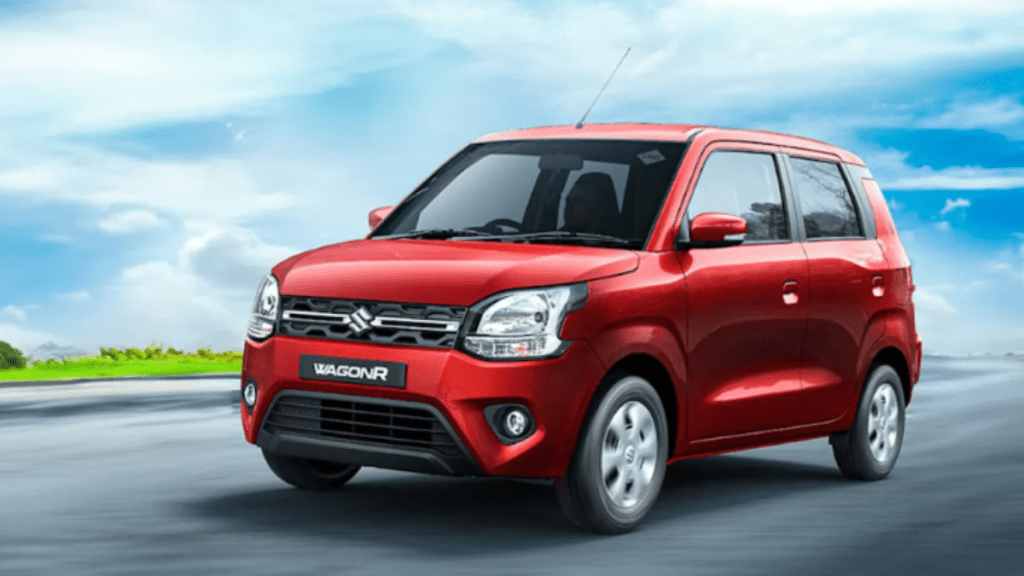
When it was launched in December 1999 — during the days of the sleek Esteem, Zen, and Cielo — the Wagon R, powered by a 1,061-cc petrol engine, defied aerodynamic convention. It was tall, boxier than a box, and looked like a van — even its name had the word ‘wagon’ in it.
The response was lukewarm.
After the first full year of sales (2000), the Wagon R was at the 11th position, far lower than India’s original tall boy car, the Hyundai Santro, which had become India’s second-largest selling car in 2000, after Maruti 800. The Santro had a year’s headstart, and was backed by an aggressive marketing campaign featuring Shah Rukh Khan. It took the Wagon R nine years to reach its first 500,000-unit sales, but it hit the next 500,000 units in just four years.
In 2004, the Wagon R got a minor facelift, and an LPG-plus-petrol engine, which changed its fortunes. It started to be accepted as India’s definitive ‘big small car’. “Indians began seeing it as a rare car in its segment with the unique ability to comfortably accommodate taller passengers despite its compact footprint, and started getting drawn to its exceptional interior packaging and sense of space,” says Harish Bijoor, brand strategy expert & founder, Harish Bijoor Consults. “Now, across its three generations, it has remained a perennial best-seller, proving that for the Indian buyer, practical utility and value for money are the ultimate drivers of longevity.”
The Wagon R, which is celebrating its silver jubilee, has crossed the 3.5-million-unit production milestone, joining the ranks of the Alto (5,224,000 units produced) and Swift (3,574,000 units). With 20.1% share, it is also the largest-selling hatchback in the $43-billion passenger car market (Source: SIAM data).
Along the way, Maruti Suzuki’s silver bullet has demonstrated tremendous adaptability. As marketing gurus keep reminding us, whether a brand has a local or global playbook, its long-term growth depends on its ability to adapt to change, take on challenges, and improve constantly.
Adapt & grow
In 2010, the second-generation Wagon R arrived, with a new K-Series engine — 998-cc, 3-cylinder, all-aluminium, fuel-efficient, and BS4-compliant — as well as an extensive design change, increasing its popularity with middle-class families and the taxi/fleet market, because it was the most spacious car you could run on a tiny budget.
Despite rising competition — compact sedans such as the Maruti Suzuki Dzire were eating into hatchback sales — the popularity of the Wagon R kept increasing.
In 2015, the Wagon R lost its only direct competitor when Hyundai decided to discontinue the Santro, despite good sales. The Korean carmaker wanted to focus more on the Grand i10 and Elite i20, as well as make production space for the Creta. Hyundai revived the Santro in 2018, but not as a tall-boy design, and that backfired — eventually, the Santro was discontinued in 2022.
The Wagon R, meanwhile, was at the cusp of greatness.
In 2019, the third-generation model was launched with a 1,197-cc, 4-cylinder engine (the 998-cc remained for lower variants). Sales further shot up, and finally in 2021, it became the country’s best-selling car — a position it maintained in 2022 and 2023, narrowly losing to the Tata Punch in 2024.
This year, till now, it’s at the third position, after the Dzire and Creta.
Despite its continued success, the Wagon R has had a big setback — it was supposed to be Maruti Suzuki’s first EV, but that EV never happened.
In 2018, Maruti Suzuki flagged-off 50 units of the Wagon R EV prototypes for nationwide field testing, but in a couple of years the project was shelved. A former Maruti Suzuki executive told FE that a high cost of production of turning an ICE car into EV would have meant a price of more than `10 lakh — not feasible for a budget EV. Eventually, the carmaker shifted to a ground-up EV platform, paving the way for the eVitara, which will be launched early next year.
The Wagon R, meanwhile, changed its fuel, and instead of EV, it is expected to be launched soon as a flex-fuel car (ethanol plus petrol).
Gaurav Vangaal, associate director, Light Vehicle Forecasting, S&P Global Mobility, says the design of the Wagon R, even though it’s not as sleek as other cars, has worked to its advantage. “In a country with tight parking, its high seating position allows for effortless ingress and egress. Inside, it offers roominess that matches that of compact SUVs,” he said. “Over three generations and many facelifts, the Wagon R has evolved from a basic car with a 1,061-cc engine to a feature-packed hatchback with 1.2-litre K-Series engines, AGS (Auto Gear Shift) technology, and a 7-inch touchscreen. It hasn’t aged because its core value proposition — maximum space per lakh rupees — remains timeless.”