



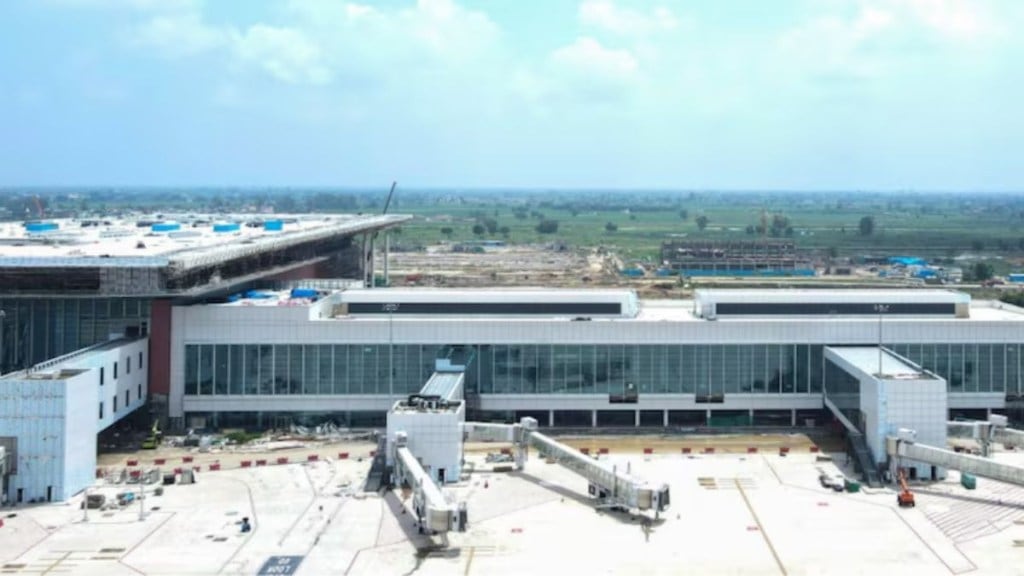
When Noida International Airport opens its doors, it plans to do so without the familiar bustle of manned counters, long queues for check-in, or staff directing passengers at every step. Instead, the airport is positioning itself as the country’s first fully digital, mid-sized airport, designed from day one to run largely on automated and self-service systems.
Unlike large hubs such as Delhi, Mumbai or Hyderabad, where automation has been layered gradually over older processes, Noida Airport is starting with a clean slate. “The Rs 10,000 crore airport has been built as the country’s first fully digital airport,” Christoph Schnellmann, chief executive officer of Noida International Airport, told FE in an interaction. He added that a single master systems integrator is tying together all information and communication technology, operational platforms and passenger-facing systems.
Technology to do heavy lifting
The idea is simple: technology, not manpower, will do most of the heavy lifting. From the moment passengers enter the terminal, they will encounter self-service at multiple touchpoints. Self-bag-drop counters and self-boarding gates will allow travellers to check in baggage and board flights without traditional counters. Human staff will be present largely for supervision, emergency response and regulatory functions rather than routine processing.
Security and baggage handling have also been designed around automation. In Phase I, the terminal will have 13 security lanes, with cabin baggage screened using an automated tray retrieval system. Checked-in bags will move through an in-line baggage handling and tracking system. The aim, Schnellmann said, is to reduce uncertainty and waiting times, making passenger flows more predictable for both airlines and travellers.
The terminal layout itself reflects this digital-first approach. Noida Airport will operate a mixed-rotation gate system, unusual for a mid-sized airport, where a gate used by a domestic arrival can also handle an international departure, and vice versa. This flexibility is expected to cut aircraft turnaround times and make better use of available stands. Domestic and international passenger streams will remain segregated through a multi-level terminal design to meet security and regulatory norms.
Accelerated automation using AI
What sets the airport apart, executives say, is not just individual automated features but the way systems talk to each other. Check-in, baggage, security, retail and ground transport platforms are being built to share data in real time. To manage this complexity, the airport has roped in Kyndryl to run its technology operations using Kyndryl Bridge, an AI-powered monitoring and integration platform.
By continuously tracking the health of IT and operational systems, the platform is designed to flag potential issues before they affect passengers. Cybersecurity is also embedded into daily operations, with automated threat detection and first-response mechanisms forming part of the core setup.
Connectivity beyond the terminal is another focus area. From the start of operations, passengers will have access to intercity and long-haul buses, airport taxis and a fleet of electric taxis operated by Mahindra Logistics Mobility. A memorandum of understanding with the Uttar Pradesh State Road Transport Corporation will enable direct bus services to Noida, Greater Noida, Ghaziabad, Agra, Aligarh, Mathura–Vrindavan and Meerut.
Looking ahead, the ground transportation complex is being planned to handle up to 50,000 vehicles by 2030, including buses, cars and two-wheelers. Space has also been earmarked for future metro and Namo Bharat train stations at underground levels, reflecting the airport’s long-term, multimodal vision.
On the airside, the airport will be equipped with CAT III navigation systems, allowing aircraft to operate in low-visibility conditions. Phase I has been designed for 12 million passengers annually, with expectations of handling 6–8 million passengers in the first full year. Expansion to the next phase will be triggered once traffic reaches 80 per cent of initial capacity.
Over time, capacity is planned to scale up to 30 million, then 50 million and eventually 70 million passengers a year by 2050. IndiGo is set to be the launch carrier, while Akasa Air plans domestic and international services, initially connecting Noida with cities such as Bengaluru, Hyderabad, Mumbai and Kolkata.
The terminal has also been future-proofed, with provisions for full-body scanners and next-generation CT scanners for hand baggage, which would allow passengers to keep electronics and liquids inside their bags.