



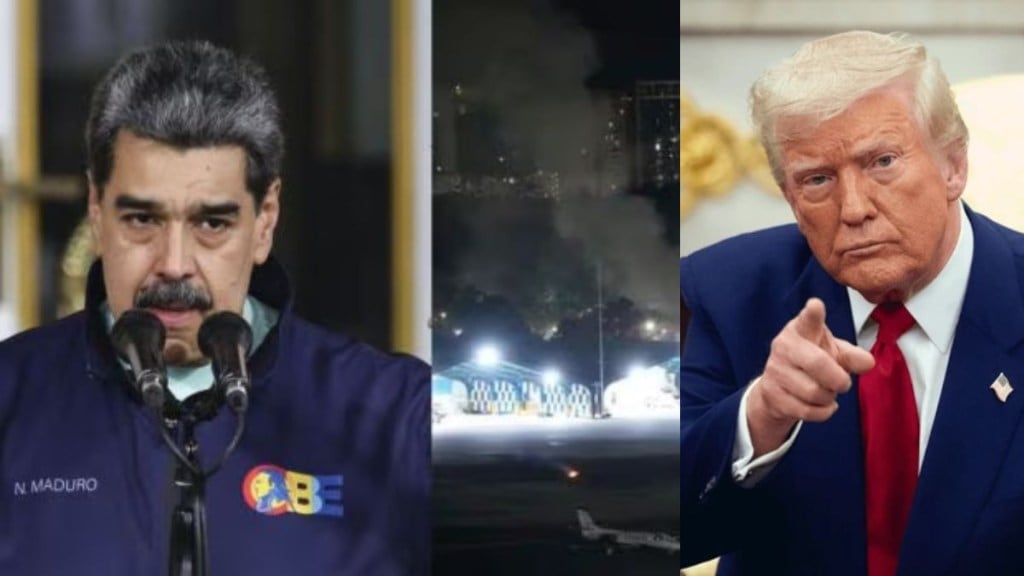
The United States launched a “large scale attack” on Venezuela early Saturday and “captured” its leader, President Nicolas Maduro, along with his wife and flew them out the country, a dramatic escalation in Washington’s months-long pressure campaign against the South American nation.
“The United States of America has successfully carried out a large-scale strike against Venezuela and its leader, President Nicolas Maduro, who has been, along with his wife, captured and flown out of the Country,” Donald J Trump posted on social media platform Truth Social.
“This operation was done in conjunction with the U.S. Law Enforcement. Details to follow. There will be a News Conference today at 11 A.M. (Washington time), at Mar-a-Lago where further detailed operations will be revealed,” Trump added.
Why is the US going after Venezuela?
The attack on Saturday comes after months of US military build-up in the region, with the deployment of troops, aircraft and warships. The US government has accused Venezuela’s Nicolás Maduro of running a “narco state”, and of working with gangs designated as terrorist organisations. Maduro has denied these allegations. Experts interviewed by The Indian Express believe Trump’s real motives are to force Maduro out of power, by hook or by crook.
Multiple geo-political analysts interviewed by NYT and The Indian Express also believe that one of the larger motives behind the attack is to allow US companies access to Venezuela oil reserves. Venezuela presently holds the largest oil reserves in the world.
The attack follows a larger narrative built by the United States of America where they have repeatedly accused Venezuelan president Nicolás Maduro of working with high end drug trafficking criminal networks that have been labelled as terrorist groups under the Trump administration.
“For Trump, it is a national security initiative meant to eliminate a source of tons of cocaine from entering the United States,” José Cárdenas, a former National Security Council and US State Department official who has dealt extensively with Latin America policy, told Newsweek.
United States’ long quest for Venezuelan oil
Ever since anti-Washington socialist Hugo Chávez was voted to power in Venezuela in 1999, the US has long struggled to exert greater control over the country’s oil reserves. As per the Indian Express, it is this oil interest only that prompted the US to back an eventually unsuccessful coup against Chávez in 2002. The oil reserves continue to be the bedrock of America in Venezuela today.
According to Tom Shannon, a career diplomat who served as undersecretary for political affairs during the first Trump administration, “Venezuela is sitting on the largest reserves of oil and gas in the world, and OFAC (Office of Foreign Assets Control), through its licensing process, gets to control who works in the oil and gas sector”.
As per Shannon, it is believed by the US establishment, if US companies were given licenses to operate in Venezuela, then it would gain immense strategic advantage over competitors from nations viewed as hostile to US interests such as China and Russia.
A chequered history
According to reports published by The Indian Express, the US has a long history of meddling in the affairs of Latin American countries (and elsewhere), one which has seen Washington rig elections, facilitate coups, and undermine democratic processes, all to install acquiescent regimes in strategically important countries.
Interestingly, during first term as president in January 2019, Donald Trump had officially declared pro-Washington opposition leader Juan Guaidó as Venezuela President, and handed over the control of Venezuela’s bank accounts and property in the US to him.
This came after Washington imposed sanctions on the sale of oil to the US, a major source of income for Venezuela. Maduro’s personal assets were also frozen, and he was effectively barred from leaving his country.
Furthermore, as per NYT reports, in 2017-18, ahead of the 2018 presidential polls in Venezuela, the Trump administration had held secret meetings with rebellious military officers from Venezuela to discuss plans for a coup to overthrow Maduro.
The NYT, in 2019, had described Trump’s actions as “one of Washington’s most overt attempts in decades to carry out regime change in Latin America”.
As per NYT reports, a draft legislation is presently being circulated at the White House and on Capitol Hill that would give Trump broad powers to wage war against drug cartels he deems to be “terrorists,” as well as against any country he says has harboured or helped them.