



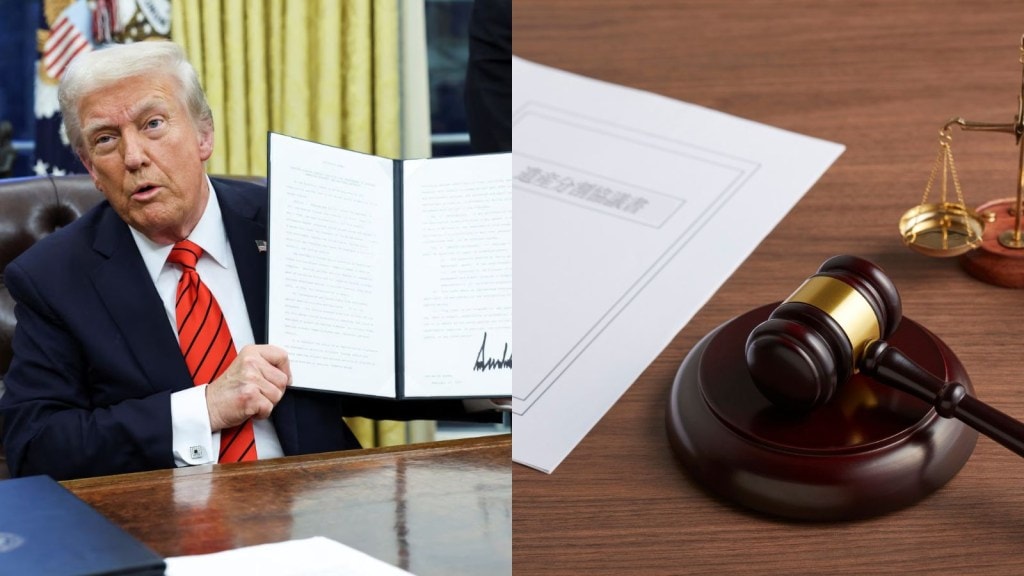
Since returning to the White House, Donald Trump has been locked in one legal fight after another. From freezing Harvard’s funding to reducing the Education Department by half, tightening immigration rules, cutting federal money, and firing top officials, his second term has triggered a wave of lawsuits across the US. Courts have stepped in again and again—sometimes blocking the administration, sometimes supporting it—leaving many of Trump’s biggest moves stuck in legal limbo. Here’s a look at the major battles and why they matter.
Donald Trump legal battle: The Harvard funding freeze
When Donald Trump began his second term as president, his administration decided to take a tough stand against top US universities. The White House said these schools were too political, too liberal, and had failed to properly deal with antisemitism on campus.
The government began launching aggressive investigations and also threatened to block billions of dollars in federal research money that Harvard depends on. For Harvard, this funding supports medical research, science labs, and long-term academic projects. Trump wants Harvard to pay $500 million. Harvard has said it is willing to spend that amount, but only on workforce training programs, not as a payment to the federal government. Recently, Trump officials changed their stance. They now want part of that money paid directly to the government, calling it a “fine.”
Harvard filed a lawsuit in federal court, saying the Trump administration was illegally punishing the university. Harvard said this was a threat to academic freedom and free speech. Instead of backing off, multiple federal agencies opened probes into Harvard. The government also proposed limiting international students, which would hit the university financially and academically.
Later, in September, a federal judge in Boston ruled in Harvard’s favour, calling the funding cuts illegal. Even though Harvard won in court, the problem did not fully go away. Federal research funding is approved in cycles, not permanently. The administration could still try to block Harvard from future grants or contracts. The White House controls many levers beyond just one court ruling.
For months now, President Donald Trump has been saying that his administration is close to striking a big deal with Harvard University. According to Trump, this deal would finally bring an end to the pressure campaign his government has been running against the Ivy League school.
Even inside Harvard, some people believed the agreement was almost done earlier this summer. But eight months after the fight between Harvard and the federal government exploded into public view, there is still no deal.
Donald Trump’s legal battle: Education Department mass firing
In March 2025, the US Education Department was shaken by one of the biggest job cuts in its history. More than 1,300 employees were fired in one go. The department’s workforce was reduced by half. By the end of it, the agency had gone from 4,133 employees at the time of Trump’s inauguration to about 2,000.
The Education Department oversees federal student loans, tracks how students perform across the country, and enforces civil rights laws in schools. The biggest concern was around the Office for Civil Rights (OCR), which investigates complaints of discrimination in schools. Several regional offices, including those in New York, San Francisco, and Boston, were either shut down or left with just a handful of staff.
Later, the courts intervened and temporarily blocked the Education Department from completing the layoffs of Office for Civil Rights staff. But, the Supreme Court later cleared the way for the administration to cut the department’s staff by nearly half. Instead of bringing those workers back, the department placed 299 OCR employees on paid administrative leave. Over time, 52 quit, leaving 247 stuck in limbo.
In November, teachers, school districts, unions, and disability-rights groups took the Trump administration to court, accusing it of illegally tearing apart the US Department of Education. According to The New York Times, the lawsuit accused the administration of shifting tens of billions of dollars meant for education programs to other federal agencies without legal authority. The case was filed in the US District Court for the District of Massachusetts. It challenged Education Secretary Linda McMahon’s plan to move major education programs and oversight responsibilities out of the department and spread them across several other agencies.
Then, in early December, many of those workers received an unexpected email telling them to return to work. They were asked to report to their regional offices on December 15. The department confirmed the decision was temporary and said it would continue appealing court rulings while using staff already being paid.
Donald Trump legal battle: Federal funding cuts under fire
Since returning to the office, President Donald Trump has moved to freeze, cut, or fully end billions of dollars in federal funding across the country. The money affected has impacted several programs, including scientific research, mental health services, arts and culture, education, public broadcasting, school meal programs, disaster preparedness, foreign aid, and major transportation projects.
These moves have triggered one of the largest waves of legal challenges in recent US history. States, cities, school districts, nonprofits, universities, unions, and advocacy groups have all appealed to courts.
One of the most closely watched cases involved disaster relief funding. The Department of Homeland Security issued rules saying that states and cities receiving disaster preparedness and recovery grants would have to follow the Trump administration’s immigration policies. Twenty state attorneys general sued DHS and the Federal Emergency Management Agency. In September, a federal judge sided with the states and ordered that disaster relief funds be released.
Another major case began after the administration attempted to freeze federal funding to states across the board. More than 20 states sued the Office of Management and Budget. A judge later ruled that the White House had failed to follow a court order that required the funds to be released.
Multiple lawsuits were filed against the administration’s decision, ranging from the education department to universities and research groups, Housing authorities, Public health groups, Public broadcasters, including PBS and NPR. Arts groups, domestic violence shelters, immigration legal services, climate organisations, and food security nonprofits also took legal action.
Courts have delivered mixed rulings so far. Some cases were dismissed, including challenges brought by arts groups, school districts, and local governments. Other cases ended in clear wins for the plaintiffs. Judges blocked funding cuts tied to immigration rules and ruled that several agencies acted unconstitutionally. A few rulings split the difference, allowing some changes to move forward while blocking others.
Donald Trump legal battle: Immigration wars
Immigration has become one of the biggest legal battlegrounds of the Trump administration. Several lawsuits are now challenging the government’s efforts to tighten immigration rules and mass deportations. These cases question several major policies, including allowing immigration agents to enter places of worship, deportations without full hearings, cutting federal funds to sanctuary cities, and making it harder for refugees to claim asylum in the United States.
In May, the Supreme Court allowed the Trump administration to cancel a humanitarian program that had offered temporary residency to more than 500,000 migrants from Cuba, Nicaragua, Venezuela, and Haiti. The ruling means many of those migrants could now face deportation. Earlier that same month, the court also allowed the administration to remove protections from nearly 350,000 Venezuelans. Appeals in related cases were later dismissed in November.
In May, the administration announced it would block Harvard University from enrolling international students. Harvard sued within a day. A federal judge in Boston sided with Harvard in June and stopped the administration from revoking the school’s right to host international students.
Church groups sued after policies allowed immigration agents to enter houses of worship. Cities like Chicago, New York, San Francisco, and Chelsea have challenged efforts to punish sanctuary cities by cutting federal funds. Farmworker unions, refugee aid groups, legal service providers, and civil rights organisations also went to court.
Some cases have been dismissed. Others have ended in wins for the plaintiffs, including rulings protecting Temporary Protected Status holders and blocking certain deportation actions. Several cases remain active, with hearings, appeals, and new filings still in the process.
Donald Trump legal battle: Birthright Citizenship battle
When Donald Trump returned to the White House, one of the very first things he did was sign an executive order that shook the country. On Day One, he moved to end birthright citizenship for certain children born in the United States. Under this order, children born in the US after a set date would no longer be treated as American citizens if their parents are undocumented immigrants or if they are in the country legally but only on a temporary basis, such as on visas.
The move triggered immediate outrage and a long list of lawsuits. So far, the Supreme Court has not directly ruled on whether Trump’s executive order is constitutional. That question is still open.
However, in June, the court ruled that several district court judges had gone too far by blocking the policy across the entire country. In simple terms, the justices said lower court judges do not have unlimited power to stop a president’s policy nationwide. Soon after, the American Civil Liberties Union (A.C.L.U.) filed a new lawsuit to challenge the policy head-on.
In the case known as CASA v. Trump, an immigrant rights group sued the administration. The case was appealed on October 7 and continues to be closely watched.
Just hours after the Supreme Court limited nationwide injunctions, the A.C.L.U. took another approach. In Barbara v. Trump, filed on September 10, lawyers asked the court to treat the case as a class action. This move allowed a federal judge, in July, to block the administration from enforcing the order, even after the Supreme Court’s ruling. Trump’s order has also been challenged by states, counties, and advocacy groups across the country. For now, the future of birthright citizenship remains uncertain. Courts are still debating not just whether Trump’s order is legal, but also who has the power to stop it.
Donald Trump legal battle: Executive firings
Since starting his second term, Donald Trump has removed several government officials from their jobs. These include agency watchdogs, regulators, and even a member of the Federal Reserve’s Board of Governors. The firings have sparked a long list of lawsuits, with judges across the country weighing in on whether the president actually has the power to do this.
Several lower courts have said Trump crossed a line. But for now, the Supreme Court has largely backed him, allowing many of these firings to move forward while the cases continue.
One of the biggest and most closely watched cases involves the Federal Trade Commission. In March, Trump fired Rebecca Kelly Slaughter, an FTC commissioner, along with her colleague. The FTC is meant to be independent, and for decades, the law has said commissioners can only be removed for very specific reasons. A federal court later ruled that Slaughter’s firing was illegal.
Then, in September, the Supreme Court stepped in. It paused the lower court’s ruling and removed Slaughter from her job for now. She will stay out of the office until the Supreme Court hears full arguments in the case, which is expected before the end of 2025. This case is known as Slaughter v. Trump.
Another major case involves the Consumer Product Safety Commission. In May, Trump fired three Democratic members of the five-person commission. The law says commissioners can only be fired for serious wrongdoing, such as neglect or misconduct. Trump did not give any reasons.
A federal judge first ordered that the officials be reinstated. But in July, the Supreme Court allowed Trump to enforce the firings. An appeals court later put the case on hold, waiting for the Supreme Court’s final word in the FTC case. This lawsuit is known as Boyle v. Trump. A third similar case filed is called, Cook v. Trump. Beyond these headline cases, dozens of other lawsuits have been filed by federal employees, unions, states, and watchdog groups.
These cases involve departments like Homeland Security, Education, Justice, and the Office of Personnel Management. Some lawsuits are still active. Some were dismissed. In a few, the plaintiffs won. In others, the Trump administration came out on top.