



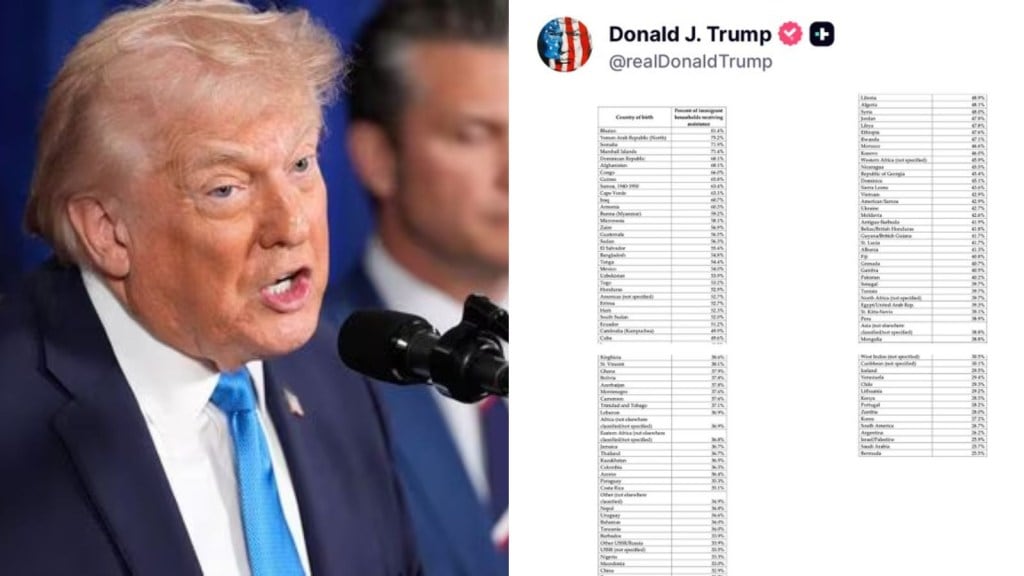
US President Donald Trump on Sunday shared a chart showing the percentage of immigrant households from different countries that receive welfare and public assistance in the United States. The data was posted on his social media platform, Truth Social. While the list named nearly 120 countries and territories, India did not appear anywhere on the chart. This stood out, especially because many of India’s neighbours, including Pakistan, Bangladesh, Bhutan, China and Nepal, were clearly listed.
The chart, titled Immigrant Welfare Recipient Rates by Country of Origin, came just hours after the US attacked Venezuela, arresting President Maduro and his wife. However, the post did not explain what type of welfare was counted or how long households received support.
Trump shares immigrant welfare data
According to the data shared by Trump, some countries showed very high levels of welfare use among immigrant households. Bhutan was at the top of the list, with 81.4 per cent of immigrant households receiving assistance. Yemen followed at 75.2 per cent, Somalia at 71.9 per cent, and the Marshall Islands at 71.4 per cent. The Dominican Republic and Afghanistan were both listed at 68.1 per cent, while Congo, Guinea, Samoa (1940–1950), and Cape Verde also appeared among the top ten.
President Trump posts data outlining Immigrant Welfare Recipient Rates by Country of Origin.
— America (@america) January 4, 2026
The Top Three:
-Bhutan: 81.4%
-Yemen Arab Republic (North): 75.2%
-Somalia: 71.9% pic.twitter.com/it9uBVnXFo
Countries with the lowest welfare use
At the other end of the chart were countries with much lower rates of welfare use. Bermuda ranked lowest at 25.5 per cent, followed closely by Saudi Arabia, Israel/Palestine, Argentina, and South America as an unspecified category. Korea, Zambia, Portugal, Kenya and Kuwait rounded out the bottom ten. The chart did not include any country below roughly the 25 per cent mark.
While India itself was missing, several neighbouring countries were listed. According to the chart, 54.8 per cent of immigrant households from Bangladesh receive assistance in the US. Pakistan stood at 40.2 per cent, Nepal at 34.8 per cent, and China at 32.9 per cent. Bhutan, as noted earlier, recorded the highest percentage overall.
Ukraine was also included, with 42.7 per cent, along with a broader category titled “Asia (not elsewhere classified)” at 38.8 per cent.
Why India may not be on the list
The chart does not directly explain why India was excluded. However, the most likely reason is that Indian immigrants have one of the lowest rates of welfare use among all immigrant groups in the United States, possibly well below the threshold reflected in the chart.
Indian-American households are among the highest earners in the country, according to a recent Pew Research Center analysis of US Census Bureau and American Community Survey (ACS) data from 2021 to 2023 In 2023. The median income of Indian-headed households was over $151,000 a year. For households led by Indian immigrants, the number was even higher, at around $156,000, far above that of many Americans.
Many Indians arrive through skilled visa programmes like the H-1B, and work in fields such as technology, medicine, engineering and finance. High levels of education and steady employment mean most Indian immigrants are financially stable and rarely depend on welfare programmes like Medicaid or food assistance.
Separate data from the Pew Research Centre has consistently shown that Indian Americans are one of the highest-earning ethnic groups in the United States. They make up about 21 per cent of the Asian-origin population in the country, making them the second-largest Asian group.
Pew’s 2023 figures show that Indian Americans aged 16 and above had median personal earnings of $85,300. This is far higher than the overall Asian median of $52,400.